Watch It First
Real valve tone at home volume has always been the tricky part. Crank a tube amp enough to get proper sag and breakup, and your neighbours start banging on the wall within minutes.
Marshall’s answer is the DSL5CR — a genuine all-valve combo that scales its output all the way down to half a watt without turning into a different amp when you do it.
It’s been out since 2018 and it’s still one of Marshall’s best-selling combos. Let’s get into why.
Tone and Channels
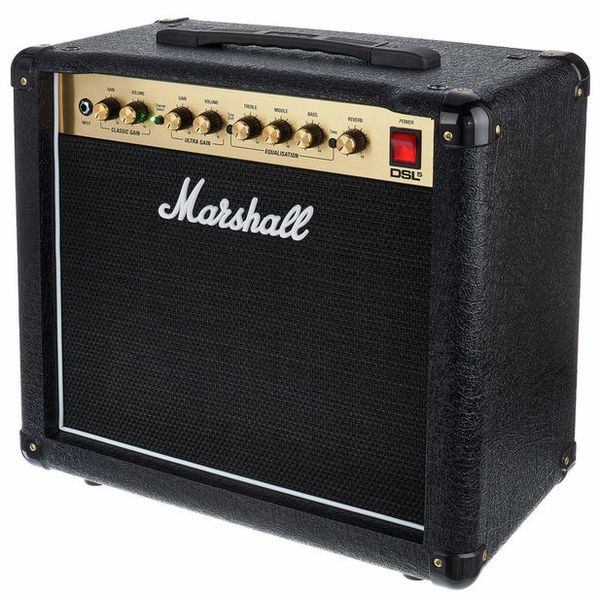
Two footswitchable channels — Classic Gain and Ultra Gain — cover a genuinely wide range. Classic goes from glassy clean into a light, chimey crunch. Ultra Gain is where the DSL name earns its keep: proper Marshall snarl, plenty of sustain, and enough gain on tap for most rock and metal rhythm work.
Shared Treble, Middle and Bass controls sit alongside a Tone Shift button that reshapes the midrange, plus a Bass switch that adds resonant low end. It’s more tone-shaping than you’d expect from a 10-inch combo this size.
If you’re specifically hunting for higher-gain territory, it’s worth cross-checking against our 5 Best Tube Amps For Metal roundup — the DSL5CR holds its own, but there are punchier options if metal is the main goal.
Power Scaling: The Real Party Trick
Here’s the feature that actually justifies the price. A rear-panel switch drops the output from 5 watts down to 0.5 watts, and critically, the tone character holds up at the lower setting.
That’s not always true of power-scaled amps — some get thin and lifeless once you pull the wattage down. This one stays gnarly enough to feel like a real Marshall even at half a watt, which is genuinely late-night-practice quiet.
Reverb and Effects Loop Included
Built-in reverb and a series effects loop both come standard — neither is a given at this price point. The loop means your time-based pedals sit after the preamp distortion rather than smearing everything in front of it.
Build Quality
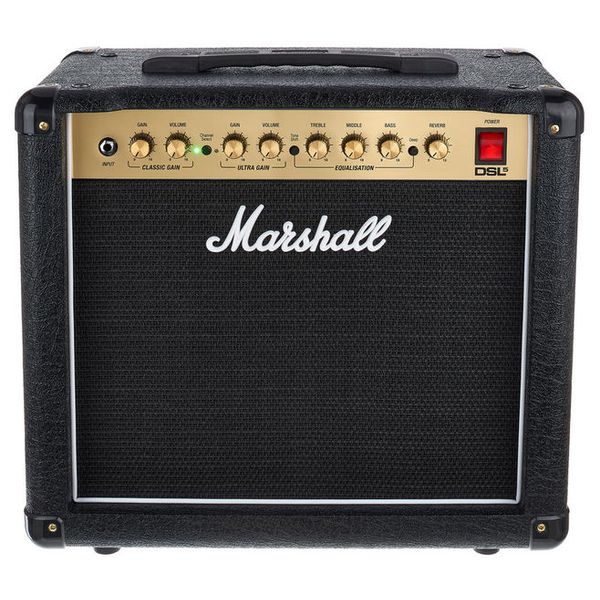
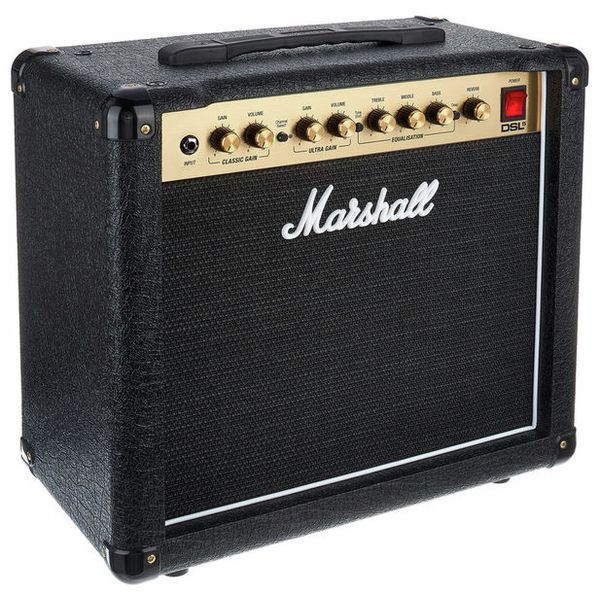
12.7kg, a single 10″ Celestion Ten-30 speaker, and Marshall’s classic black tolex-and-piping look. It’s a proper combo, not a toy — solid enough that you don’t think twice about gigging it at low volumes or hauling it to a rehearsal room.
A footswitch is included in the box for channel switching, which is a nice touch — plenty of amps in this range make you buy that separately.
Who’s This Actually For
Players who want a real valve amp but live somewhere they can’t crank a full-size stack. Apartment dwellers, home recordists, and anyone whose „practice space” doubles as a living room all fit the brief here.
It’s also a solid step-up amp. If you started on something budget-friendly and want your first genuine tube experience, pairing this with a guitar like the Squier Sonic Strat covers a lot of ground without breaking the bank on both ends.
It’s less ideal for players chasing a huge range of tones in one box. For that, a modeling amp is the better call — our Best Amps For Distortion & Overdrive roundup lists a few worth comparing against this one.
Playability and Everyday Use
Dynamically, it responds the way a real valve amp should — dig in and it pushes back, back off and it cleans up. That touch sensitivity is the whole reason to pick a tube combo over a modeler in the first place.
The Ultra Gain channel does have a lot of gain on tap, and a few owners note it can feel a touch loose or fizzy right at the top of the dial. Backing the gain off slightly and letting the power tube do more of the work usually tightens things up nicely.
Recording With It
The emulated line out is the feature that makes this genuinely useful past midnight. Plug straight into an interface and you get a usable, cab-simulated direct tone without mic’ing anything up.
Headphone output uses the same idea for silent practice — not studio-reference quality, but perfectly serviceable for working out parts without an amp in the room at all. Between that, the power scaling, and the effects loop, it’s a genuinely flexible home-recording amp for something this size.
The Honest Cons
- Ultra Gain channel can get a bit fizzy dimed all the way up — dial it back slightly
- No onboard digital effects — this is a straight valve amp, pedals do the rest
- Single 10″ speaker means less low-end punch than a 12″ combo
- Some owners report light effects loop noise — worth testing your own pedals in it
- 12.7kg isn’t heavy, but it’s not a grab-and-go travel amp either
None of these are dealbreakers for what this amp is trying to be. Just know what you’re signing up for.
How It Compares
Against its bigger siblings in the DSL Reissue range, you’re trading raw headroom for a genuinely usable low-power mode — most players gigging small rooms or practicing at home won’t miss the extra watts. Our 10 Best Marshall Amps For All Budgets guide covers the wider lineup if you want to compare against the 20W and 40W versions.
Against a budget alternative like the Harley Benton Tube 15 Celestion, the DSL5CR costs more but brings genuine Marshall voicing, a proper effects loop, and better build — worth the jump if the tone matters that much to you.
Against a compact tube head like the Orange Micro Terror we covered recently, this is the more complete package — reverb, effects loop, real power scaling — but it costs more and weighs more too. Different tools for slightly different jobs.
Full Specs
- Type: All-valve guitar combo
- Power: 5W, switchable down to 0.5W
- Channels: 2 (Classic Gain, Ultra Gain), footswitchable
- Speaker: 1x 10″ Celestion Ten-30
- Preamp tubes: 2x ECC83
- Power amp tube: 1x 12BH7/ECC99
- Reverb: Yes
- Effects loop: Series, external
- Recording output: Emulated line out
- Headphone output: Yes
- Footswitch: Included
- Dimensions: 450 x 240 x 420mm
- Weight: 12.7kg
Final Verdict
The DSL5CR solves a problem a lot of players actually have: wanting real tube dynamics without the volume that usually comes attached. The power scaling isn’t a gimmick here — it genuinely works, and the tone holds its character all the way down.
Add in built-in reverb, a proper effects loop and a usable direct recording output, and you’ve got a combo that covers home practice, small gigs and late-night recording sessions without asking you to compromise much on any of them.
If proper valve tone at sane volume is what you’re after, this is one of the smartest combos in Marshall’s current range — and honestly, in this whole price bracket.