Watch It First
Most three-quarter-size acoustics are toys with strings on. The Baby Taylor is the reason people stopped assuming that.
The BT2 is the mahogany-top version, and it has been in production so long that it has quietly become the default answer to “what small acoustic should I get?”
It is not cheap for a small guitar though, and that deserves scrutiny rather than a shrug.
Solid Top on a Guitar This Size
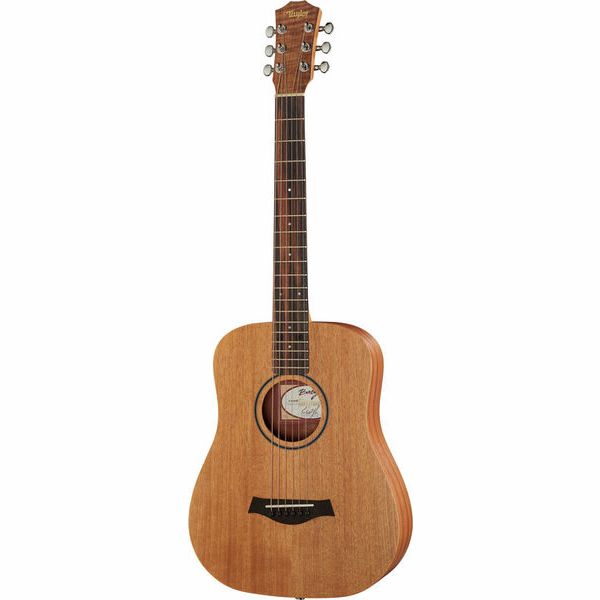
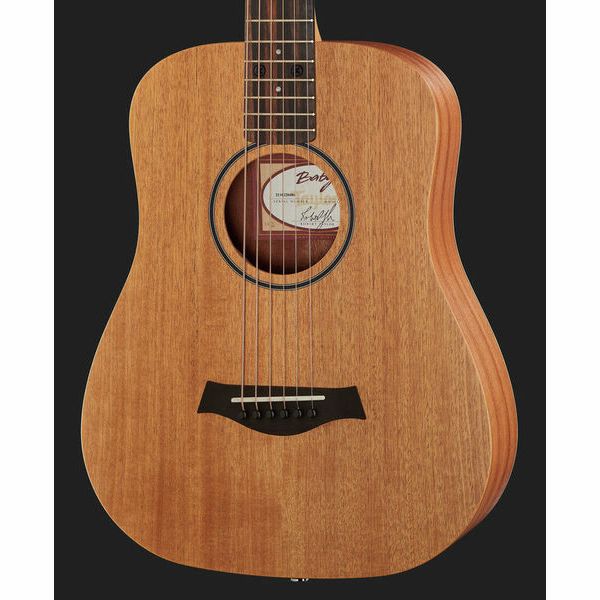
This is the bit that separates the BT2 from every budget mini-acoustic on the shelf. The top is solid mahogany, not laminate, with proper X bracing underneath.
A solid top on a small body is where you actually feel the benefit most. There is less air to move, so the responsiveness of the soundboard does a lot of the heavy lifting.
It also means the guitar will open up over the years. Give it two or three years of regular playing and it sounds noticeably warmer and fuller than it did new.
Mahogany versus the spruce BT1
The BT1 has a spruce top and is brighter, snappier and a bit more percussive. The BT2 is warmer, rounder and softer in the top end.
For strumming chords and singing over the top, the mahogany wins IMO. For fingerpicked lines where you want note separation, the spruce edges it.
Neither is wrong. Try both if you can, and if you cannot, the BT2 is the safer default.
It Is Louder Than It Has Any Right to Be
This surprises everyone. Owners consistently report that the BT2 holds its own in a room with full-size guitars, which is not what a 578 mm scale instrument is supposed to do.
It will not out-boom a dreadnought. Nothing this size will. But it is a real instrument at real volume rather than a quiet practice novelty.
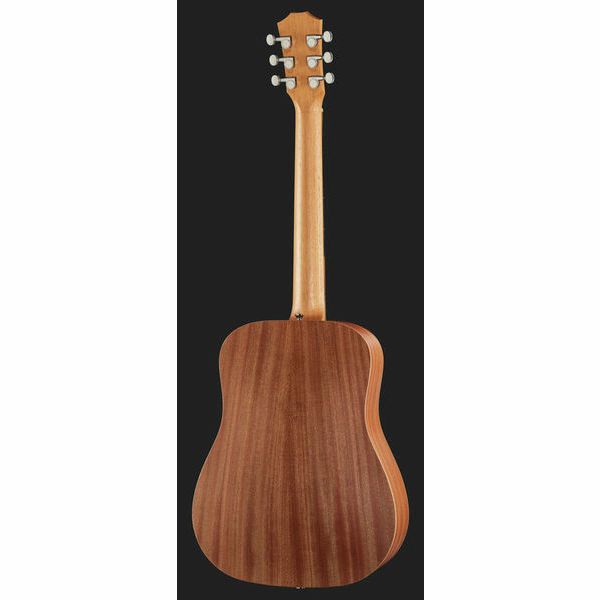
The sapele back and sides are layered rather than solid, which is the obvious cost saving and also makes the guitar far more robust in a car boot or overhead locker.
Why Kids and Teachers Love It
Short scale means less string tension, which means less finger pain. For a beginner in their first six weeks, that difference decides whether they keep going or quit.
The neck is sapele with a slim profile and a 42.8 mm nut. Small hands cope with it easily, and adult hands do not feel cramped either.
Action from the factory is usually good. Taylor’s consistency at this price point is genuinely better than most rivals, which matters when you are buying online for a birthday.
And why pros keep one too
Songwriting on the sofa. Hotel rooms. Backstage. Buses. Anywhere a full acoustic is a hassle and silence is worse.
It also records surprisingly well as a layering guitar. That slightly tighter, more focused voice sits nicely under a full-size acoustic track without fighting it.
If you want the small-body idea with a bigger voice and electronics, the Cort Core-OC SP is worth a look.
The Honest Cons
Tuning stability takes patience
Several owners flag that it drifts more than they expected in the early weeks. Part of that is a new solid top settling, part of it is the short scale amplifying small changes.
It does settle. But if you buy one, expect to reach for the tuner more often for the first month than you would with a full-size guitar.
No electronics
The BT2 is purely acoustic. If you need to plug in, you are looking at the BT2e or an aftermarket pickup, and neither is free.
For a travel and practice guitar that is fine. For gigging it is a limitation you need to price in.
It costs proper money
There is no getting around this. You can buy two or three perfectly serviceable full-size beginner acoustics for the price of one BT2, including things like the Harley Benton D-120NT.
What you are paying for is the solid top, the build consistency, the Taylor gig bag and a guitar that will still be worth something in ten years. Whether that is worth it depends entirely on how much you will actually play it.
What I Would Cross-Shop
The Yamaha F310 is the obvious value argument. Full size, laminate top, a fraction of the money, and it does the job.
The Harley Benton CLO-65M NT gets you all-mahogany looks and a smaller body for far less, though the build consistency is a lottery by comparison.
If your budget stretches and you want something you can gig, the Fender CC-60SCE or the step-up Taylor 110ce both make more sense than a Baby with a pickup bolted in.
Strings and Setup Make a Big Difference
Short-scale guitars are fussy about strings in a way full-size instruments are not. The lower tension means a heavy gauge can sound flabby and a light gauge can sound thin.
The BT2 ships with coated D’Addario XS phosphor bronze, which is a genuinely good choice and lasts a long time. If you swap them, staying with a 12-53 phosphor bronze set is the safe move.
A capo behaves oddly on this scale too. Because the frets are closer together, the same capo pressure pulls notes sharper than you are used to, so retune after clamping it on.
None of this is a fault. It is just the physics of a small guitar, and knowing it up front saves you blaming the instrument for something that is easily fixed.
Specs at a Glance
- Style: small body dreadnought, three-quarter scale
- Top: solid mahogany with X bracing
- Back and sides: layered sapele
- Neck: sapele
- Fingerboard: ebony with dot inlays
- Frets: 19
- Scale: 578 mm
- Nut width: 42.8 mm
- Nut and saddle: NuBone
- Factory strings: D’Addario XSAPB1253
- Finish: natural
- Includes: Taylor gig bag
- Made in Mexico, with an extended warranty available on registration
Final Verdict
The Baby Taylor BT2 has survived a decade of cheaper competition for a simple reason: it is a proper guitar that happens to be small, rather than a small thing that happens to have strings.
The solid mahogany top is the whole argument. It gives you warmth now and improvement later, and no laminate rival can match that at any size.
Buy it if you travel, if you have small hands, if you want a sofa guitar you will actually pick up, or if you are getting a kid something they will not outgrow in a year.
Skip it if you need volume, if you need to plug in, or if the money would be better spent on a full-size solid-top instead. Those are real reasons, and I would rather you knew them now than after the box arrives.