Watch It First
I went looking for a Les Paul Tribute to write about and discovered Gibson quietly buried it. So this is the next best answer to the same question: what is the cheapest way to get a real Gibson Les Paul on a strap?
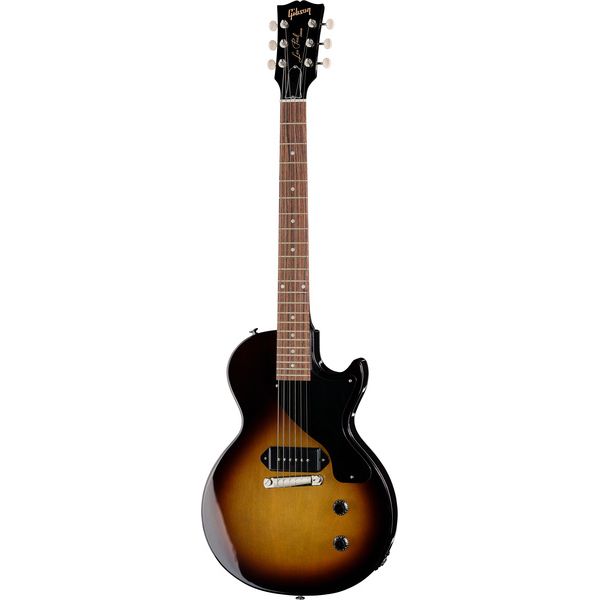
It is this. One pickup, no maple top, no binding, no fancy anything – the Les Paul Junior, still made in Nashville, still shipping in a hard case.
And here is the awkward truth I will get out of the way early: a lot of people who buy a Standard end up wishing they had bought one of these.
Stripped Back Is the Feature, Not the Compromise
The Junior started life in 1954 as a student guitar. Gibson took a Les Paul, removed the carved maple top, removed the binding, removed a pickup, removed most of the electronics, and sold it cheap.
What they accidentally created was a rock and roll machine. Slab mahogany body, one screaming P90, a bridge with almost nothing to go wrong, and a resonance you simply do not get through a glued-on maple cap.
Leslie West. Johnny Thunders. Billie Joe Armstrong. Mick Jones. That is not a list of people who could not afford a Standard.
The P90 Is the Whole Guitar
One dogear P90 single coil at the bridge, one volume, one tone. Hand-wired with an Orange Drop capacitor, which is a small detail that actually matters because that tone control is genuinely usable across its whole sweep.
A bridge P90 in a slab mahogany body is one of the great sounds in electric guitar. Fat like a humbucker in the low mids, but with the bite and detail of a single coil on top.
Clean it is chunky and slightly gnarly. Push a valve amp and it does that thing where the notes bloom rather than compress. Really push it and it howls in the best possible way.
The obvious downside: you have one sound. No neck pickup, no in-between position, no bailout. If you want variety you use your hands, your volume knob and your amp, which is either the point or the dealbreaker depending on who you are.
It also hums. It is a P90. If your rehearsal room has fluorescent lights you will know about it.
That Wraparound Bridge
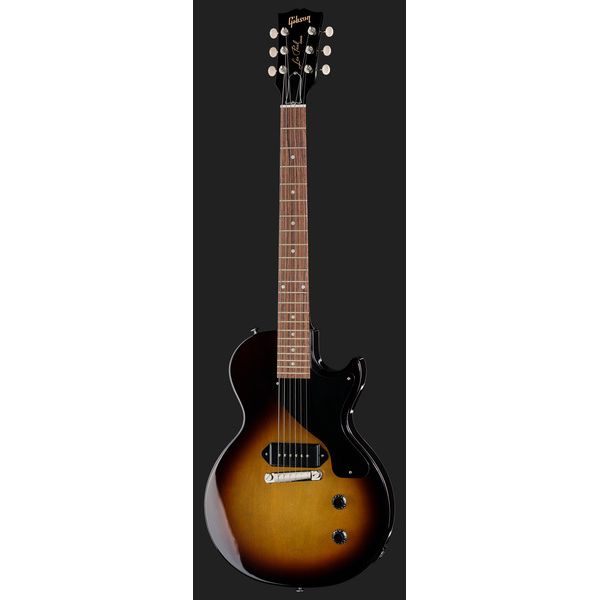
A compensated wraparound – one piece of metal that acts as bridge and tailpiece. Two studs, no saddles to rattle, minimal mass between string and wood.
It transfers energy into the body better than a tune-o-matic and stop bar, and it is a big part of why a Junior sounds so alive unplugged.
The catch is intonation. The compensation is cast in, so you get it roughly right and then live with it. On a well set-up example it is fine. On a badly set-up one you will notice the B string sulking. Worth checking before you commit.
The Neck Will Divide People
Mahogany, rosewood board, 22 frets, 628 mm scale, 43 mm nut, and a Vintage 50s profile. That last one is not marketing – it is a proper handful.
If you learned on a thin Ibanez neck this will feel like gripping a rolling pin for the first hour. Give it a day. Most people who complain about fat necks are actually complaining about unfamiliarity.
The payoff is that your hand relaxes over a long set instead of cramping, and there is more wood under the strings, which you hear. The Graph Tech nut is a nice touch too – no binding, no ping, no tuning drama.
The shorter Gibson scale also means slinkier strings at pitch. Bends are easy. Everything feels a little softer than a Fender-scale guitar.
The Honest Niggles
- One pickup means one sound. Obvious, but people still get caught out.
- P90 hum is real and there is no coil-split escape hatch.
- Intonation on the wraparound is a compromise by design.
- Quality control still varies. Gibson is much better than it was, but check the nut slots and fret ends before you accept it.
- Nitro finish marks easily. Belt buckles, stands, string swing – it all leaves a mark. Some people call that character. Some people cry.
- No neck pickup route, so adding one later means routing a real Gibson. Do not.
So Is This Really the Cheapest Real Gibson Les Paul?
More or less, yes, and it is certainly the most stripped-back one Gibson currently makes. A Studio sits in roughly the same territory and gives you two humbuckers, so if versatility is the priority that is your guitar.
But the Junior gives you something the Studio does not: a genuinely different instrument. It is not a discounted Standard, it is its own thing, and it has been its own thing for seventy years.
If you want the classic two-humbucker Les Paul experience for far less, the Epiphone Les Paul Standard 60s is superb value and the Epiphone Custom looks like a million quid.
If it is the one-P90 concept you want on a budget, the Epiphone Les Paul Junior does the same job for a fraction, and the Harley Benton SC-450 is the budget benchmark.
And if you want P90 grit with two pickups and a Gibson logo, the SG Special is the other end of the same conversation.
Specs at a Glance
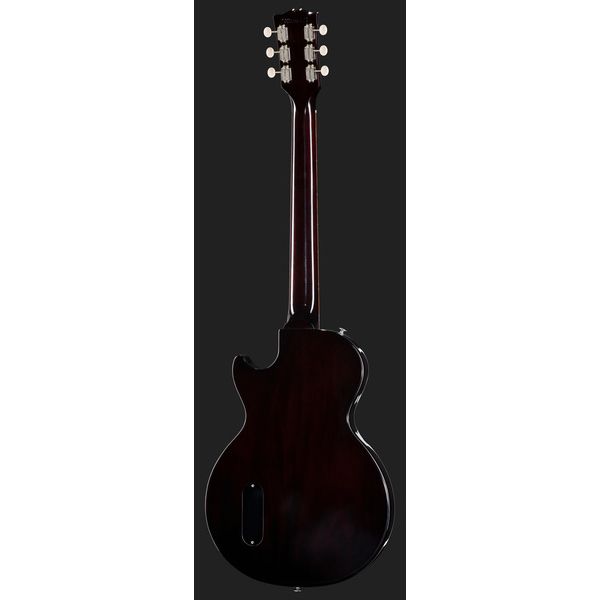
- Body: solid mahogany, no top, no binding
- Neck: mahogany, Vintage 50s profile, glued in
- Fingerboard: rosewood, 22 frets
- Scale: 628 mm, nut width 43 mm, Graph Tech nut
- Pickup: 1 x P90 dogear single coil (bridge)
- Controls: 1 volume, 1 tone, hand-wired with Orange Drop capacitor
- Bridge: compensated wraparound
- Finish: Vintage Tobacco Burst, nitrocellulose
- Includes hard case, made in the USA
- Thomann item number: 462521
Final Verdict
The Junior is the most honest guitar Gibson makes. There is nowhere to hide on it – no second pickup to switch to when things get boring, no coil taps, no clever wiring.
It is rated 4.7 out of 5 by Thomann buyers, which for a Gibson at this end of the range tells you people are getting what they hoped for.
It will not suit everyone. If you play covers across five genres a night, buy something with more switches. If you want a mahogany slab that sounds like the first three chords of every rock record you love, this is it.
With the Tribute gone, this is where I would put my own money for a real Gibson Les Paul. Comes with a case, made in Nashville, and it will still be worth something in ten years. Not a bad way to spend a guitar budget.