Watch It First
The JCM800 2203 is one of those amps that basically defined a decade of rock. If you know the sound of the 80s, you know this preamp, even if you’ve never touched the real thing.
Marshall’s Studio Classic SC20C shrinks that exact circuit into a 20-watt combo with a power reduction switch down to 5 watts, so you can actually use it somewhere other than a stadium.
I’ve had this amp in the room for a proper stretch now, cranked at both ends of the dial, and it’s one of those rare „studio” amps that doesn’t feel like a compromise.
Build and Design
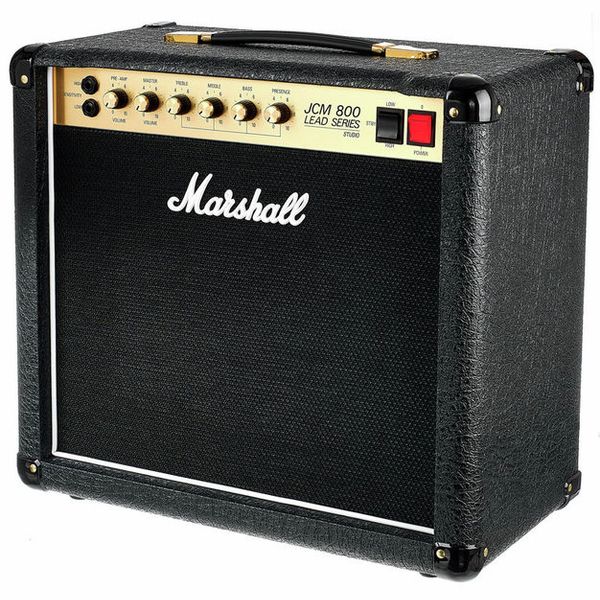
Classic black tolex, gold piping, the script Marshall logo – if you’ve ever seen a JCM800 head, this looks like someone put it through a shrink ray and welded a cab onto the front.
It’s not exactly light at 14.55kg, and the cabinet is noticeably bigger than you’d expect for what’s inside – there’s a real 10-inch Celestion V-Type in there, and reviewers keep pointing out how much bigger it sounds than its size suggests.
One Channel, Six Knobs, No Nonsense
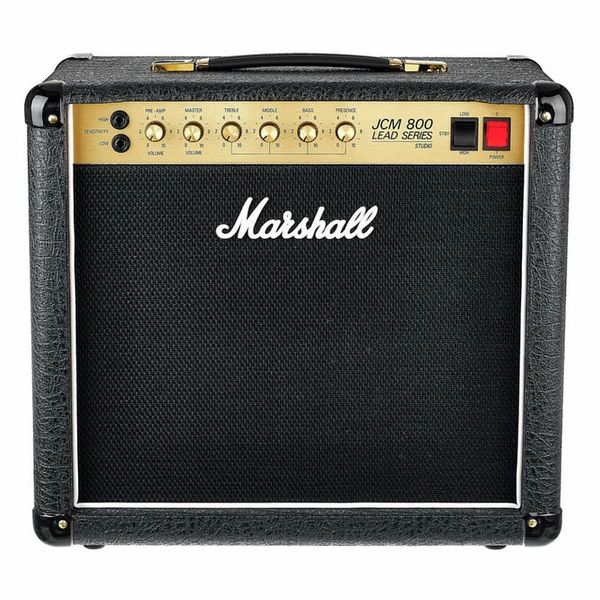
Preamp, Master Volume, Treble, Middle, Bass, Presence. That’s it. No built-in effects, no channel switching, nothing to overthink – just the JCM800 2203 preamp circuit doing what it does.
Two inputs on the front, high and low sensitivity, exactly like the original. Round the back you get a series effects loop and a DI out for recording or going straight to a mixing desk without miking the cab.
Tubes That Do the Actual Work
Two ECC83 preamp tubes, a third ECC83 acting as phase inverter, and two EL34 power tubes on the output. That’s the same recipe as the original JCM800 head, just at a fifth of the wattage.
The power reduction switch drops it from 20W down to 5W without a noticeable drop in tone or dynamics – several owners specifically call this out as the feature that makes the amp actually usable at home.
Playability and Sound
Clean tones exist but honestly aren’t really the point – push the preamp gain up and this thing wants to break up. Once it does, you get that sharp, biting JCM800 midrange snarl that’s all over classic rock and metal records from the 80s onward.
It’s genuinely responsive to pick dynamics too. Dig in and it barks, back off and it cleans up more than you’d expect from a one-channel amp. That touch sensitivity is the whole appeal of the original circuit and it survived the shrink.
Paired with something like a PRS SE Paul’s Guitar, the humbuckers push it into thick, saturated rock tones fast. An Epiphone Explorer leans it even further into that hard rock, almost metal territory.
If you want something a bit more modern and versatile for the same rig, a Cort G290 Modern is worth a look – the extra output on its bridge pickup suits this amp’s gain range nicely.
The one recurring complaint in reviews is the effects loop – some users report noticeable noise or signal loss when it’s engaged, even with quality pedals. Bypass it if you’re not using loop-dependent effects and the amp is dead quiet.
Who It’s For
Rock and metal players who want the real JCM800 circuit without a 100-watt head and matching cab. Home recordists who want authentic tube saturation through a DI without disturbing the household. Anyone who’s been chasing that specific 80s crunch and hasn’t found it in a modelling amp.
Honest Niggles
It’s a one-trick pony by design – single channel, no built-in effects, no reverb. If you want spring reverb or channel switching, look elsewhere.
The effects loop noise issue is real and shows up in multiple owner reviews, not just an isolated complaint.
At 14.55kg and a cabinet larger than the speaker inside really needs, it’s heavier and bulkier than some rivals in the same power class.
No headphone output and no footswitch included, which is a slightly odd omission on an amp otherwise built around low-volume home use.
A Note on the 10-Inch Speaker
A lot of people see „10 inch” on a Marshall combo spec sheet and assume it’s going to sound thin. It doesn’t. Multiple owners specifically mention being surprised at how full and low-end-heavy this thing is, and the Celestion V-Type is doing real work here rather than just being a budget filler driver.
It also means the amp is lighter and more forgiving to record than a typical 12-inch cab, since a smaller cone tends to be a bit more even and less boomy up close with a mic. If you’re planning to record direct through the DI anyway, this barely matters, but it’s a nice bonus if you do end up miking it.
SC20C vs the Alternatives
Marshall’s own DSL40CR is the practical rival – more headroom, footswitchable channels, built-in reverb and effects loop that doesn’t get complained about nearly as much. It costs less too, but you’re trading the exact JCM800 2203 voicing for a more modern, flexible DSL circuit.
If you’re shopping the whole Marshall range, our guide to the best Marshall amps for all budgets lays out where the SC20C sits against the rest of the lineup.
Metal players specifically should also check our best tube amps for metal roundup and the wider best amps for distortion and overdrive list – the SC20C’s gain range covers classic rock through to the edge of thrash, but it’s not purpose-built for modern high-gain metal the way some amps on those lists are.
Specs
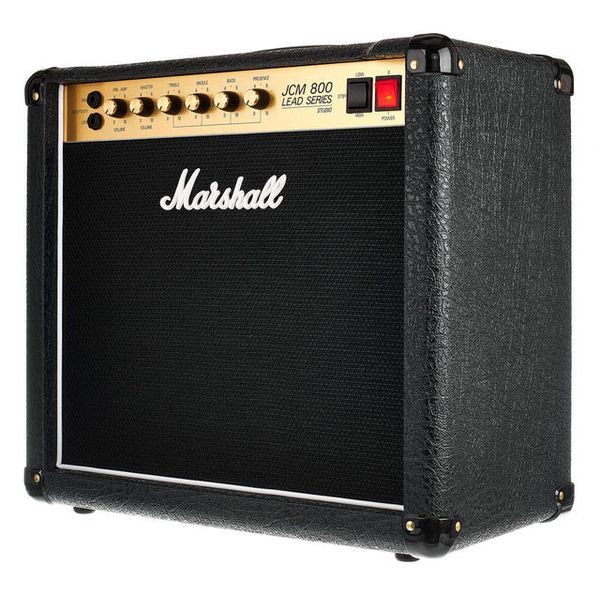
- Power: 20W, switchable down to 5W
- Speaker: 1x 10″ Celestion V-Type
- Tubes: 2x ECC83 preamp, 1x ECC83 phase inverter, 2x EL34 power
- Channels: 1 (High and Low sensitivity inputs)
- Controls: Preamp, Master Volume, Treble, Middle, Bass, Presence
- Outputs: DI out, series effects loop, external speaker connection
- Weight: 14.55kg
- Dimensions: 510 x 460 x 255mm
- Available since March 2019
Final Verdict
The SC20C isn’t trying to be everything to everyone, and that’s exactly why it works. It’s the JCM800 2203 sound in a package you can carry up a flight of stairs and actually play in a house with neighbours.
If you want channel switching, onboard reverb, or built-in effects, this isn’t your amp. But if what you actually want is that specific, snarling 80s Marshall crunch at a volume that won’t get the police called, nothing else at this size gets closer.
Just watch the effects loop if you’re planning to run pedals through it – front-of-amp is where this thing sounds its best anyway.