Watch It First
Every guitarist ends up owning a tiny second amp eventually. It’s basically a rite of passage.
The Marshall MS-2 has been sitting on Thomann’s shelves for what feels like forever, and it just won’t go away. Thomann alone has sold more than 50,000 of these little things.
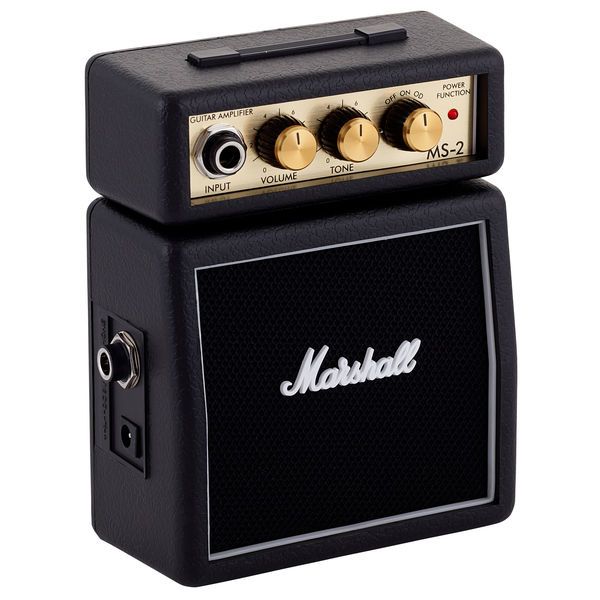
It’s a 1-watt, battery-powered mini stack shaped like a shrunken Marshall full stack, complete with a belt clip. Yes, a belt clip. We’ll get to whether that’s actually useful.
Build and Design
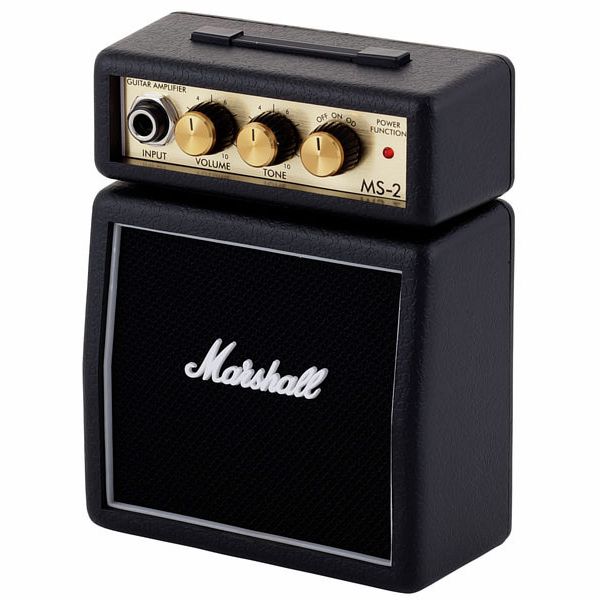
First thing you notice: it’s tiny. 110 x 60 x 140mm and about 340 grams – lighter than some pedals once you add a power supply.
Marshall’s been making micro amps in this shape since the 90s, and the MS-2 is basically the modern continuation of that idea – shrink the stack, keep the look, sell it for pocket money.
It runs off a single 9V battery, or a separate adapter (not included – classic Thomann move, but the adapter itself is cheap).
The cabinet is plastic, obviously. But it doesn’t feel flimsy. The grille cloth and the control knobs feel like a proper little Marshall stack, not a toy that fell out of a Christmas cracker.
The belt clip is genuinely part of the pitch
You can clip this to your belt and busk with a wireless setup, or just carry it room to room without a case. It’s a gimmick that actually, weirdly, works.
Tone and Sound
Let’s set expectations first. This is a 2-inch speaker being pushed by a single watt. It is never going to sound like a real Marshall stack, and anyone telling you otherwise is selling something.
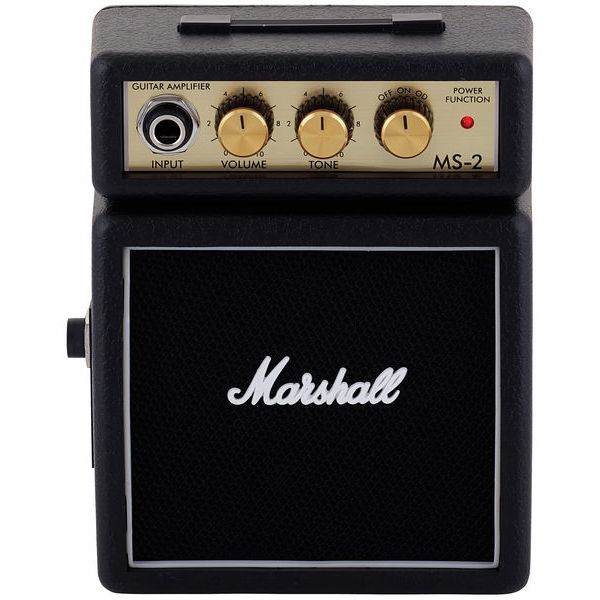
There’s a Clean channel and an Overdrive channel, plus a single Tone knob doing a surprising amount of work across a wide range.
Clean channel: honestly decent for what it is. Bright, a bit thin, but genuinely usable for chords and quiet practice.
Overdrive channel: this is where opinions split hard. Crank it and you get a fuzzy, slightly broken-up gain tone that some players love for its rawness, and others call the worst overdrive ever committed to plastic.
FYI – it’s not replacing your dirt pedal. But plugged into headphones at 2am, it’s a genuinely fun way to noodle without waking the house up.
Using It as a Practice Tool, Not a Tone Machine
Where the MS-2 actually earns points is muscle memory practice – scales, chord changes, picking exercises – the stuff you do quietly at a desk rather than the stuff you record.
Plug in headphones and you’ve got a silent-ish practice rig that costs less than a set of strings and a setup. That’s genuinely handy for late-night sessions or small apartments.
Features and Usability
Controls are dead simple: Volume, Tone, and an Off / On / Overdrive switch. That’s the whole panel.
The 6.3mm headphone output doubles as a line/preamp out, so you can run it into a bigger amp, an interface, or headphones for silent practice.
Compare that to something like the NUX Amp Academy, which crams amp modelling and Bluetooth into a similar footprint – the MS-2 feels almost defiantly analog by comparison. No app, no presets, no learning curve. You turn two knobs and you’re done.
Who’s This Actually For
- Beginners who want something between a toy and a real amp
- Anyone who travels a lot and can’t justify packing a full combo
- Parents buying a stocking-filler for a kid who just started guitar
- Guitarists who already own six amps and desperately need a seventh
That last one isn’t really a joke. Nobody needs a seventh amp. Everybody kind of wants one, though 😉
Honest Niggles
None of this is a surprise given the price, but worth saying out loud before you order one expecting a miracle.
- Overdrive channel gets fizzy and thin above half volume
- Only 1 watt of power – don’t expect it to fill a room
- No aux input for jamming along to backing tracks
- Knobs feel a bit loose after heavy use
- Battery drains faster than you’d hope if you forget to switch it off
How It Stacks Up Against the Alternatives
If you want a similarly tiny amp but with a proper vintage voicing, the Vox Mini Superbeetle is the poshier cousin – same shrunken-stack format, nicer clean tone, higher price tag to match.
Want actual gain and real amp behaviour in a small combo you could realistically use for a bedroom band practice? The Marshall MG10 wipes the floor with the MS-2’s overdrive channel. It’s a proper practice amp, not a novelty.
For busking specifically, skip the MS-2 entirely and look at the Roland Cube Street EX – also battery-powered, but actually loud enough to be heard on a street corner.
And if modelling and Bluetooth matter more to you than nostalgia, both the Boss Katana Head Gen 3 and the Positive Grid Spark Mini exist at very different price points and do vastly more – just not for pocket change like the MS-2.
Marshall MS-2 Specs
- Power: 1 Watt
- Speaker: 1x 2″
- Channels: 2 (Clean / Overdrive)
- Controls: Volume, Tone
- Power supply: 9V battery or 9V DC adapter (sold separately)
- Output: 6.3mm headphone / line output
- Dimensions: 110 x 60 x 140mm
- Weight: 0.34kg
Final Verdict
The Marshall MS-2 isn’t trying to be a serious amp, and once you accept that, it’s actually great fun.
It’s budget-friendly, portable, looks the part, and the clean channel is more usable than it has any right to be.
Just don’t go in expecting the overdrive channel to satisfy anyone who’s used a real amp – that was never really the point of this thing.
For bedroom noodling, gifting, or tossing in a backpack before a holiday, it earns its keep. For anything more serious, look further up this list.
Honestly, the fact we’re still talking about a 1-watt novelty amp this many years after launch says something. It’s not the best-sounding thing on this page, not by a long shot, but it might be the most charming.
If you go in with the right expectations – toy-adjacent, not a tone machine – you’ll get a lot of use out of it.