Watch It First
Pedalboard amps have been creeping up on traditional heads and combos for a while now, and the Blackstar Amped 1 is one of the ones people actually keep talking about years after launch.
It’s a 100-watt amp, reverb unit, cab simulator, and USB interface crammed into a box smaller than most wah pedals. No cab, no combo, nothing to lug around beyond your board.
I wanted to find out if it’s a genuine amp replacement or just a clever novelty, so I spent time running it both live into a cab and direct through headphones and a DAW.
Build and Design
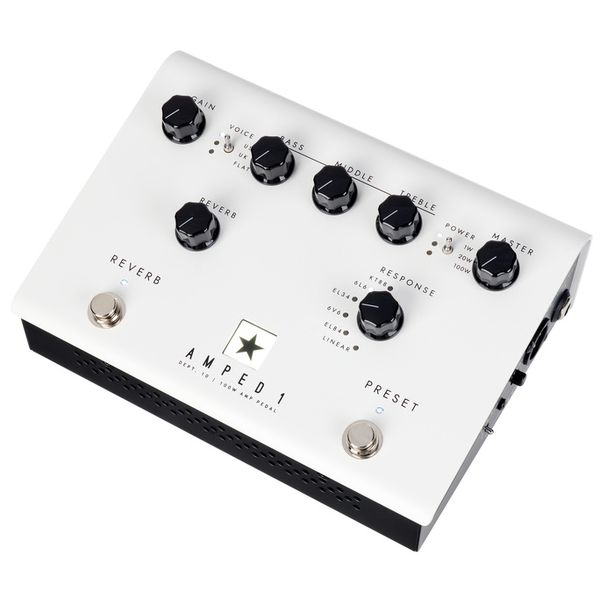
It’s a metal enclosure roughly the footprint of two stomp boxes side by side, at just 1.53kg. The illuminated Blackstar logo is a nice touch that also doubles as a rough power/status indicator on your board.
Everything you need lives on the top and side panels: gain, EQ (bass, middle, treble), preamp voice selector, power amp response, reverb level, and the power scaling switch. It’s dense but not fiddly once you know where things live.
Under the Hood: Three Amps, Six Power Sections
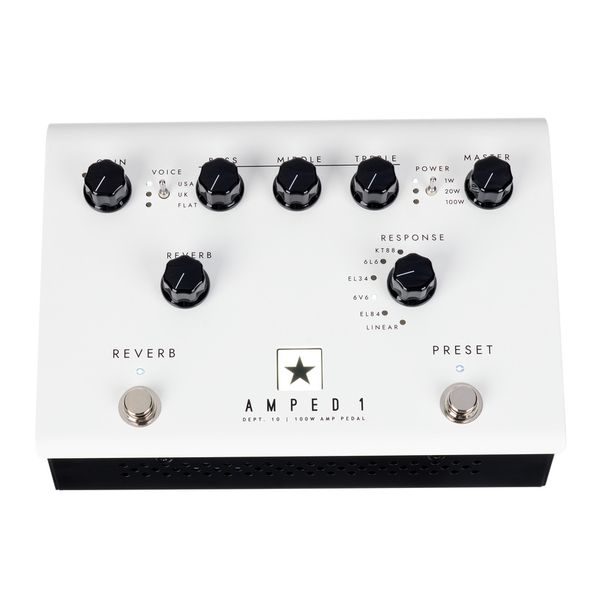
Three preamp voicings – USA, UK, and Flat – give you the broad tonal starting points. Then a Response knob lets you choose how the power section behaves, modelled after six classic power tube types: KT88, 6L6, EL34, 6V6, EL84, or a flat linear response for pedal-preamp users who don’t want any extra colouration.
Power itself scales from 100W down to 20W and all the way to 1W, so this genuinely covers everything from a loud stage to silent late-night practice through headphones.
Connectivity That Actually Matters
Built-in Cab Rig DSP with an XLR output means you can go straight to a mixing desk or interface without a physical cab at all. There’s also USB audio for recording straight into a DAW, a headphone out, a real effects loop, MIDI in for preset switching, and two 9V outputs to power a couple of pedals on your board.
Playability and Sound
USA mode is scooped and glassy on clean, pushing into a tight, articulate crunch as you add gain. UK mode is the Marshall-flavoured setting – more midrange push, more natural breakup, very responsive to pick dynamics. Flat mode is genuinely flat, which is exactly what you want if you’re running a dedicated preamp pedal in front and just need clean amplification.
The reverb is a genuine highlight – lush, controllable, and the Freeze function is a fun bonus for ambient textures, though it won’t replace a dedicated reverb pedal for players chasing something very specific. Fans of shimmer and wash tones will still want a proper pedal in the loop.
Running a distortion pedal like the one in our Fender Pugilist Distortion review into the Flat setting works really well – the Amped 1 just gets out of the way and amplifies what the pedal is doing, which is exactly the use case a lot of owners buy it for.
If you play jazz or want cleaner, more headroom-focused tones, check our best guitar pedals for jazz roundup – several of those pair beautifully with the USA voicing here.
Paired with a Yamaha Revstar Standard RSS20, the UK setting gave genuinely convincing British rock tones – enough that a bandmate assumed I’d brought an actual tube head to rehearsal.
Who It’s For
Gigging guitarists who are tired of carrying heads and cabs. Home recordists who want reliable, repeatable amp tones without mic placement variables. Anyone building a pedalboard-first rig who wants a single trustworthy amp brain at the end of the chain.
Honest Niggles
Connector placement is a real, frequently-mentioned issue – the outputs and IR switch sit on the right side, so if you’re placing this at the end of a left-to-right signal chain (the usual layout), those connections get blocked by neighbouring pedals. Plan your board layout before you buy.
You can’t load your own third-party IRs – you’re stuck with Blackstar’s onboard cab sims. They’re good, but pedal-steel-level tone obsessives with a favourite IR pack will be limited.
The included effects loop cable is a straight (not angled) Y-cable, which several owners found awkward on a tightly packed board – budget for a proper angled replacement.
It’s a genuinely deep piece of digital gear, and the Architect software adds another layer of complexity most players will need to sit down and actually learn rather than plug in and instantly get.
Amped 1 vs the Alternatives
The obvious step-up in the same line is the Amped 2, which swaps in a Classic preamp voicing and adjustable presence for a bit more tonal range, at a higher price. If three voicings genuinely covers what you play, the Amped 1 is the smarter buy.
If you’d rather have a traditional combo with a built-in speaker instead of a pedalboard brain, our best amps for distortion and overdrive roundup and best tube amps for metal guide cover more conventional options at similar price points.
Modelling combo fans should also look at the Fender Mustang LT25 – a completely different form factor, but the same basic pitch of „lots of amp tones, one small box,” just with a speaker built in rather than requiring a separate cab or PA.
Specs
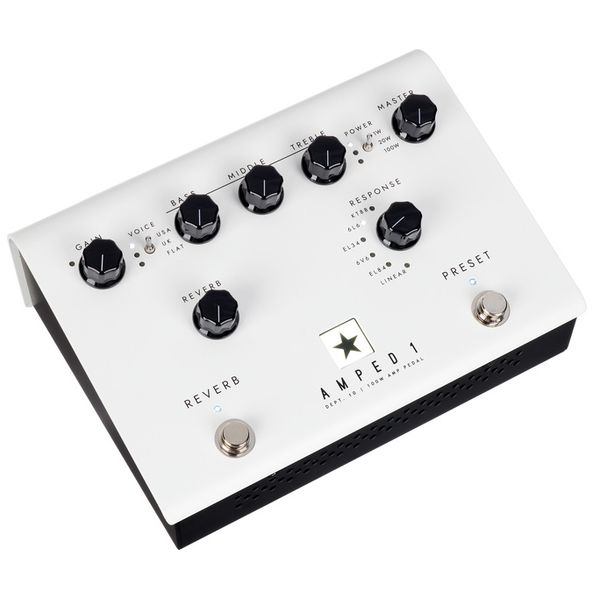
- Power: 100W, switchable to 20W or 1W
- Preamp voicings: USA, UK, Flat
- Power amp characteristics: KT88, 6L6, EL34, 6V6, EL84, Linear
- EQ: Bass, Middle, Treble
- Reverb with Freeze effect
- Built-in Cab Rig DSP with XLR output
- USB audio interface, headphone out
- Effects loop (series/parallel via Architect software)
- MIDI in, footswitchable presets
- 2x 9V pedal power outputs (500mA combined)
- Speaker outputs: 8 or 16 ohms
- Weight: 1.53kg, Dimensions: 200 x 81 x 149mm
- Available since October 2022
Final Verdict
The Blackstar Amped 1 delivers on its core promise: a genuinely gig-worthy amp that lives on your pedalboard instead of taking up floor space behind it. The tones are convincing, the flexibility is real, and the connectivity options cover recording, silent practice, and full-volume gigging in one box.
It’s not plug-and-forget gear – you’ll want to spend time in the Architect software and think carefully about board layout before you commit. But for guitarists tired of hauling amps to gigs, this is one of the more convincing cases for going all-in on a pedalboard-first rig.
If your playing spans clean to crunch and you value flexibility over having a single signature tone, it’s worth every bit of the board space.