Watch It First
Can something the size of a thick paperback actually sound like a real tube amp? That’s the exact question Hughes & Kettner is answering with the Spirit of Rock, part of their Spirit Nano series.
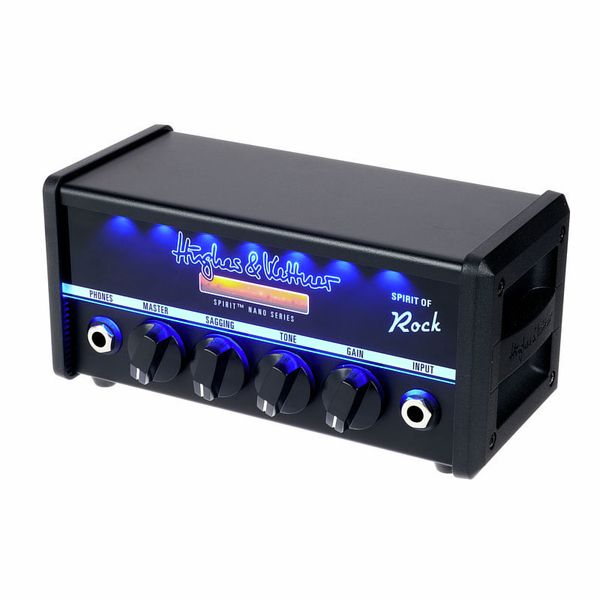
It’s not a pedal exactly, and it’s not a full amp head either. It’s somewhere in between: a genuine 50W guitar amp crammed into a box roughly the size of a large stompbox, weighing barely over a kilo.
I went in skeptical, because „sounds just like a tube amp” is a claim every modelling company makes. This one gets closer than most, and here’s why.
The Bionic Spirit Tone Generator
Instead of digital modelling, Hughes & Kettner built a fully analogue circuit that mimics the complicated, non-linear behaviour of a real tube stage. They call it the Spirit Tone Generator, and it’s the whole reason this thing doesn’t sound like a typical solid-state practice amp.
The difference shows up most in how it responds to your picking dynamics. Dig in and it compresses and saturates the way a real tube power stage does, rather than just getting louder and harsher the way cheap transistor circuits tend to.
The Spirit of Rock specifically is voiced for punchy American and British rock tones from the 80s and 90s, think bold, driving crunch rather than scooped high-gain metal. Its siblings, Spirit of Vintage and Spirit of Metal, cover the cleaner and higher-gain ends of the spectrum respectively.
What’s genuinely impressive is that Hughes & Kettner managed to fit this technology into a housing not much bigger than a pedal, when the same „authentic tube feel” claim usually requires a full-size chassis and a proper power section to back it up.
The Sagging Knob Is the Star
Alongside the usual Gain, Tone, and Master controls, there’s a knob labelled Sagging. It saturates the power amp stage independently of overall volume, which lets you dial in that spongy, dynamic tube feel even when you’re not cranked up loud.
That’s the detail that separates this from a generic modelling amp. Most of them fake gain with a distortion circuit; this one is actually simulating how a tube power section reacts to being pushed, which feels completely different under your fingers.
Roll the Sagging control up and chords start to bloom and compress in that classic „amp on the edge of breakup” way. It’s the single control that does the most to sell the illusion, and it genuinely works.
Genuinely Useful in Every Situation
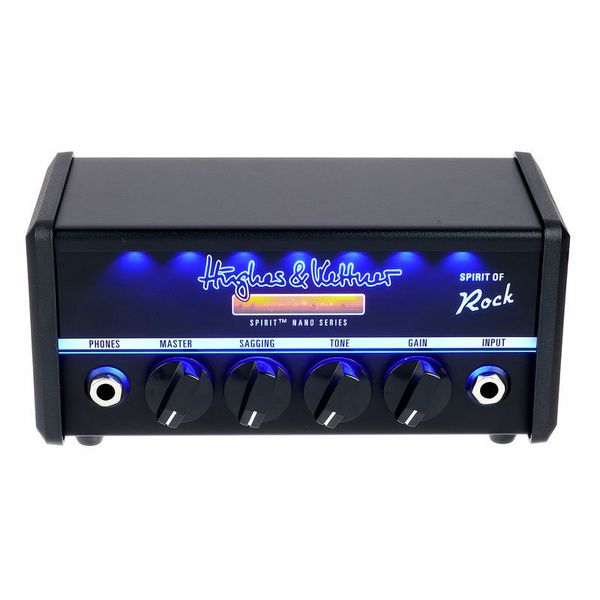
The built-in RedBox cab simulation (borrowed from the TubeMeister 18) means the headphone output and line-out both sound like a mic’d cabinet rather than a raw, farty direct signal. That’s huge for anyone recording at odd hours or silently practicing with headphones.
There’s also a 3.5mm aux input for jamming along to backing tracks through headphones, which is exactly the kind of feature that turns a „gigging amp” into something you’ll actually reach for during a quick 20-minute practice session too.
Plugged into a real 4×12 cab, the 50W output genuinely fills a room. This isn’t a desktop toy; it’s a legitimate rehearsal and small-gig amp that happens to also double as a bedroom practice tool.
I also appreciated how quickly it becomes part of the furniture, so to speak. It’s small enough to just leave clipped to a pedalboard or tucked in a gig bag pocket permanently, rather than being a separate thing you have to remember to pack.
Honest Cons
Some owners report a noticeably high noise floor, especially at higher gain settings, which means you’ll want your guitar’s volume pot cranked to avoid audible hiss. It’s more noticeable on headphones than through a loud cab.
It’s also a single-channel design with no built-in reverb or effects loop, so if you want onboard ambience or want to run time-based pedals in an effects loop rather than in front of the input, you’re out of luck here. Everything goes in the front, full stop.
And obviously, there’s no clean channel switch. If you need to jump between crunch and sparkling clean mid-song, you’ll be doing it with your guitar’s volume knob or a separate boost pedal, the old-school way.
Who Should Actually Buy This
This is ideal for guitarists who need a genuinely gig-capable rock tone that fits in a backpack pocket, or anyone tired of hauling a full head-and-cab rig to rehearsal every week. It’s equally great as a silent, headphone-friendly practice and writing tool thanks to the RedBox-loaded outputs.
It’s not the right pick if you need multiple channels, onboard effects, or a totally silent noise floor for quiet studio work. For that, you’re better off looking at a full-featured modelling combo instead, ideally one with an effects loop and proper channel switching built in.
- Power: 50W into 4 Ohm
- Channels: 1 (analogue Spirit Tone Generator circuit)
- Controls: Gain, Tone, Sagging, Master
- Headphone output with RedBox (TubeMeister 18) cab simulation
- Unfiltered line-out for use with software cab sims
- 2x 6.3mm speaker outputs (min. 4 Ohm), 3.5mm aux input
- Dimensions: 190 x 90 x 90mm
- Weight: 1.1kg
Final Verdict
The Spirit of Rock genuinely earns the „big tube-like tone, pocket sized” tagline. The Sagging control alone makes it feel more alive than most amps in this size and price bracket, and the RedBox-loaded outputs make it a legitimately useful silent practice and recording tool too.
The noise floor and single-channel simplicity are worth knowing about, but neither one undoes what this amp does well: real dynamic response in a box small enough to forget you’re even carrying it.
Want to compare it against other pocket-sized options? Our Orange Micro Terror review covers a similarly compact head. If you’re chasing that classic wah tone to pair with a rock rig like this, check our Dunlop Cry Baby review. For a full-size analogue alternative without any tube maintenance at all, see our Orange Super Crush 100 review, and for more bedroom-practice options, our Roland Cube-10GX review and Blackstar TV-10 A review are both worth a look. Chasing more gain? Our 8 best amps for distortion and overdrive roundup has more options.