Watch It First
I’ve owned three loopers in my life. Two of them are sitting in a drawer somewhere, unplugged and mostly forgotten.
The Boss RC-500 is the one still bolted to my board, and it isn’t even close.
Let’s get into why this is the looper I actually reach for, and where it still manages to annoy me.
Build Quality – Feels Like It’ll Outlive You
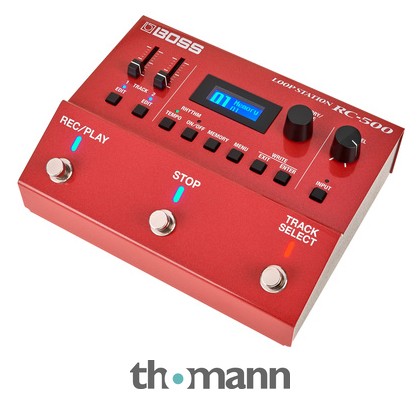
First thing you notice picking this up: it’s heavier than it looks. Metal chassis, solid footswitches, no creaky plastic anywhere.
Compare that to some of the budget loopers on the market and you’ll feel the difference in about five seconds. This thing is built to survive being stepped on by a drummer, repeatedly, for a decade.
The footprint is still small enough to fit on a normal pedalboard, which is impressive given how much is crammed inside. The colour LCD screen is genuinely useful too — you can actually see where you are in a loop instead of guessing, which matters more than you’d think mid-song.
Sound – Where Boss Actually Delivers
The RC-500 runs 32-bit AD/DA conversion with floating-point processing, and honestly, you can hear it. Loops don’t degrade the way they do on cheaper units.
Stack ten overdubs on a budget looper and it starts sounding like it’s being played back through a fax machine. Do the same here and it stays clean. That headroom is the whole reason to pay Boss prices instead of grabbing whatever’s cheapest.
There’s also an XLR mic input with phantom power built in, which is a genuinely nice touch. Want to loop an acoustic mic’d up, or layer in a vocal harmony? You don’t need a separate preamp for that anymore.
The onboard rhythms (16 drum kits, dozens of patterns with A/B variations) aren’t going to replace your drummer, but for practicing timing alone in a room, they’re more than good enough.
Playability and Everyday Use
Two independent tracks, and you can run them in series or in parallel, which opens up a lot more than a single-track looper like the RC-5 or RC-1.
The Loop FX are where it gets fun: Reverse, Repeat, Scatter, Shift, and Vinyl Flick all sit on tap. If you’ve ever wanted your loop to suddenly stutter or fold in on itself for a transition, this is how you do it without an outboard glitch pedal.
MIDI in and out is there for syncing to other gear, though I’ll flag now — a few users report it doesn’t always play perfectly as a MIDI slave. Worth testing with your specific rig before you build a whole set around it.
Memory-wise you get 99 phrase slots, which is more than enough to save a full setlist of loops for a gig and just scroll to the right one between songs.
The Menu Is a Bit of a Time Machine
Here’s my one real gripe with the interface: the screen is small and the menu goes deep. Setting up something more advanced means digging through a few layers, and it feels distinctly early-2010s in places.
Once you’ve set your go-to patches you barely touch the menu again, but that first week of setup takes patience.
Who Actually Needs This
If you’re a solo singer-songwriter building a full arrangement live, this is basically a one-person band in a box. Bass line on track one, rhythm guitar on track two, lead vocal live on top.
It’s also just a brilliant practice tool. If you want to actually internalise chord progressions instead of playing along to a backing track on YouTube for the hundredth time, looping your own changes and soloing over them teaches your ear way faster.
I’ve got a full looper buying guide if you want the wider picture on what’s out there before committing — but if you already know you want two tracks and proper build quality, you can stop reading that and just get this one.
Who Should Just Buy the RC-5 Instead
If you only ever need one track, don’t care about the mic input, and want to save some cash, Boss’s own RC-5 covers most of the same ground for less. The RC-500 earns its price with the second track, the mic in, and the deeper Loop FX — if you won’t use those, don’t pay for them.
The Honest Niggles
- Start/stop buttons are on the small side for how central they are to using the pedal
- Menu diving feels dated compared to touchscreen competitors
- MIDI sync as a slave device isn’t always rock solid
- No included power supply, so budget for one separately
None of these are dealbreakers IMO, but they’re worth knowing before you drop the cash.
RC-500 vs the Rest of the Loop Pedal World
Against Boss’s own RC-600, the RC-500 gives up a track and some routing flexibility but saves you real money and a chunk of pedalboard space — for most players that trade is worth it.
Against something like the TC Electronic Ditto X4 or an EHX looper, the RC-500 wins on build quality and the sheer depth of Loop FX, but loses a little on simplicity — those units are more grab-and-go.
Pairing it with something like the Boss DD-200 ahead of it opens up huge ambient layering possibilities, and if you want an infinite-sustain trick without eating up a whole track, the EHX Freeze is a fun companion pedal for that.
If you’re building a whole practice setup around this, a modelling amp like the Marshall Code 25 or something like the Positive Grid Spark 2 makes a great home base — both are built with bedroom-volume practice in mind. And if you’re running high-gain stuff into the looper, chuck a Boss NS-2 before it so your loops don’t pick up hiss on every layer.
Specs at a Glance
- 2-track looper with independent mixing
- Up to 13 hours of recording time
- 32-bit AD/DA, 32-bit floating point processing
- Colour backlit LCD display
- XLR mic input with phantom power
- Loop FX: Reverse, Repeat, Scatter, Shift, Vinyl Flick
- 16 drum kits, 57 built-in rhythms with A/B variations
- MIDI in/out, USB for backup and WAV import/export
- 99 memory slots for saved phrases
Final Verdict
The RC-500 isn’t the flashiest looper on the market and the menu could use a facelift, but it nails the fundamentals: it sounds great after ten overdubs, it’s built like a tank, and the two-track workflow covers 90% of what solo performers actually need.
If you’re serious about looping — not just messing around with a single riff, but actually building arrangements — this is the one to save up for. It punches well above its price bracket and I don’t see myself replacing mine anytime soon.