Watch It First
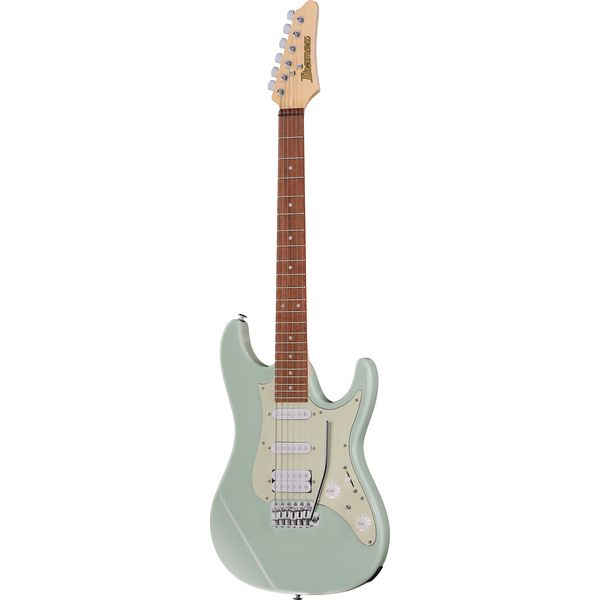
We have covered the AZ2204 and the AZ2402 on here already, so you know what the AZ platform is meant to be: Ibanez trying to build a Strat for people who actually shred.
The AZES40 is the version of that idea built to a price that would make a Prestige buyer choke on their coffee. Same silhouette, same basic layout, roughly a tenth of the money.
So the question is not „is it as good as a Prestige”. Obviously not. The question is whether Ibanez left the interesting bits in.
The Short Scale Is the Headline
This is the bit everybody skips and then complains about later. The AZES40 has a 635 mm (25 inch) scale, not the 648 mm you get on a Strat or on most of the RG line.
That extra centimetre missing makes the strings feel slacker at the same tuning. Bends are easier, big stretches are less of a reach, and drop tunings sit better without a string gauge rethink.
It is not a „beginner” thing, whatever the marketing implies. It is a genuine tonal and feel choice that sits between a Fender and a Gibson, and once you have played one for an hour going back to 25.5 feels weirdly stiff.
The Neck Is Better Than It Has Any Right To Be
Maple, bolt-on, with a jatoba fingerboard and a 250 mm (9.84 inch) radius. Twenty-two medium frets, 42 mm nut.
The profile is Ibanez own AZES shape – 21 mm at the first fret, 23 mm at the twelfth. That is thin, but not the razor-thin Wizard carve from the RG421. There is enough there to grip.
The satin finish on the back is the real win. No sticky gloss, no clammy thumb, and it stays fast when your hands get warm. Cheap guitars usually get this wrong.
Fret ends were smooth on both units I have had my hands on. That is not a given at this money and Ibanez deserve credit for it.
The Dyna-MIX9 Thing, Explained Properly
One Accord humbucker at the bridge, two Essentials single coils in the middle and neck, one volume, one tone, a five-way switch, and a small push-push switch labelled Alter.
Normally HSS gives you five sounds. Press the Alter switch and the five-way reconfigures to give you four more – series and parallel combinations that pull the humbucker apart and mix things you cannot normally get.
Nine sounds total. Is it a gimmick? Partly, yes. You will use three of them regularly and forget the rest exist.
But two of the alternate positions are genuinely useful: a bright bridge-and-neck combination that no standard Strat wiring gives you, and a fatter middle setting that fixes the usual thin-middle-pickup complaint.
How It Sounds
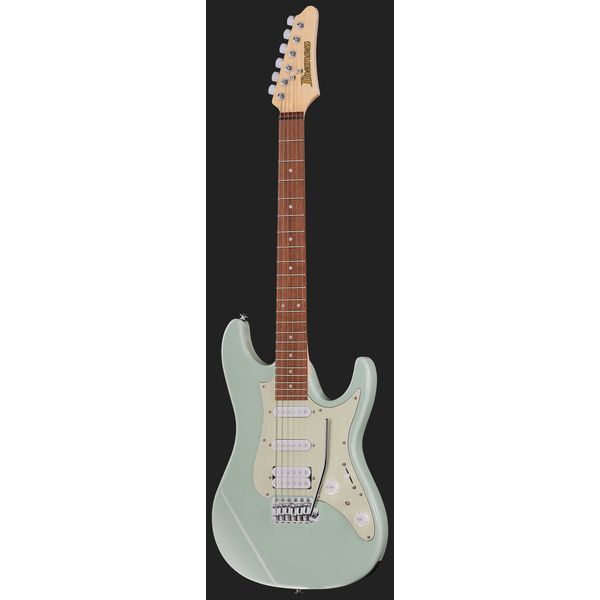
The single coils are the strong point. Clear, a bit polite, not especially vintage, but articulate and free of the woolly mush you normally get at this price.
The Accord humbucker is fine rather than exciting. It has plenty of output and it stays tight under gain, but it is a little flat in the upper mids compared to the pickups in the pricier AZ models. If you gig this seriously, that is your first upgrade.
Clean, it is lovely. Through a small valve amp with a bit of reverb this thing does funk, pop and indie all day.
High gain is where the compromise shows. It handles it, it does not fall apart, but it is not the guitar I would take to a death metal audition. Get a GRG170DX for that and spend the difference on a better amp.
The Bits I Do Not Love
- The T106 tremolo is basic. Two-point, works fine for wobble, will drift if you dive. No locking anything.
- Synthetic nut rather than bone or graphite. Binds a bit. Pencil lead in the slots is your friend.
- Poplar body is heavy for its size on some units. Weight varies noticeably.
- The Alter switch is fiddly mid-song. It is a push-push next to the tone control and you will hit it by accident.
- Stock strings are terrible. As usual.
Who Should Buy One
Anyone with smaller hands, anyone coming from acoustic, anyone who wants one guitar that will do clean, crunch and a bit of everything without needing three of them.
It is also a very good second guitar for a Strat player who wants something that behaves differently. It is not a Strat clone – the scale, the neck and the wiring all push it somewhere else.
If you specifically want a vintage Strat sound, do not buy this. Buy a Squier Classic Vibe instead, or the Affinity Strat if money is tight. The AZES40 is a modern guitar wearing a vintage outline.
Specs at a Glance
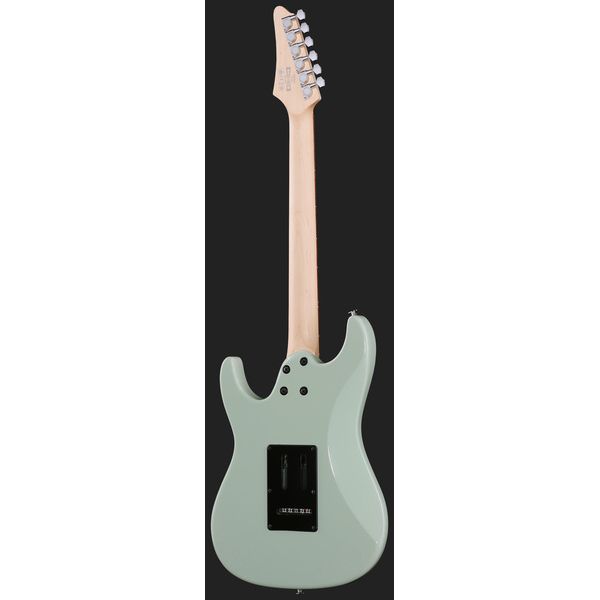
- Body: poplar, mint green with mint pickguard
- Neck: bolt-on maple, AZES profile (21 mm at 1st, 23 mm at 12th)
- Fingerboard: jatoba, 250 mm (9.84 in) radius, white dot inlays
- Frets: 22 medium
- Scale: 635 mm (25 in), nut width 42 mm
- Pickups: 1 x Accord humbucker (bridge), 2 x Essentials single coils
- Electronics: dyna-MIX9 with Alter Switch, 5-way, 1 volume, 1 tone
- Bridge: Ibanez T106 tremolo
- Hardware: chrome, Ibanez machine heads
- Thomann item number: 524946
Setup Notes Before You Plug In
Every AZES40 I have seen arrives with the tremolo floating at a slightly optimistic angle and the action set for shipping rather than playing. Ten minutes with a truss rod key and a small screwdriver transforms it, and the two-point trem is easy to deck against the body if you never intend to use it.
The other thing worth doing on day one is a proper string change. The short scale means a set of .010s feels closer to .0095s under the fingers, so a lot of players end up happier on .010-.046 or even .011s than they expect. Try a heavier set than you normally would before you decide the guitar feels floppy – nine times out of ten that is the scale length talking, not the instrument.
Final Verdict
The AZES40 is the rare budget guitar that is not simply a cheaper copy of something else. The short scale, the satin neck and the nine-sound switching are real design decisions, not cost-cutting dressed up as features.
It is rated 4.3 out of 5 by Thomann buyers and honestly that feels about right. Not a perfect guitar, a genuinely good one.
The trem is basic, the humbucker is average and the nut wants replacing eventually. None of that is unusual and all of it is cheap to fix.
If you want the AZ concept and the Prestige models are a fantasy, this is not a consolation prize. It is a proper instrument that happens to cost very little, and I would happily keep one on a stand.