Watch It First
Gretsch tone is one of those things that arguing about is pointless. Just listen.
Everybody wants a Gretsch until they look at what a proper one costs. Then they buy a Telecaster and tell themselves it is basically the same thing.
It is not the same thing. Gretsch guitars have a specific chime and clank that nothing else quite does.
The Electromatic Jet Club is the cheapest honest route to that sound, and honest is the word I want to defend here.
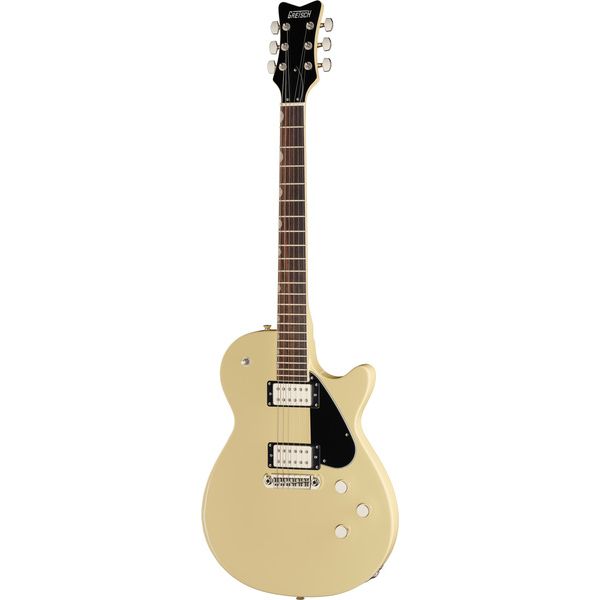
Chambered Mahogany Is the Secret
The body is chambered mahogany, not a solid slab. That is the single biggest reason this sounds like a Gretsch rather than a Les Paul in a Gretsch costume.
Chambering gives you a slightly airy, springy response. Notes bloom a bit rather than just landing.
It also keeps the weight down. A Jet is not a light guitar historically, and this one is far more shoulder-friendly than you would guess from the size.
The Single-Cut Shape
Visually it is Les Paul-adjacent, but the Jet is chunkier through the waist and the horn is squarer.
It looks like nothing else, especially in Buttercream. Gretsch have always been unafraid of colours other brands would call risky.
Sitting down it balances fine. Standing up there is a hint of neck weight but nothing that needs a fix.
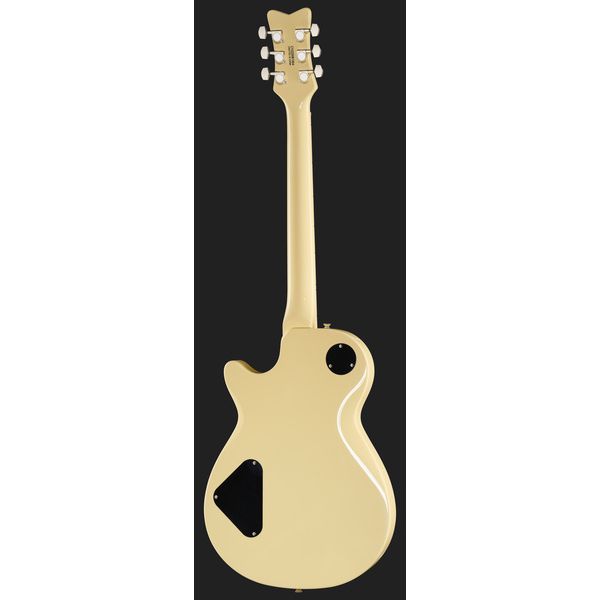
PureVolt Twin Six Humbuckers
Two PureVolt Twin Six humbuckers. Gretsch describe them as Filter Tron-inspired and for once the marketing is roughly accurate.
They are lower output than a standard humbucker and considerably clearer. You get chime and definition rather than thickness and compression.
Clean they sparkle. Slightly overdriven they get that spanky, wiry snarl that rockabilly and indie players chase.
The Push/Pull Tone Controls
Two tone controls, both push/pull. Pull them and you get a different voicing that thins things out usefully.
Combined with the single master volume and the Gretsch knurled Radio knob, the control layout is more flexible than it first appears.
It takes a session to learn where everything lives. Once you do, you stop reaching for a second guitar.
Where It Fits Musically
Rockabilly, obviously. Country, indie, garage, anything where you want the guitar to sound present rather than fat.
It also does surprisingly good clean funk. Those lower-output pickups have real attack.
High gain metal? No. Absolutely not. The chambering and the pickups will fight you. Get a Schecter C-1 Hellraiser for that.
Amps and Pedals That Suit It
Anything with a bit of spring reverb. A Fender Champion II 25 is a natural pairing for the money.
A light overdrive rather than a heavy distortion. The pickups want to be pushed, not buried.
A slapback delay finishes the picture. Not compulsory, but you will end up there anyway.
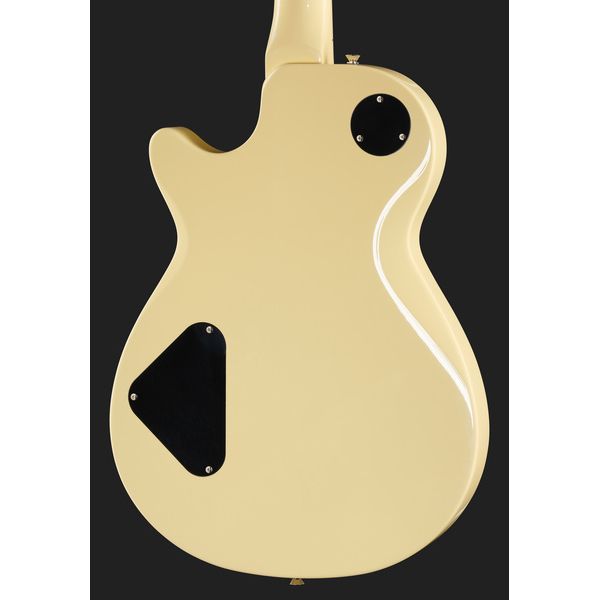
Playability and Hardware
Mahogany neck, rosewood board, 625 mm scale, 43 mm nut, 22 medium jumbo frets, pearloid block inlays.
The short scale means slinky string tension. Bends are easy, chords feel loose in a pleasant way.
The LockDown locking bridge is the smart bit. Traditional Gretsch bridges famously wander around on the top. This one does not, which removes the single most annoying thing about owning a vintage-style Gretsch.
Honest Niggles
- No Bigsby at this price – if the wobble is what you want, that is a different guitar
- Lower-output pickups mean it will not do heavy gain convincingly
- Die-cast tuners are fine but not locking
- The block inlays and gold-ish appointments are not to everyone taste
- Chambered body picks up more feedback at high volume than a solid body would
The bridge alone makes up for most of that, in my opinion. It is the fix Gretsch owners have wanted for decades.
Who Should Buy One?
Anyone who has been circling Gretsch for years and cannot justify the Professional Collection money. This is the genuine entry point.
Also anyone whose collection is all humbuckers and single coils and needs a third flavour. It genuinely sounds like neither.
If you want a bigger, hollower Gretsch voice, the G2420 Streamliner and the G2622 Streamliner are the hollow and semi-hollow routes. The G5210-P90 Electromatic Jet is the P90 variant of this same idea, and the Jet Club Bass exists if you want the matching low end.
Electromatic vs Streamliner vs Professional
Gretsch have three tiers and the naming does not make it obvious which is which, so quickly:
Streamliner is the entry line – broad tone humbuckers, Indonesian build, keenest prices. Electromatic is the middle – better hardware, pickups closer to the real Filter Tron voice, Korean build. Professional is the expensive Japanese and USA stuff.
The Electromatic tier is where the value sits, and this Jet Club is at the friendly end of it.
What the Extra Money Buys Over a Streamliner
Mostly the pickups and the bridge. The PureVolt units are noticeably clearer than Streamliner Broad Trons, and the LockDown bridge is a genuine improvement.
Fretwork is a step up too. Not dramatically, but consistently.
Recording With It
It sits in a mix beautifully because it does not occupy the low mids the way a normal humbucker does.
Layering two takes of this against a Strat gives you a very wide-sounding rhythm bed with almost no EQ work.
The attack is fast enough that it works well for anything percussive – muted eighths, chicken picking, staccato chord stabs.
Living With the Chambering
At bedroom and rehearsal volume you will never notice it. At loud stage volume in front of an amp it will start to feed back if you are careless with placement.
Standing side-on to the cab solves it. This is normal semi-hollow behaviour, not a fault.
The Spec Sheet
- Electromatic Series
- Body: Chambered mahogany
- Neck: Mahogany
- Fingerboard: Rosewood with pearloid block inlays
- Scale length: 625 mm
- Nut width: 43 mm
- 22 medium jumbo frets
- Pickups: 2 x PureVolt Twin Six humbuckers
- Controls: 1 volume, 2 tone controls with push/pull
- Gretsch knurled Radio knob
- Black plexi pickguard
- Bridge: LockDown locking bridge
- Die-cast machine heads
- Finish: Buttercream
Final Verdict
This is the cheapest way into that Gretsch vibe that does not feel like a compromise the moment you plug in.
The chambered body and the Filter Tron-flavoured pickups do the tonal work. The LockDown bridge fixes the historic annoyance. The short scale makes it fun to play.
It will not do metal and it does not come with a Bigsby. Fine. Neither of those is why anyone wants a Jet.
If you have wanted that chime for years and kept talking yourself out of it, this is the one that removes the excuse.