Watch It First
Every guitarist’s first „real” amp decision usually comes down to something small, cheap, and forgiving. Fender’s old Champion 20 used to be the default answer to that. It’s gone now, replaced by the Champion II 25, and honestly? The upgrade is bigger than the name change suggests.
Same idea — small 8″ combo, bedroom-friendly, dead simple to use — but Fender crammed in proper voicing options and effects that the old Champion never had. It’s still a beginner amp at heart. It just stopped feeling like one the second you plug in.
I plugged in expecting another disposable practice amp. Came away actually impressed, which doesn’t happen often with anything under this size and price bracket, lol.
Build and Design
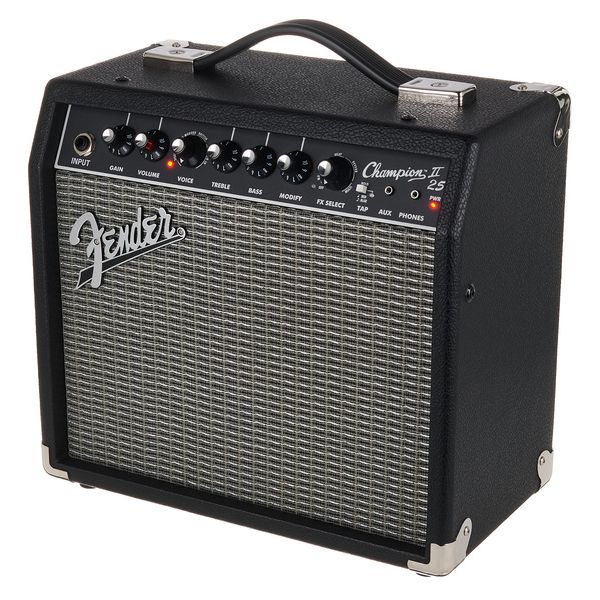
It’s a 25W combo running through a single 8″ Fender Special Design speaker, wrapped in the classic black textured vinyl cabinet Fender’s used forever. Nothing fancy about the cab construction — 19mm medium-density fibreboard, seven-ply — but it’s solid enough that it won’t rattle apart after a year of being dragged between a bedroom and a mate’s garage.
At around 5kg it’s genuinely portable. One hand, one strap over the shoulder, done. Compare that to lugging around something like a Blackstar HT-20R MKIII and you’ll appreciate how light this thing is when you just want to jam in a different room.
Control Layout — Actually Simple
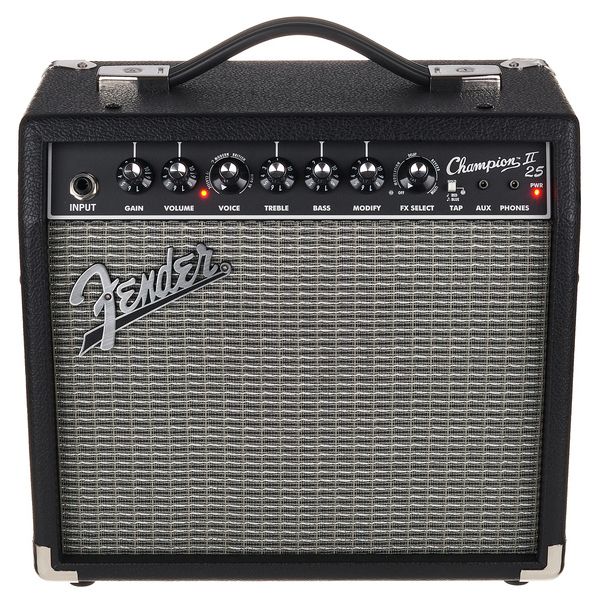
Gain, Volume, Voice, Treble, Bass, FX Level, FX Select. That’s it. The „Voice” knob is doing the heavy lifting — it scrolls through different amp voicings so you’re not stuck with one flavour of clean or one flavour of drive.
No menu diving, no app required, no fifteen-minute tutorial before you can play a chord. Twist two knobs and you’ve got a usable tone. That matters a lot more than spec sheets suggest when you’re actually the one standing there at 11pm trying to practice quietly.
Tone — Voicings and Onboard Effects
The clean voicing is where this amp earns its Fender badge — bright, a little chimey, believable even at low volume. That’s not a given on cheap combos; a lot of them go thin and harsh the second you back off the gain.
Switch through the other voicings and you get usable crunch and higher-gain tones too, plus onboard reverb and modulation-style effects via the FX Level/Select knobs. None of it is going to replace a proper Peavey Vypyr X2-style modeling rig for serious tone-chasing, but for the price bracket it’s shockingly competent.
There’s also an aux input for jamming along to backing tracks and a headphone output for silent practice — both things a beginner amp genuinely needs and plenty of competitors skip.
Getting the Best Tone Out of It
A trick worth knowing: this amp actually sounds better once you stop cranking the Gain knob and instead lean on the Voice selector to find the right base tone first. A lot of beginners do the opposite — max the gain hunting for „rock tone” — and end up with mush. Set Gain moderate, dial Voice to taste, then use Treble/Bass to shape from there.
It also responds well to pedals in front of it if you want to experiment down the line. A simple overdrive or a compressor into the clean voicing gets you a surprisingly flexible rig for the money — you’re not locked into just the built-in options forever.
One more practical note: the headphone output doubles as a line/recording-ish out in a pinch — it’s not studio quality, but for quick voice memos of riff ideas at 1am, it does the job without waking the house up.
Who’s This Amp For
Total beginners first and foremost — this is a „plug in and start learning” amp, not a project. Parents buying a first amp for a kid who just started lessons. Anyone who wants a grab-and-go practice amp for a second room or to throw in the car for a lesson.
It’s also a genuinely good option for someone who already owns a bigger rig — like a Marshall DSL1CR for tone-chasing at home — but wants something dumb-simple for quiet late-night noodling without waking anyone up.
The Honest Niggles
25 watts through an 8″ speaker is not a gigging amp, full stop. Don’t buy this expecting to play a rehearsal with a drummer — it’ll get buried instantly. The onboard effects, while a nice bonus, aren’t tweakable beyond a single level knob, so tone nerds will hit a ceiling fast.
No Bluetooth, no recording output either, which feels like a missed opportunity in 2026 when even budget amps increasingly offer USB connectivity for home recording. If that matters to you, look elsewhere.
How It Compares
Against something like a Boss Dual Cube LX, the Fender is cheaper and simpler but gives up some tonal sophistication and stereo width. Against Fender’s own step-down, the Frontman 20G, the Champion II 25 is a clear upgrade — more voicings, actual effects, better clean tone.
If you’re going to eventually add pedals to the chain, keep in mind an amp this size can’t really show off something like a Boss AC-3 Acoustic Simulator the way a bigger combo would — small speakers have limits, not just in volume but in how full the effect can sound.
Quick Specs
- Power: 25W
- Speaker: 1x 8″ Fender Special Design
- Channels: 1, with selectable Voice
- Controls: Gain, Volume, Voice, Treble, Bass, FX Level, FX Select
- Inputs: 6.3mm instrument jack, 3.5mm aux
- Output: 3.5mm headphone out
- Cabinet: 19mm MDF, black textured vinyl
- Weight: approx. 5kg
Worth noting too — the 8″ speaker in this cabinet is a Fender Special Design unit, not a generic off-the-shelf part, and it shows in how the clean voicing holds together at bedroom volumes instead of getting boxy. Cheaper amps in this bracket often cut corners exactly here.
Final Verdict
The Fender Champion II 25 does exactly what a first amp should — it gets out of the way and lets you actually learn to play, while still sounding like a real Fender when it counts. It’s not going to gig, and it’s not chasing tone-nerd features, but nobody buying this amp needs it to.
For the price bracket it sits in, this thing punches well above its weight. If you’re shopping for a beginner or just need a genuinely good bedroom amp, it’s an easy recommendation.