Watch It First
Small guitars are supposed to sound small. That is the trade you sign up for – you hand over some air and low end, and in return you get a box you can hold on the sofa without your right shoulder filing a complaint.
The Yamaha CSF3M apparently never got that memo. It is a parlour-sized instrument with a solid Sitka spruce top over solid mahogany back and sides, and the first full strum out of the gig bag is genuinely startling.
I have spent enough time with one to have proper opinions about it, including two or three grumpy ones. Here they all are.
So What Exactly Is This Thing?
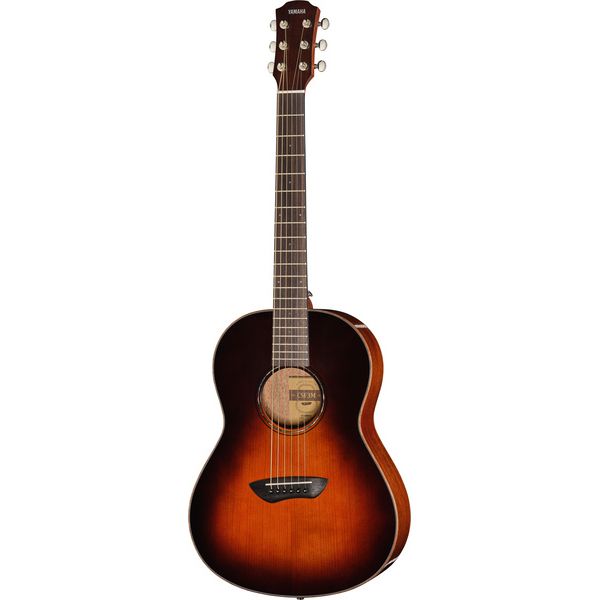
Yamaha files the CSF3M under „compact folk”, which is marketing-speak for something that sits between a parlour and a 0-size. The body is narrow, the waist is pronounced, and it looks a bit like a shrunken vintage flat-top rather than a novelty travel guitar.
The important number is the scale: 600 mm, roughly 23.6 inches. That is properly short. Twenty frets, a 43 mm nut, rosewood fretboard and bridge, nato neck, gig bag thrown in.
All-solid construction at this price bracket is still not the norm, and that is really the headline here. Plenty of small-bodies in this money are solid-top-with-laminate-everything-else, like the perfectly decent Harley Benton CLO-65M, but Yamaha went all-in on the timber.
Short Scale Has Consequences
A 600 mm scale makes strings feel slack. Bends happen almost by accident, barre chords stop being a workout, and if you have small hands or you are recovering from a wrist thing, this is a gift.
The flip side: tuning stability across the first few frets takes some getting used to, and you can absolutely choke a note by fretting too hard. Yamaha ships it with slightly beefier factory strings to compensate, and I would not go lighter than that.
Coming straight off a dreadnought, the first ten minutes feel faintly ridiculous. Then your hand recalibrates and you stop noticing. FYI, that adjustment goes both ways – going back to a 25.5 inch scale afterwards feels like arm wrestling.
The Sound Is the Whole Argument
Mahogany back and sides with a spruce top is a classic pairing for a reason. You get a woody, slightly compressed midrange that flatters both flatpicking and fingers, without the glassy scoop that some spruce-and-rosewood combinations give you.
What surprises people is the projection. It is not going to out-shout a jumbo across a pub, but it moves a genuinely respectable amount of air for something this size, and the low end has actual body rather than the papery thinness you get from cheap small guitars.
- Midrange forward, with a warm mahogany character that thickens up over time
- Trebles that are sweet rather than brittle – no ice-pick strumming
- Enough low end to hold down a song solo, though it will never be a bass cannon
- Fast note decay, which is a plus for busy fingerstyle and a minus for big ringing open chords
It also does that thing good all-solid guitars do where it audibly opens up after a few months of regular playing. Not a placebo – the difference between a new one in a shop and a well-played one is easy to hear.
Plugged In: The Passive SRT Piezo
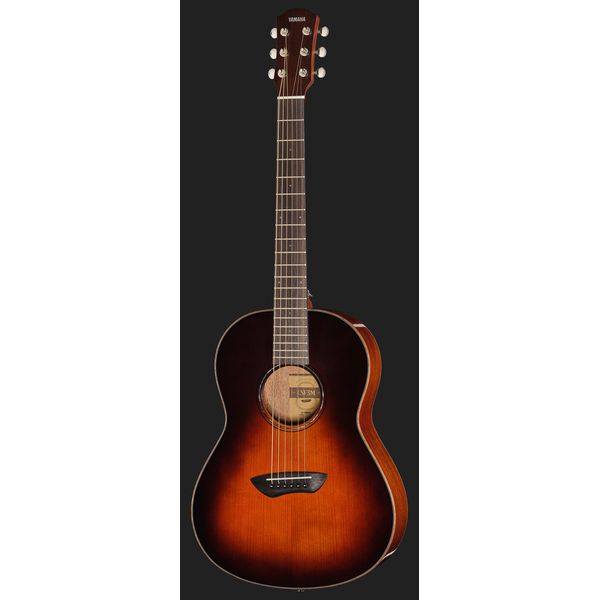
This is where I get slightly picky. The CSF3M uses a passive SRT piezo system – under-saddle pickup, no preamp, no onboard tuner, no controls at all.
On the plus side, that means no battery to die mid-gig, no ugly control pod cut into the side, and a signal that stays honest as long as you feed it something decent. Through a proper acoustic preamp or a DI with impedance matching, it sounds legitimately good.
Straight into a cheap PA channel, though, it is thin and quacky in the way passive piezos always are. If you plan to gig this, budget for a preamp pedal. Something like the Boss AC-3 family of acoustic-focused boxes, or any half-decent acoustic DI, will do the job.
Compared with the fully-loaded systems on guitars like the Fender CD-60SCE, the Yamaha is deliberately minimalist. Whether that reads as classy or as cost-cutting probably depends on your mood.
Build, Fit and the Honest Niggles
Yamaha factory QC is famously boring, and I mean that as a compliment. Fretwork on the ones I have handled has been clean, the finish is even, the tobacco sunburst is tasteful rather than gaudy, and nothing rattles.
Niggles, because there are always niggles:
- The included gig bag is thin. Fine for the boot of a car, not fine for a bus
- No cutaway, and with 20 frets the upper register is awkward to reach
- The passive electronics genuinely need external help to shine
- Short scale plus a 43 mm nut means it is a bit cramped for heavy-handed fingerstyle players
- Strap button placement means most people will end up drilling for a second one
None of these are dealbreakers. The gig bag one annoys me most, honestly, because a guitar this portable deserves a case you would actually trust.
Who Is This Actually For?
Songwriters, mostly. It is small enough to live on a stand next to the desk, loud enough to record without fuss, and comfortable enough that you pick it up more often than the big guitar in the corner.
It is also a brilliant second guitar. If your main is a dreadnought like the Yamaha F310 or something in Taylor territory, the CSF3M gives you a completely different voice rather than a slightly worse version of what you already own.
Travellers get a lot out of it too, though the flimsy bag means you will want a hard case for anything involving airports.
Who Should Probably Look Elsewhere
Bluegrass players. Anyone who needs volume for volume sake. Anyone who does most of their playing above the twelfth fret. And anyone who wants plug-and-play electronics with a tuner built in – you are being asked to bring your own preamp here.
How It Compares
Against the Cort Core-OC SP, the Yamaha is warmer and less hi-fi, and the Cort has more usable electronics. Against the Harley Benton CLP-15ME, the CSF3M costs meaningfully more but the build and the resale value justify it.
And against a full-size cutaway like the Taylor 110ce, this is simply a different job. One is a stage workhorse, the other is the guitar you write songs on at 1am.
If prettiness matters to you and you want something in the same small-body space, the Yamaha Storia III is worth a look, although it is a softer, less serious instrument than the CSF3M.
Specs at a Glance
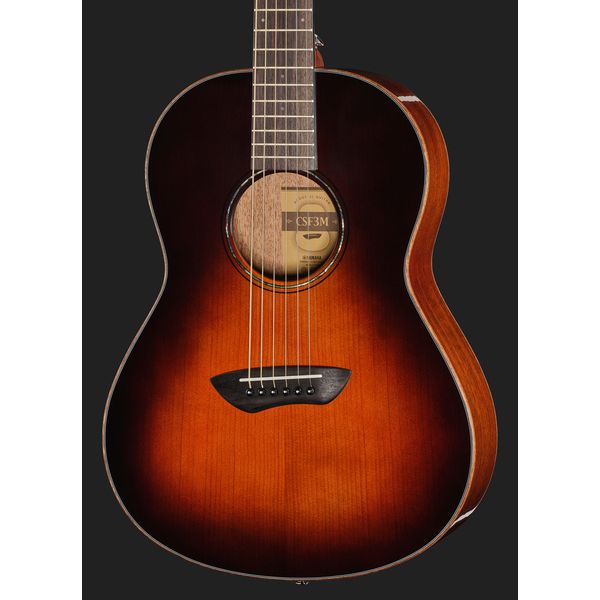
- Top: Solid Sitka spruce
- Back and sides: Solid mahogany
- Neck: Nato
- Fretboard and bridge: Rosewood
- Scale: 600 mm
- Nut width: 43 mm
- Frets: 20
- Electronics: Passive SRT piezo system
- Machine heads: RM-1242N-4 (SLG type)
- Finish: Tobacco Sunburst
- Extras: Gig bag included
- Thomann article number: 432568
Final Verdict
The CSF3M is one of those guitars that quietly earns its place. It does not have a gimmick, it does not shout, and the spec sheet reads like a sensible person wrote it.
What you actually get is an all-solid small-body that sounds bigger than it has any right to, plays beautifully, and holds up to years of casual abuse. The passive electronics and the sad gig bag are real compromises, but they are compromises you can fix with money you would have spent anyway.
If you want a compact acoustic you will genuinely reach for rather than admire from across the room, this is an easy recommendation. IMO it is the best-value all-solid parlour Yamaha has ever put out.