Watch It First
There is a version of the guitar-buying journey that basically everyone goes through. Strat or Les Paul, then something weird, then eventually a 335.
The Gibson one costs about as much as a used car. The Epiphone one costs about as much as a decent amp.
And since the Inspired by Gibson refresh, the gap between them is much smaller than Gibson would probably like.
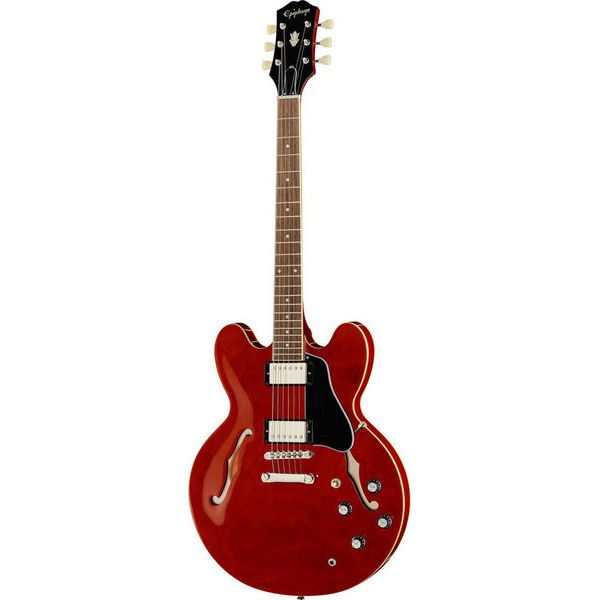
What Changed With The Inspired By Gibson Version
The old Epiphone 335s were fine. This one is properly good, and the differences are not cosmetic.
The headstock is now the correct Gibson-style shape rather than the old droopy one. Petty? Yes. Does it matter to how it sounds? No. Does everyone care anyway? Absolutely.
More importantly, the electronics got a serious upgrade. AlNiCo Classic PRO humbuckers, proper CTS-style pots, and the LockTone hardware that actually stays put.
The nut is GraphTech NuBone, which is a genuinely good nut, not a plastic placeholder.
The build
Laminated maple top, back and sides, mahogany neck, Indian laurel fingerboard with dot inlays and cream binding.
Laminated maple is not a cost-cut here – real 335s use laminated maple too. It is part of why the design works. Solid maple would be heavy and feedback-prone.
Scale is 628 mm with a 43 mm nut. Standard Gibson-ish measurements, so anything you know from a Les Paul transfers directly.
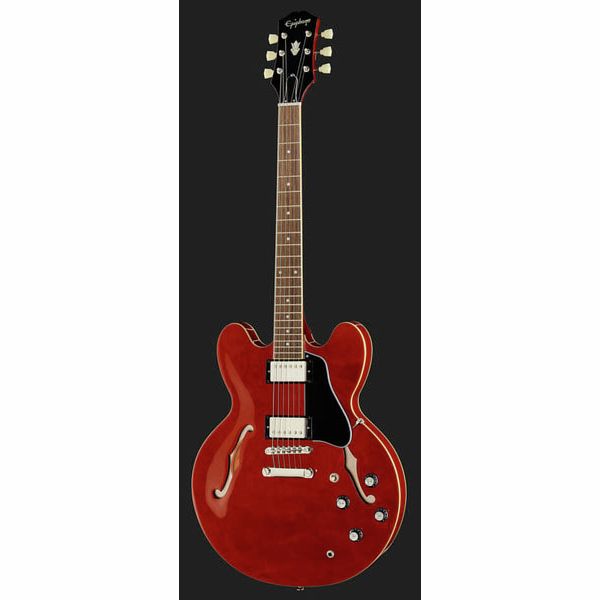
How It Plays
The Rounded C neck is the star. It is meatier than a modern slim taper without being a boat oar – somewhere in the region of a late 50s profile but sanded sensibly.
If you have small hands you might find it chunky. Everyone else will find it extremely comfortable after about ten minutes.
The 22 frets are well dressed on the ones I have handled. Not stainless, not perfectly polished, but no sprouting ends and no scratchy edges.
Upper fret access is the usual 335 compromise. The double cutaway gives you way more room than a Les Paul, but the neck joint is still there at the 19th.
The size thing
It is a big body. Not deep like a jazz archtop, but wide. Sitting down, it wants to slide off your leg unless you sit properly.
Standing up it is fine and surprisingly light. Lighter than most Les Pauls, which your back will notice by the third set.
How It Sounds
This is the bit people underestimate. A 335 does not sound like a Les Paul with holes in it – it sounds like its own thing.
The neck pickup is warm and vocal with a woody quality that solid bodies just cannot fake. Roll the tone back and it goes full jazz-box.
The bridge pickup has bite but it is never harsh. There is a natural top-end roll-off from the semi-hollow body that keeps things sweet.
Middle position is the money setting. Chords bloom in a way that makes rhythm playing genuinely fun instead of a chore.
Crank the gain and the center block does its job. You can get properly loud before it starts complaining, unlike a fully hollow guitar like the Guild Starfire I DC.
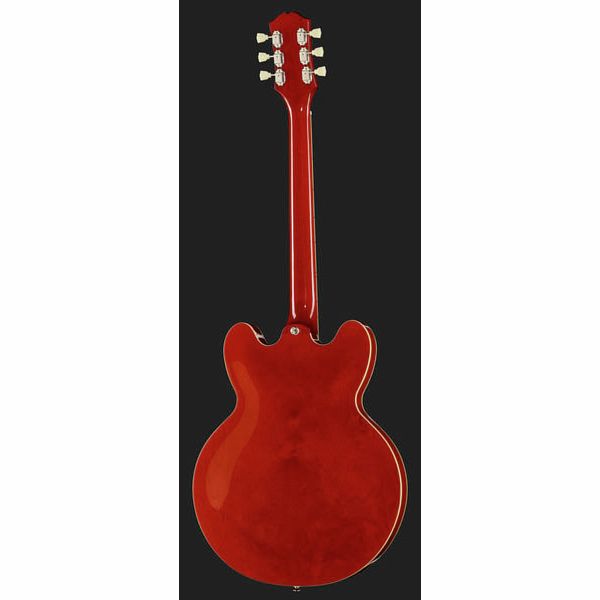
The Honest Niggles
The Epiphone Deluxe tuners work but they are the weakest part of the guitar. They hold tune, they just feel a bit vague turning.
Quality control on the finish varies. Mine was clean, but I have seen a few with slightly rough binding scrape near the cutaway.
And the wiring, while much improved, is still not the cleanest job in the world. If you ever have the pots out for a service, get someone to tidy it.
Also – and this is a general 335 thing, not an Epiphone thing – changing pickups is a horrible job. Everything goes in and out through the f-holes with string and patience. Buy the sound you want.
How It Compares
Against the Ibanez AM73G, the Ibanez is smaller, brighter and more jazz-leaning. The Epiphone is fatter and more rock.
Against the Ibanez AS93FM, the AS93 is the flashier looking guitar and arguably better finished. The Epiphone has the more classic voice.
And against a Gretsch G5210 Electromatic Jet, it is a completely different flavour – the Gretsch snaps, the Epiphone sings.
Within Epiphone itself, if you want more aggression, the SG Standard or the 1959 Les Paul Standard are the obvious siblings.
Who Should Buy One
Blues players, obviously. Also anyone in a covers band who needs one guitar that sounds convincing on about eighty percent of the setlist.
It is also a brilliant second guitar. If you already own something solid and modern, a 335 adds a completely different colour rather than a slight variation.
What it is not is a first guitar. The body size and the price both push it out of that bracket.
Specs at a Glance
- Series: Inspired by Gibson
- Construction: semi-hollow with center block
- Top, back and sides: laminated maple
- Neck: mahogany, Rounded C profile
- Fingerboard: Indian laurel with dot inlays
- Binding: cream
- Nut: GraphTech NuBone, 43 mm
- Scale: 628 mm
- Frets: 22
- Pickups: 2x AlNiCo Classic PRO humbuckers
- Controls: 2 volume, 2 tone, 3-way switch
- Bridge: LockTone Tune-o-matic with LockTone stopbar
- Tuners: Epiphone Deluxe
- Colour: Cherry
Final Verdict
The Epiphone ES-335 is one of those rare guitars where the budget version does not feel like a compromise, it feels like a slightly less shiny version of the real thing.
You get the shape, the voice, the playability and the versatility. What you give up is some finish refinement, some hardware feel, and the badge.
For most people that is an extremely easy trade. This is the guitar you buy when you want a 335 and you would rather spend the difference on an amp.
Everyone starts with one of these for a reason. Turns out the reason is that it is genuinely brilliant.
The Cherry Finish Deserves A Paragraph
Cherry on a 335 is one of the great guitar colours and Epiphone have got it right here.
It is translucent enough that you can see grain through it, and it darkens nicely in the middle of the body where the light catches.
Under stage lights it reads red. In a room it looks almost brown. It is a genuinely lovely thing to have on a stand.
Ageing
These finishes do check and fade over years, especially if the guitar lives out of its case. Some people hate that. Personally I think a slightly faded Cherry 335 is one of the better looking objects in music.
Small Upgrades Worth Doing
If you want to spend a little to get a lot, there are two obvious moves.
Tuners. A set of locking tuners fixes the vague feel and speeds up string changes on a guitar where string changes are already a chore.
A proper setup. Semi-hollows benefit enormously from having the bridge height and intonation dialled in properly, and factory setups are usually just about acceptable rather than good.
I would leave the pickups alone. The Classic PROs are genuinely nice, and swapping them means fishing wiring through f-holes, which is nobody idea of a good afternoon.
Long Term Impressions
The thing that keeps surprising me about this guitar is how often I reach for it when I am not trying to do anything specific.
Solid bodies tend to have a job. Metal guitar, country guitar, indie guitar. A 335 just sits there being useful for whatever you are in the mood for.
It also records beautifully. That slight natural compression from the semi-hollow body sits in a mix with almost no work.
Two years in, the only thing I would still change is the tuners. Everything else has held up exactly as it was on day one.