Worth noting too that Thomann’s own return policy makes trying this guitar close to risk-free – if the tone or feel doesn’t click with you after living with it for a couple of weeks, sending it back costs nothing but a bit of packing tape and time.
Watch It First
Ibanez isn’t the first brand that comes to mind for acoustic guitars. Fender, Taylor, Martin — sure. Ibanez feels like it belongs in the electric aisle.
That’s exactly why the AAD51CE-NT is worth a second look. It’s Ibanez’s Advanced Acoustic line, and it’s quietly undercutting a lot of the more famous names on price.
Big dreadnought body, solid top, proper onboard electronics. Let’s see if it actually holds up.
What Is „Advanced Acoustic,” Anyway?
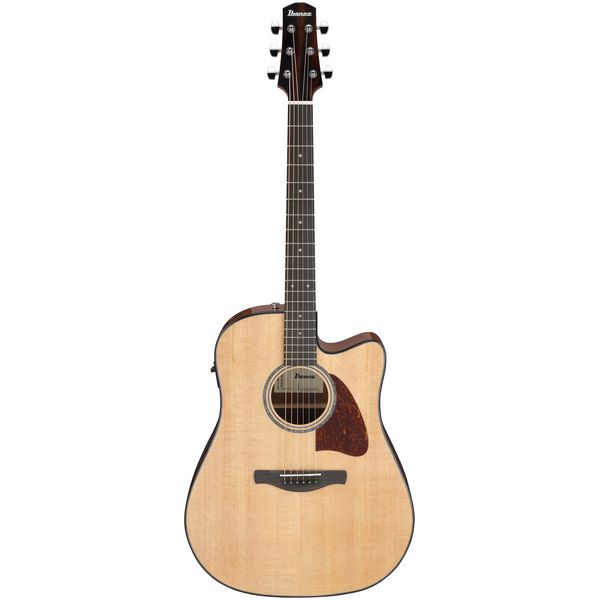
Ibanez calls this line „Advanced Acoustic” because it’s built around a Grand Dreadnought body — a slightly bigger, slightly deeper take on the standard dreadnought shape, designed to push more volume and low end.
Pair that with X-M bracing — Ibanez’s own scalloped bracing pattern — and the goal is clear: more resonance and projection than a typical budget dread.
Build & Materials
- Top: Solid Sitka spruce
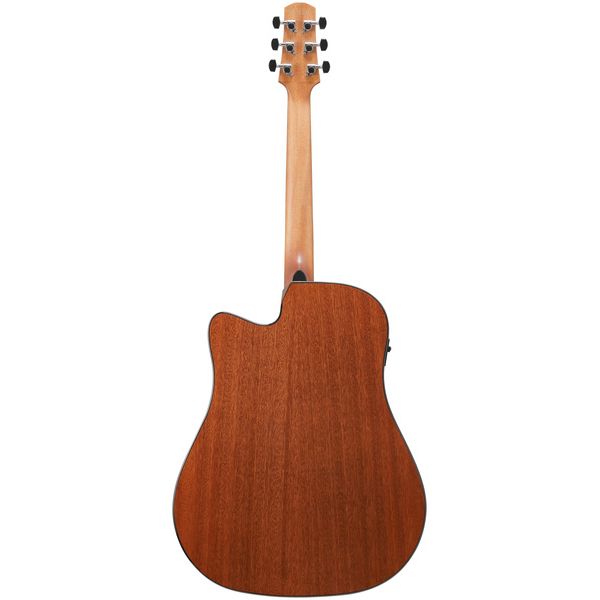
- Back & sides: Sapele
- Neck: Okoume, Low Oval Grip profile
- Fretboard & bridge: Amaranth (purple heart)
- Rosette: Abalone
The abalone rosette is a nice cosmetic touch that a lot of guitars at this price skip entirely. It doesn’t affect tone, but it does make the guitar feel less „budget” in person.
Playability
The Low Oval Grip neck profile is comfortable for pretty much every hand size and playing style, and the cutaway gives real access to the upper frets — something plenty of budget dreadnoughts still skip.
There’s also an A.I.R. soundhole port on the upper bout, which is designed to let the player hear more of their own direct sound on stage. It’s a small but thoughtful detail for gigging players.
How It Sounds
The Grand Dreadnought body backs up its billing — this is a genuinely loud, projecting acoustic unplugged. Strummed hard, it fills a room the way a good dreadnought should.
Tonally it sits in a fairly balanced place — not as scooped-mid bright as an all-spruce guitar, not as dark as an all-mahogany one. Sapele back and sides land somewhere between mahogany and rosewood in character, which makes this a solid all-rounder for strumming and fingerstyle both.
The Electronics: T-Bar Pickup + AEQ-TP2
This is where the AAD51CE-NT really separates itself from cheaper competition. The Ibanez T-Bar pickup runs through an AEQ-TP2 preamp with a built-in tuner, and — crucially — offers both XLR and standard jack outputs.
Having an XLR output built in is genuinely rare at this price. It means you can run straight into a mixing desk or acoustic amp without needing a separate DI box, which is a real convenience for gigging singer-songwriters.
Who’s This For?
- Gigging players who need reliable plug-and-play electronics
- Anyone who wants a loud, projecting dreadnought for the price of a mid-tier guitar
- Electric guitarists dipping into acoustic who want familiar Ibanez build quality
Honest Niggles
It’s a big-bodied guitar, so it’s not the best pick for smaller players or travel duty. If that matters to you, look at a smaller-bodied option instead.
No case or gigbag included, which is a little disappointing given the XLR output practically begs to be gigged. Budget for one separately.
How Does It Compare?
If you’re specifically shopping the Fender California series instead, our 8 Best Fender Acoustic Guitars roundup and our Fender Redondo Player review are good starting points for comparison.
Want a more traditional, warmer voice instead of the Ibanez’s balanced projection? The Seagull S6 and Takamine P3DC are both worth cross-shopping. And if budget stretches further, the Martin D-X2E remains the benchmark for „affordable but real” dreadnought tone.
Ibanez’s Acoustic Side, Explained
Ibanez has quietly been building acoustic guitars since the 1960s, though the brand’s identity has always leaned electric thanks to shredders and metal players. That history means less brand cachet in the acoustic world, but it also means Ibanez has zero incentive to charge an acoustic-guitar premium.
The AAD range specifically launched to compete directly with Taylor and Martin’s entry-level lines on spec sheet alone, undercutting them by a real margin while still using solid tops rather than laminate.
Recording and Home Studio Use
That XLR output mentioned earlier isn’t just a stage convenience – it also makes this a genuinely useful home recording guitar. Running straight into an audio interface’s XLR input with phantom power skips a chain of adapters most acoustic-electrics require.
For anyone recording demos or content at home without a dedicated microphone setup, that alone could be worth the price of admission on its own, even before considering the acoustic performance.
Finish and Hardware
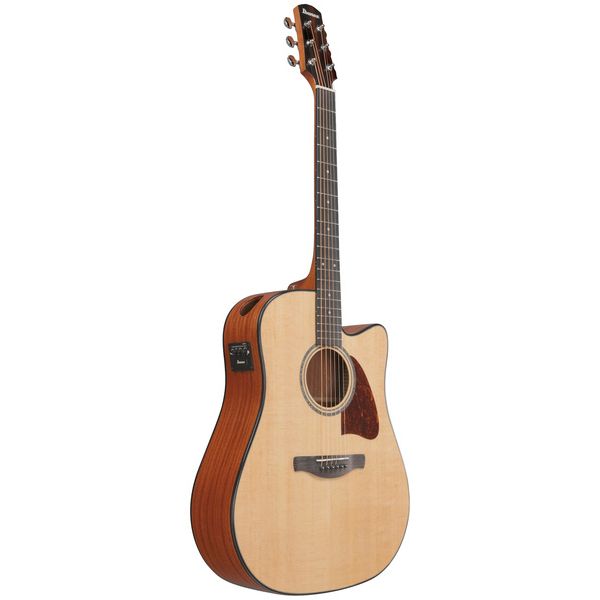
The high-gloss natural finish shows off the spruce grain nicely and photographs well, though gloss finishes do show fingerprints and light scratches more readily than satin options. Tuners and hardware are unbranded but functional – nothing to write home about, nothing to complain about either.
Full Specs
- Type: Grand Dreadnought, cutaway, electro-acoustic
- Top: Solid Sitka spruce, X-M bracing
- Back & sides: Sapele
- Neck: Okoume, Low Oval Grip
- Fretboard & bridge: Amaranth, 20 frets
- Nut width: 43 mm, scale length 650 mm
- Electronics: Ibanez T-Bar pickup, AEQ-TP2 preamp with tuner
- Outputs: XLR and 1/4″ jack
- Finish: Natural, high gloss
Final Verdict
The Ibanez AAD51CE-NT is a legitimately excellent value proposition: a genuinely loud, well-built Grand Dreadnought with electronics that punch well above the price, including that rare XLR output.
It’s not going to make anyone forget about Ibanez’s electric guitar reputation, but as a gigging acoustic-electric, it stacks up against names that cost quite a bit more. Worth serious consideration if you need something stage-ready.