Watch It First
Desktop amps have a reputation problem. They usually mean „fine for silent practice, useless for anything else.”
The Boss Dual Cube LX quietly breaks that rule. It is small enough for a desk but has enough tricks to actually gig with in the right setting.
I have used it for late-night practice, for recording ideas, and once, out of curiosity, for an actual small acoustic set. Here is how it held up.
Build and Design
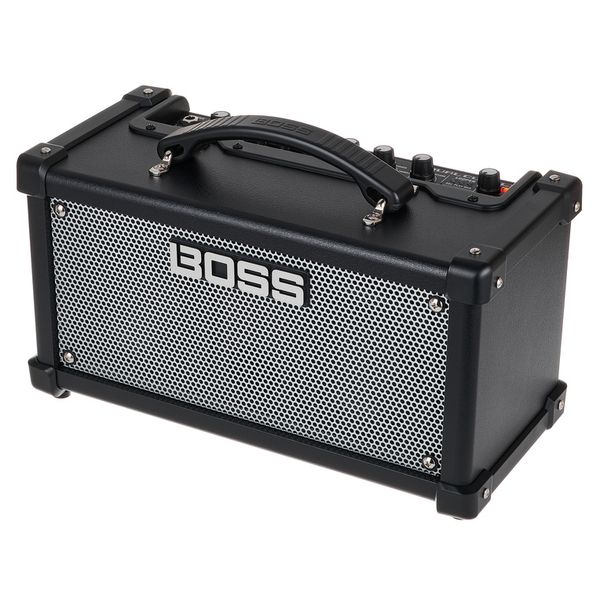
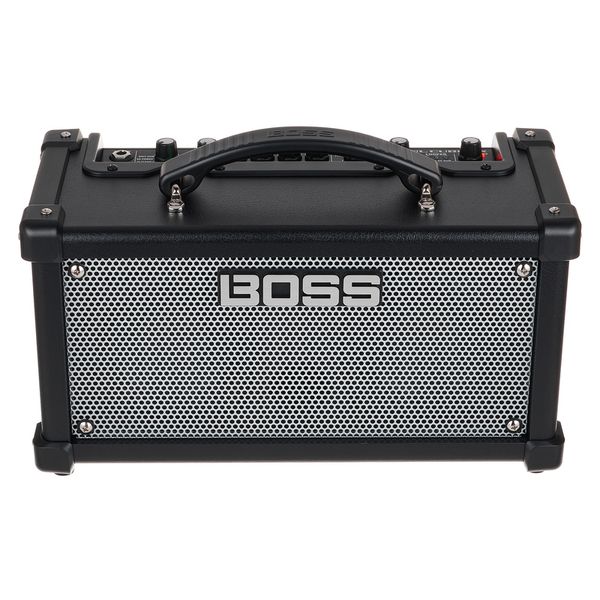
At 3.3kg and roughly the size of a large book, this thing is genuinely portable. Two 4″ speakers give it real stereo width for a box this size.
You can run it from a 9V power supply or 8 AA batteries, which is a nice touch if you actually want to take it outside or to a friend’s place.
Boss clearly built this to survive being thrown in a bag. The knobs feel solid, and the overall footprint is small enough that it disappears on a desk when not in use.
Sound and Tone
8 Amp Types, Stereo Effects
Eight guitar amp types plus a dedicated mic preamp mode cover more ground than you would expect from a desktop unit.
The stereo input mode is the real trick here – plug in a stereo modeler or pedal and the Dual Cube LX genuinely sounds wide, not just loud.
Built-in chorus, flanger, phaser, tremolo, and heavy octave cover the modulation side, while delay, reverb, and spring round out the ambience. It is a lot of ground for something this size.
The Looper and Memory Slots
27 memory slots let you save your favourite combinations, which matters more than it sounds since you will be dialing in a lot of different tones with this many options on tap.
There is also a built-in looper, though you will need a separate footswitch to use it hands-free – similar territory to the Boss RC-500 if you want dedicated looping power instead.
Bluetooth Add-On
Out of the box there is no wireless, but the optional BT-Dual adaptor plugs straight in and adds Bluetooth audio streaming plus app control.
It is a small extra cost, but it turns the Dual Cube LX into a genuinely wireless practice rig – streaming backing tracks from your phone without a cable in sight.
Given how many players will want this feature day one, it is a bit of a shame Boss did not just build it in, but the add-on route at least keeps the base price down.
Playability and Everyday Use
This is genuinely one of the more fun amps to just sit down and noodle on. The DUAL CUBE LX Editor app opens up deep editing without touching a single knob.
Stereo line out with speaker emulation means it also works as a quick-and-dirty recording tool, and the i-CUBE Link/Aux input makes jamming along to tracks from your phone painless.
USB-B connectivity rounds it out for basic recording duties, though do not expect audio interface levels of fidelity.
Who Should Buy This
Anyone who needs a genuinely portable, battery-capable amp that does not sound like a toy. Buskers, apartment players, and anyone who travels between practice spaces will get the most out of it.
It also works well as a second amp for silent-ish recording sessions where you want something better than headphones alone.
Honest Niggles
Crunch and high-gain tones are the weak spot. Cleans, chorus, and delay sound genuinely great; push it into distortion and things get raspy fast.
No included footswitch for the looper or tap tempo is annoying given how central those features are to the pitch. You will want to budget for one separately.
And while 10W combined is loud for a desktop amp, it is still not going to cut through a full band rehearsal.
How It Compares
Against the Boss Katana Air EX, the Dual Cube LX trades wireless freedom for portability and battery power – different use cases entirely.
Compared to the Positive Grid Spark 2, Boss keeps things simpler and hardware-focused rather than leaning on an app for tone shaping, which some players will actually prefer.
If chorus tones specifically are what draws you to this amp, it is worth also checking out the standalone Boss CH-1 Super Chorus pedal for a dedicated, more detailed version of that effect.
And for a smaller, cheaper, battery-friendly alternative with less feature depth, the Marshall MS-2 is worth a glance too.
Getting the Most Out of the Stereo Mode
The stereo input is the feature most people skip past, and it is arguably the best reason to buy this amp over a mono competitor.
Run a stereo chorus or modeler into both inputs and the width genuinely surprises people who have only heard it in mono demos online.
If you only ever plug in a single mono cable, you are leaving a big chunk of what makes this amp special on the table. Worth experimenting with even if stereo rigs are not normally your thing.
Desktop Amp or Practice Amp?
It is worth being clear-eyed about what category this actually falls into, because „desktop amp” undersells it a bit.
Unlike a lot of desktop units that are basically computer speakers with a guitar input bolted on, the Dual Cube LX has genuine amp modeling and effects processing under the hood.
That puts it closer to a shrunk-down practice combo than a novelty desk toy, and it is why it holds up so much better than the category name suggests.
Specs at a Glance
- Power: 2x 5W into 2x 4″ speakers
- 8 guitar amp types plus 1 mic preamp type
- 7 built-in effects, stereo input mode, 27 memory slots
- Powered via 9V PSU or 8x AA batteries
- USB-B, stereo line out with speaker emulation, built-in looper
- Weight: 3.3kg
Final Verdict
The Boss Dual Cube LX is one of the more well-rounded desktop amps out there – portable, battery-capable, and genuinely versatile for its size.
It will not replace a real combo for high-gain tones or a proper rehearsal, but for practice, recording ideas, and the occasional acoustic gig, it earns its spot on the desk.