Watch It First
A 1-watt Marshall sounds like a joke at first. Then you plug it in.
The DSL1CR is a fully tube combo built for people who want real Marshall grit at living-room volume, not a scaled-down toy version of one.
I have been running it through everything from a Tele to a high-output humbucker guitar. Here is the honest rundown.
Build Quality
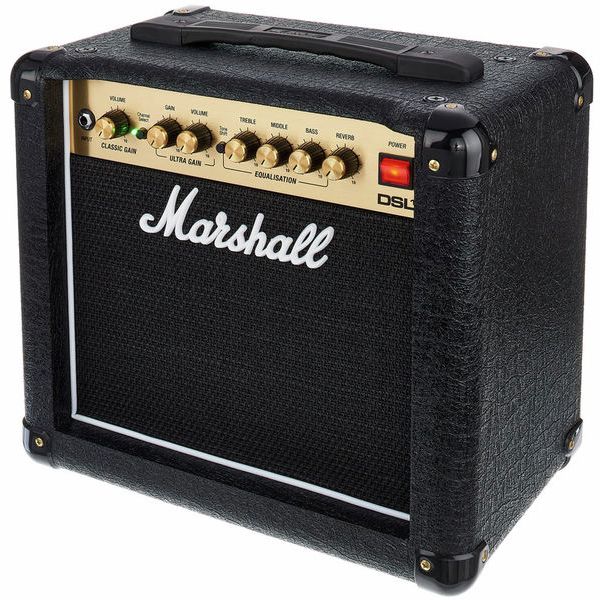
Marshall did not cheap out on the electronics just because the power section is tiny. You get a real ECC82 and two ECC83 tubes doing the work, not a solid-state amp pretending.
The cabinet is compact – 360 x 340 x 215mm and 7.9kg – with an 8″ Celestion Eight-15 speaker that punches well above its size.
Classic black tolex, script logo, and the included footswitch all make it feel like a proper Marshall shrunk down, not a novelty item.
Sound and Tone
Two Channels, Real Character
Classic Gain and Ultra Gain channels are footswitchable, and they are genuinely different voicings rather than just a volume boost.
Classic Gain cleans up nicely and does crunch really well when you push it. Ultra Gain gets into proper rock and modern territory, with enough saturation for riffing without falling apart.
The Tone Shift button reshapes the midrange, which matters more than you would think on an amp this small – it is the difference between boxy and full.
The Power Trick
The real party trick is the power scaling: 1W down to 0.1W. At 0.1W you can genuinely crank the power amp into breakup territory without waking the neighbours.
That is the whole reason this amp exists, and it delivers. Real tube compression and sag at volumes a solid-state combo simply cannot replicate.
Pairing With Pedals
Because the DSL1CR has a genuine tube power section, it reacts to pedals the way a full-size Marshall does – overdrives push the front end rather than just adding volume.
A tube screamer-style pedal in front of Ultra Gain gets you into proper vintage rock territory. Fuzz pedals, on the other hand, can get a bit farty at 0.1W since there is less headroom to work with.
Time-based effects (delay, reverb, modulation) belong in the serial FX loop rather than in front of the amp – the difference in clarity is noticeable once you try both ways.
Playability and Everyday Use
This is a practice-and-record amp first, gigging amp a distant second. Even at 1W it will get loud in a small room, but it is not going to compete with a drummer.
The emulated line out is the unsung hero here. Recording direct sounds surprisingly usable, and the serial FX loop means you can add time-based effects properly instead of stacking them in front.
No headphone output though, which is a genuinely odd omission for a bedroom-focused amp. If silent practice matters to you, keep that in mind.
Who Should Buy This
Apartment dwellers who refuse to compromise on real tube tone. If you have tried modelers and keep feeling like something is missing, this is likely what you are missing.
It also makes a genuinely great grab-and-record amp for home studios, thanks to the emulated output and FX loop.
Honest Niggles
The 8″ speaker is the ceiling here. It sounds great for its size, but it is never going to have the low-end weight of a 12″.
No gain control on the clean channel is a fair complaint from long-time owners – you get volume, not gain, on Classic Gain.
And again: no headphone jack. For an amp clearly aimed at bedroom players, that is a strange thing to leave out.
How It Compares
Against the Marshall Origin 50C, the DSL1CR trades gigging headroom for apartment-friendly volume – pick based on where you actually play.
Compared to the Fender 65 Princeton Reverb, you are choosing between Marshall crunch and Fender sparkle – both are tube amps that reward being pushed.
If you want two-channel versatility with even more low-end presence, the Peavey Classic 30 II is worth cross-shopping, though it is a much bigger amp overall.
And if you just want Marshall tone in the smallest possible footprint without going full tube, the Marshall MS-2 is the cheaper, battery-powered alternative.
Setting It Up at Home
A few practical notes if you are buying this specifically for home use.
Start on Classic Gain at 0.1W to dial in your clean and crunch tones first. Jumping straight to Ultra Gain at full power is how people decide the amp is „too much” before they have actually explored it.
If you are recording direct through the emulated out, roll off a bit of the Tone Shift brightness – it is voiced for a mic on a real cab and can sound a touch harsh straight into an interface.
And use the included footswitch. Reaching down to flick a channel switch mid-song defeats half the point of having two distinct gain stages available.
Is a 1-Watt Amp Actually Enough?
This is the question everyone asks before buying, so let us actually answer it.
1 watt through an efficient guitar speaker is louder than most people expect – easily enough to fill a bedroom or small studio space at a level that will still annoy a roommate.
What you are not getting is stage volume. Even with a mic on it, you are relying on the PA to do the heavy lifting for anything beyond a small acoustic gig or open mic.
Think of the wattage rating as a practice-and-recording spec, not a gigging spec, and the DSL1CR makes total sense.
Specs at a Glance
- Fully valve circuit: 1x ECC82, 2x ECC83
- Power: switchable 1W down to 0.1W
- 2 footswitchable channels: Classic Gain and Ultra Gain
- 1x 8″ Celestion Eight-15 speaker
- Digital reverb, Tone Shift button, serial FX loop
- Emulated line out, footswitch included
- Weight: 7.9kg
Final Verdict
The Marshall DSL1CR nails the one thing it set out to do: real tube tone at volumes your neighbours will tolerate.
It is not a gigging amp and the missing headphone jack is a genuine head-scratcher. But for home practice, recording, and just having actual Marshall tone on tap, it is hard to beat at this size.