Watch It First
Digital delays are precise. Clean repeats, exact timing, do exactly what the box says on the tin.
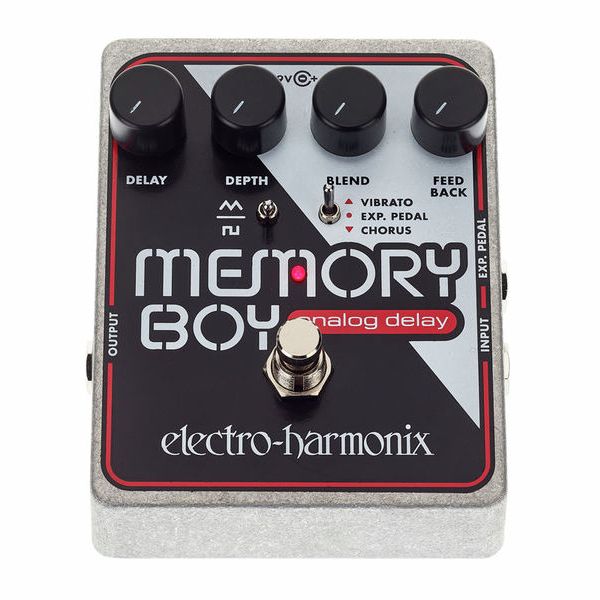
The Electro-Harmonix Memory Boy is not that. It’s a proper analog delay – warm, a little wobbly, and happy to fall apart in a good way the further you push it.
It’s basically the budget doorway into that legendary Memory Man sound, and after spending real time with one, I get why it’s stuck around this long.
The Controls – Simple, But Deep Enough
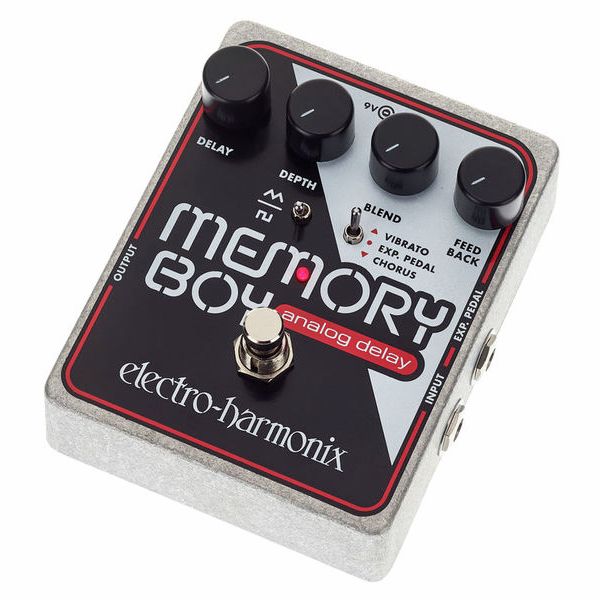
Four knobs: Delay, Depth, Blend, and Feedback. That’s it. No menus, no presets, no tap tempo – just turn knobs until it sounds right, which honestly is refreshing in 2026.
Delay time runs from a short 30ms slap-back all the way to 550ms, which covers most rhythmic and ambient uses without needing to chain repeats together.
The Vibrato/Chorus Switch
There’s a three-way switch adding modulation to the repeats – straight delay, chorus-flavored, or full vibrato wobble. Combined with the Depth knob this is where the Memory Boy earns its „weird in a good way” reputation.
Push Depth and Feedback together and you get self-oscillating, spacey textures that feel more like a modulation pedal than a delay. It’s genuinely more versatile than the simple control layout suggests.
Tone – Warm, Dark, a Little Unpredictable
Analog delays get progressively darker and more degraded with each repeat, and that’s exactly what you get here. Early repeats are warm and present, later ones fade into a fuzzy, tape-like haze.
For indie, surf, blues, and anything psychedelic-leaning, that character is a feature, not a bug. It sits behind the dry signal instead of competing with it, which makes it easy to leave on for entire songs without it feeling busy.
If you want crystal-clean, identical-every-time repeats for tight rhythmic parts, this isn’t that pedal – and it won’t pretend to be. It’s a mood pedal more than a metronome.
Build and Playability
Classic EHX big-box housing, sturdy enough for regular gigging. Unlike a lot of pedals at this price, the power supply is actually included in the box – a nice touch EHX doesn’t always bother with.
There’s a jack for an expression pedal too, so you can control delay time in real time with your foot instead of reaching down mid-song. That’s a surprisingly pro feature for a pedal at this price point.
No tap tempo though, which is the trade-off for keeping things this simple and analog. If tap tempo is a dealbreaker for you, look at something more modern instead.
Who It’s Actually For
- Indie, surf, and shoegaze players who want dark, degrading repeats rather than clean digital ones
- Anyone chasing that classic Memory Man vibe without the Deluxe price tag
- Ambient and ethereal players who like pushing feedback into self-oscillation territory
- Players who’d rather turn four knobs than dig through a menu
If you like the idea of modulated repeats, our MXR Analog Chorus review covers a pedal that shares a similar warm, analog-first philosophy, just without the delay stage.
Honest Niggles
Max delay time of 550ms is on the shorter side if you’re after huge ambient washes – some players chain two together, or step up to the Deluxe version for longer times and tap tempo.
It’s also not a subtle pedal at higher settings – the noise floor rises noticeably as you push Feedback and Depth. Not a dealbreaker for the vibe it’s going for, but worth knowing if you need a clean signal on tap.
If reliability and a totally clean repeat matter more to you than character, a digital option like the Valeton GP-200 multi-FX unit gives you more precise, tap-tempo-able delays as one part of a bigger rig.
Memory Boy vs Memory Toy vs Deluxe Memory Boy
EHX makes three sizes of this basic circuit, and it trips people up. The Memory Toy is the mini, budget version with fewer controls. The standard Memory Boy reviewed here sits in the middle, with the full four-knob control set and the mod switch.
The Deluxe Memory Boy adds tap tempo and a longer max delay time, for a noticeably higher price. If you’re just getting into analog delay and don’t need tap tempo, the standard Memory Boy is genuinely the sweet spot of the three.
Quick Specs
- Type: Analog delay pedal
- Controls: Delay, Depth, Blend, Feedback, Vibrato/Chorus/Exp. Pedal switch
- Delay time: 30 – 550 ms
- Extras: Expression pedal input
- Power: Power supply included
- Dimensions: 102 x 120 x 57 mm
Pairing it with a clean, low-gain platform makes it shine – our Positive Grid Spark Mini review and Ibanez TS9 Tube Screamer review both cover gear that leaves plenty of headroom for delay trails like this to breathe.
Setting It Up: A Few Tips
Start with Blend and Feedback both around noon, Depth off, and dial the Delay knob until the repeats land where you want rhythmically. That’s your baseline, and it’s a genuinely usable sound on its own.
From there, nudge Depth up slowly with the switch set to Chorus for subtle shimmer on the repeats, or flip to Vibrato and push Depth further for something closer to a warped tape flutter.
Placement matters too – put it after any gain pedals (fuzz, overdrive) so the delay repeats the already-shaped tone rather than getting distorted itself. Put it before reverb if you want the repeats to bloom into a wash rather than sitting dry and distinct.
Final Verdict
The Memory Boy isn’t trying to be the cleanest or most feature-packed delay on the market. It’s trying to sound like a warm, slightly broken tape machine – and at this price, nothing else nails that specific vibe as well.
If your board already has a precise digital delay and you want something with actual character to layer in, this is a genuinely smart, budget-friendly pickup. It punches well above its price for what it’s going for.
Not for everyone, and definitely not for tight, click-track-precise repeats. But for indie, surf, and psychedelic tones? It’s one of the best cheap ways into that sound, full stop.