Watch It First
EQ pedals get a bad rap. Most players see ten little sliders and assume it’s a studio-nerd thing, not a gigging tool.
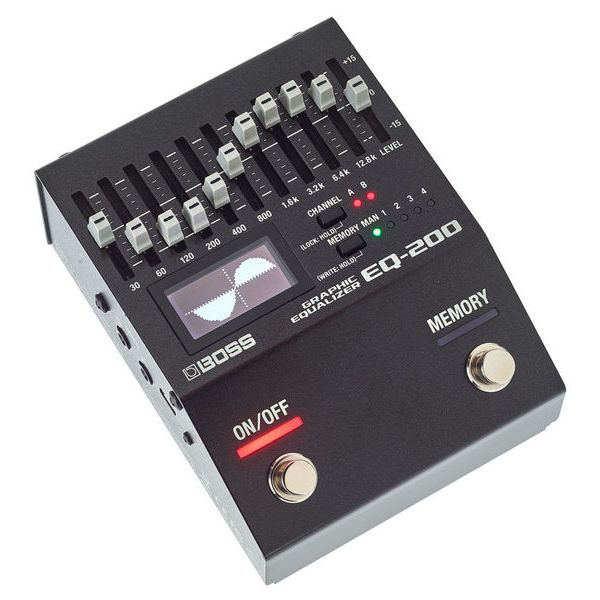
The Boss EQ-200 is the pedal that quietly changed my mind on that. It’s not one EQ – it’s two full 10-band EQs in one box, and you can run them stacked, split, or in stereo.
Sounds nerdy on paper. In practice it might be the single most useful problem-solver I’ve put on a board in years.
What You’re Actually Getting
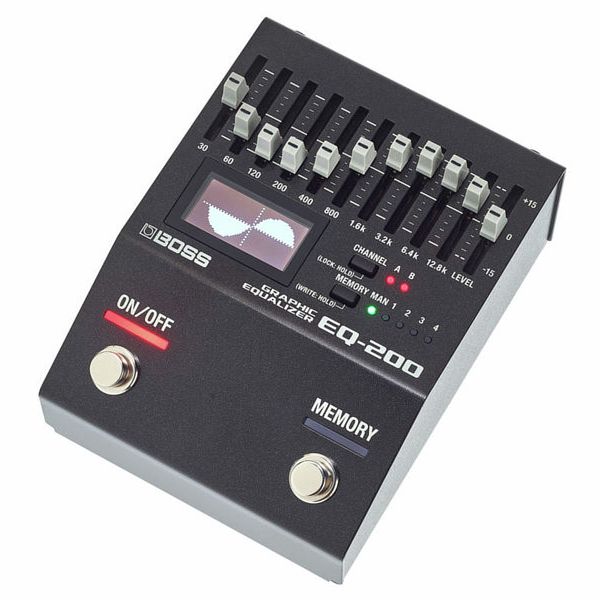
Two independent 10-band graphic EQs, each with sliders from 30Hz up to 12.8kHz. You can run Channel A and B in series (stack them for deeper shaping), in parallel (blend two different curves), or fully stereo.
There’s a small LED screen that shows the actual curve you’ve drawn, which sounds like a gimmick until you’re trying to remember which slider you nudged mid-set. It genuinely helps.
Four (Well, 128) Memory Slots
Four footswitch-accessible memories, but combine that with the panel setting and MIDI program change support and you’ve effectively got 128 usable slots. One for a mid scoop, one for a solo boost, one for taming a boomy stage, and so on.
Tone – How Much Difference Does an EQ Pedal Really Make?
More than you’d think. This isn’t a coloring pedal in the way a fuzz or overdrive is – it’s transparent by design, +/-15dB per band, and it stays clean even when you’re pushing hard cuts and boosts.
Where it earns its keep is fixing problems: a boomy room, a harsh amp, a guitar that’s a bit too honky in the midrange. Dial in a curve once, save it, and you’ve basically got a „fix this room” button for every gig after.
Run it in parallel mode and you can blend two totally different tone shapes with a single knob – think a scooped rhythm curve blended into a mid-forward lead curve on the fly. That’s the kind of trick that usually needs two pedals and a mixer.
Build and Playability
Classic Boss 200-series metal chassis – it’ll survive being thrown in a gig bag for a decade, no question. Two footswitches, real sliders (not tiny knobs), and a screen you can actually read on a dark stage.
I/O is genuinely pro-level: stereo ins and outs, an expression pedal/external switch jack, MIDI, and USB. You can run this thing in a studio chain at 32-bit/96kHz just as easily as on a pedalboard.
Power is 3x AA batteries or a 9V adapter (not included – Boss sell the matching one separately). Current draw is a bit higher than your average stomp box at 170mA, so factor that into your power supply budget.
Who It’s Actually For
- Gigging guitarists and bassists who fight the same room problems every week
- Anyone running a MIDI-controlled board who wants EQ curves tied to specific presets
- Studio players who want a transparent, surgical tone-shaping tool rather than a „vibe” pedal
- Bands that share a backline and need to quickly re-EQ for whatever amp shows up that night
If you’re building a whole board around tone-shaping rather than gain stages, our MXR Six Band EQ review covers a simpler, more affordable option worth comparing against this one.
Honest Niggles
It’s not cheap, and it’s not small. If you just want a quick mid-boost for solos, a simple EQ pedal or even a clean boost will do that job for a fraction of the size and cost.
The menu diving to set up parallel/series/stereo modes and MIDI mapping takes a bit of homework. This isn’t a plug-in-and-go pedal – budget an evening with the manual before your first gig with it.
And because it’s so transparent, it won’t scratch the itch if what you actually want is character – for that, something like our Electro-Harmonix Nano Metal Muff review is a better read.
EQ-200 vs the Rest of the Pedalboard EQ Crowd
Most pedalboard EQs are single-channel, mono, and pretty basic – fine for a quick tweak, not built for serious problem-solving. The EQ-200 is really in its own category: it’s closer to a rack EQ unit that happens to live in a stomp box.
If your rig is already MIDI-controlled (say, through something like a Valeton GP-200 or similar multi-FX unit), the EQ-200 slots in as the „fix whatever the room is doing to me tonight” piece that a lot of all-in-one units still don’t nail.
Quick Specs
- Type: Stereo graphic equalizer, 2x 10-band
- Bands: 30Hz – 12.8kHz, +/-15dB per band
- Modes: Series, parallel, or stereo channel routing
- Memory: 4 footswitchable slots (128 with MIDI)
- I/O: Stereo/dual mono in and out, expression/switch jack, MIDI, USB
- Power: 3x AA batteries or 9V DC adapter (sold separately), 170mA draw
- Dimensions: 101 x 138 x 63mm, 630g
Worth pairing with something to shape gain too – our Ibanez TS9 Tube Screamer review and Boss VE-8 Acoustic Singer review both cover pedals that play nicely alongside a serious EQ like this one.
A Real-World Use Case
Say you’re on a shared bill and you soundcheck through a rented amp that’s brighter and boomier than yours at home. Normally that means a rushed, stressful re-EQ from the amp’s own knobs mid-changeover.
With the EQ-200 sitting at the end of the chain, you dial a curve during soundcheck, save it to a memory slot, and you’re done. Next song, next set, next gig at a totally different venue – stomp the switch, same tone you rehearsed at home.
That’s really the pitch for this pedal in one sentence: consistency. Not more gain, not more character, just the same tone showing up every night regardless of what room or backline you’re stuck with.
Final Verdict
The Boss EQ-200 isn’t glamorous. Nobody’s going to ask you about your EQ pedal after a show. But it might do more actual problem-solving per gig than anything else on your board.
If you’ve ever fought a room, an amp, or a guitar that just won’t sit right in the mix, this is the pedal that ends that fight for good. Pricier than a basic EQ, sure, but it punches well above its category once you actually dig into what it can do.
Not everyone needs this much EQ. But if you’ve outgrown a basic graphic EQ and want something closer to studio-grade control on a pedalboard, nothing else at this size really competes.