Watch It First
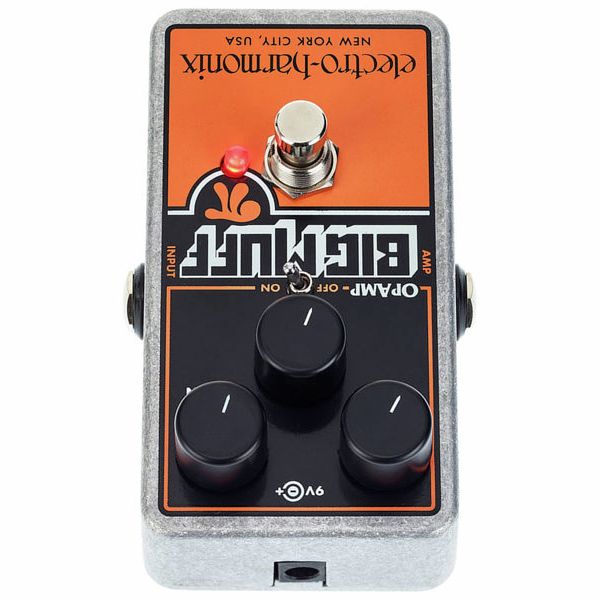
Every fuzz nerd eventually goes down the Big Muff rabbit hole, and there are approximately nine hundred versions to get lost in. But if you ask me which one actually deserves the hype, the Op-Amp Big Muff Pi is near the top of my list.
This is the reissue of the late-70s circuit that Billy Corgan made famous on Siamese Dream — that thick, saturated, almost synth-like wall of fuzz. EHX brought it back a few years ago and it hasn’t left my „recommend this to everyone” list since.
Is it just a nostalgia trip for Smashing Pumpkins fans, or a genuinely great fuzz pedal on its own merits? Spoiler: it’s both.
A weirdly specific bit of history
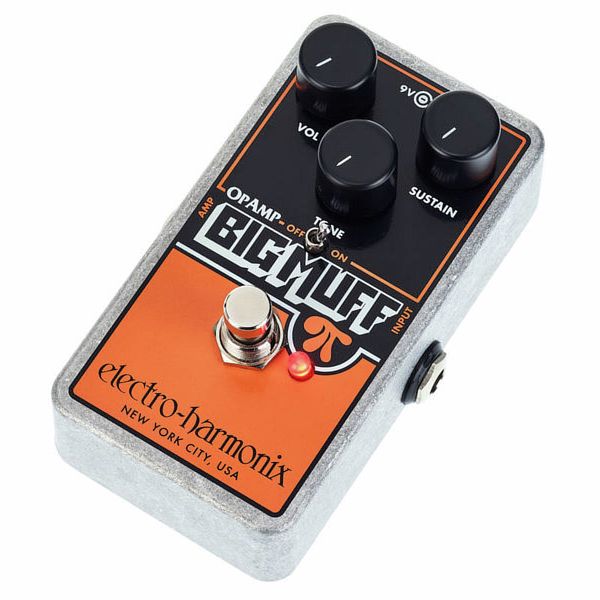
Big Muffs have gone through a bunch of circuit revisions since 1969 — Triangle, Ram’s Head, Civil War, Green Russian, you name it. The Op-Amp version, from the late 70s, swapped some of the transistor stages for op-amp chips.
The result is a fuzz that’s a bit more aggressive and mid-forward than the classic Ram’s Head, with a slightly more „electric,” compressed character. It’s also the version that ended up on a huge chunk of 90s alternative and shoegaze records, whether people realised it or not.
How it actually sounds
Sustain maxed, tone around noon, and this thing just sings. Notes bloom into feedback almost on their own, and single notes have this thick, singing quality that’s genuinely addictive to play through.
Chords get messier the more gain you pile on, which is true of basically every fuzz ever made — that’s not a knock, it’s just physics. Back off the Sustain a touch and you get a surprisingly usable rhythm fuzz tone that doesn’t collapse into mud.
The Tone control is deceptively simple — just a passive filter, no mids-sweep or anything fancy — but it does the job. Dark and woolly on one end, bright and buzzy on the other.
Who’s this actually for
Obviously, if you’re chasing that specific 90s alt-rock, shoegaze, grunge-adjacent fuzz wall, this is close to essential. Layer it with a chorus or a reverb-heavy setup and you’re basically writing your own version of a certain iconic album.
It’s also just a great all-purpose fuzz for anyone who wants something more textured than a standard distortion pedal. If your board currently only has something like a modern high-gain box such as the Nano Metal Muff, adding this alongside gives you a completely different flavour of heavy for a totally different mood.
If you want tight, articulate, modern-metal gain, skip this one — go look at something like the MXR Fullbore Metal instead. This Big Muff is fuzzy, loose, and vintage by design, not a precision tool.
Build and everyday use
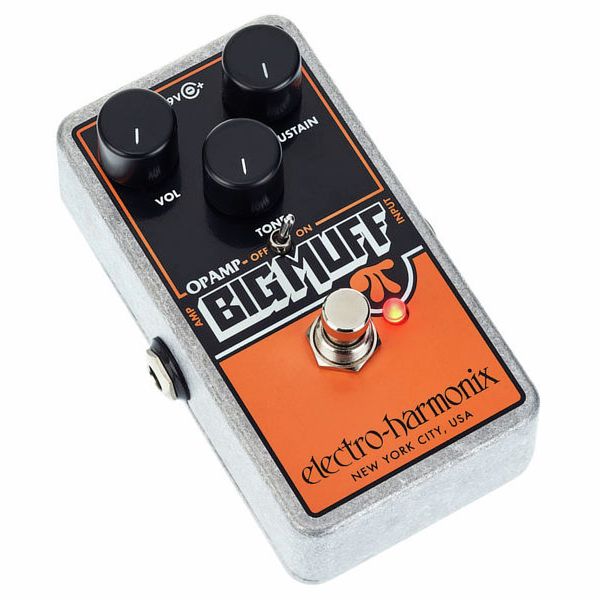
Classic die-cast EHX enclosure, three big chunky knobs, one mini toggle for tone on/off, and true bypass switching. Nothing complicated here — you’ll be dialled in within a minute of unboxing it.
Power draw is tiny at just 5mA, so it’s not going to be fussy on a shared power supply, and it’ll run happily off a 9V battery for ages if that’s your preference.
The footswitch has that satisfying old-school EHX clunk. Not silent, but not obnoxiously loud either — fine for stage use, maybe a bit much for quiet home recording sessions late at night.
Honest niggles
Only one voicing on tap here. If you want a Big Muff that can cover multiple different eras’ worth of tone, you’d need something like the Big Muff Pi 2 with its dual op-amp switching, and that’s a different, pricier animal.
No mids control means it can get a little scooped and buried in a dense full-band mix. A boost or EQ pedal ahead of it — something like the MXR Six Band EQ — genuinely helps carve out space if you’re gigging with a loud drummer.
And yeah, it’s not subtle. If you want a fuzz that can clean up nicely with your guitar’s volume knob, this isn’t the most graceful at low gain — it’s happiest fully committed.
Pairing it with the rest of your board
A lot of players ask whether a Big Muff needs to sit at the end of the drive chain or right at the front. My honest answer: try both, but end of chain is the classic move for a reason.
Run a clean boost or overdrive into it and you can push the front end harder without losing the fuzz’s core character — it just gets angrier and more compressed, which is a great look for solos.
Modulation after the fuzz is where the magic really happens for that shoegaze-adjacent sound. A slow chorus or a phaser post-fuzz turns this from „just a fuzz pedal” into a genuine texture machine — think swirling, billowing walls of sound rather than a single aggressive tone.
One thing worth knowing: because it’s an op-amp-based circuit rather than a pure transistor fuzz, it plays a little nicer with buffered pedals ahead of it than some vintage-style fuzzes do. You won’t need to obsess over true-bypass-only signal chains here, which takes some of the usual fuzz-pedal anxiety out of the equation.
Quick specs
- Circuit: Reissue of the late-70s Op-Amp Big Muff Pi
- Controls: Volume, Tone, Sustain
- Mini switch: Tone on/off
- True bypass switching
- Power draw: 5mA
- Runs on 9V battery or 9V DC adapter (not included)
- Compact die-cast enclosure: 70 x 114 x 53 mm
Verdict
The Op-Amp Big Muff Pi is a proper fuzz classic in a genuinely affordable, compact package. It’s loose, thick, occasionally chaotic, and completely addictive to play through — everything a good Muff should be.
It’s not the most versatile pedal on the market, and if you want tight, precise gain you should be shopping elsewhere — maybe the Valeton GP-200 for a more flexible multi-fx approach. But for pure, unapologetic vintage fuzz character, this earns its spot on the pedalboard.
Honestly one of the best value fuzz pedals going right now. If you’ve ever wanted „that” Smashing Pumpkins sound, or just a fuzz with real personality, this is an easy yes from me.