Watch It First
Mini pedals usually mean compromise. Smaller board space, sure, but also fiddly knobs, cut-down features, and tone that’s a step down from the full-size version. The Ibanez AD Mini quietly breaks that rule.
It’s a proper bucket-brigade analog delay squeezed into a footprint smaller than a deck of cards, and it doesn’t sound like a budget afterthought. It sounds like an analog delay, full stop.
I’ve had this sitting at the end of my chain for a good while now, mostly because it does exactly what I need without hogging real estate I’d rather give to drive pedals. Here’s the breakdown.
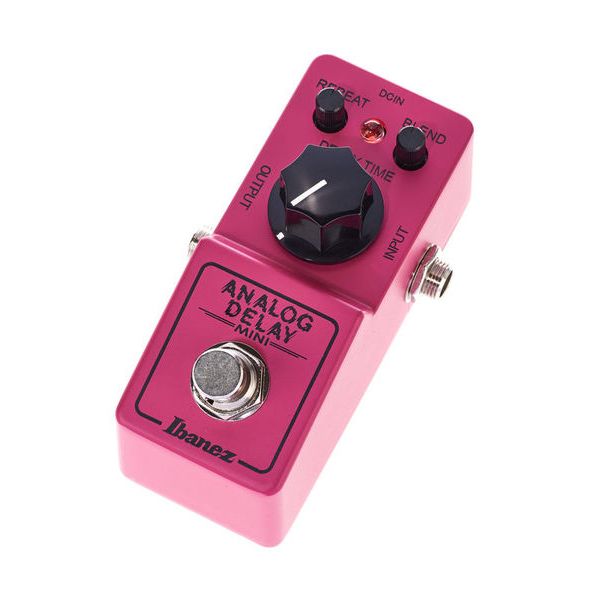
What’s Inside the Tiny Box
This is a true analog delay — signal actually runs through analog bucket-brigade circuitry rather than being converted to digital and back. That’s what gives it the warm, slightly degraded repeats that analog delay fans specifically chase.
Delay time runs from 20ms up to 600ms, which covers everything from tight slapback to properly spacious ambient trails. That’s a genuinely useful range for a pedal this size — Ibanez didn’t cut corners on the one spec that actually matters most.
The Sound
Short delay times get you that classic slapback thickening — great for rockabilly twang or just fattening up a clean tone without anyone necessarily clocking that a delay pedal is even on. It’s subtle in the best way.
Push the Delay Time knob further and the repeats get warmer and softer with each successive echo, degrading naturally the way real analog BBD delays do. It’s a completely different character than a crisp digital delay — more organic, less hi-fi, and that’s exactly the appeal.
Compared to a digital multi-effects delay engine, like what you’d find buried in something like the Valeton GP-200, the AD Mini’s repeats have real analog character that’s hard to fake in the digital domain. That’s the whole reason analog delay pedals still exist in 2026 despite digital being cheaper to make.
Controls and Practical Use
Three knobs: Delay Time, Repeat, and Blend. That’s the entire interface, and honestly, that’s all this pedal needs. Delay Time sets the echo length, Repeat controls how many times it echoes (and can self-oscillate if you push it hard), and Blend sets the wet/dry mix.
No tap tempo, no presets, no MIDI. If you need those features, look elsewhere — but if you just want a great-sounding analog delay you can dial in by ear in ten seconds, this nails the brief.
Who This Is For
Anyone building a tightly packed pedalboard who doesn’t want to sacrifice a full-size slot for delay duty is the obvious buyer here. It’s also great as a secondary „always on” delay that sits quietly doing its job while a bigger, more feature-rich delay handles the flashy stuff.
If your board already leans vintage — maybe you’re running a Ibanez TS9 Tube Screamer for drive — the AD Mini fits that same warm, organic philosophy perfectly. It’s not chasing modern ambient textures; it’s chasing the sound of analog delays from decades ago, just in a much smaller box.
Players who want more ambient, swelling delay textures should look at something like the Walrus Audio ARP-87 or UAFX Starlight Echo Station instead — those give you more modes and modulation options than the AD Mini’s straightforward, single-flavor approach.
Playability & Usability
The knobs are small — genuinely small, given the pedal’s overall footprint — and that takes some getting used to if you’ve got bigger hands or like to make tweaks mid-song with your foot. Precise adjustments are easier done before soundcheck than on the fly.
Feedback (repeat count) can run away into self-oscillation pretty easily if you’re not careful, which is fun for experimental textures but worth knowing about if you’re dialing in a subtle slapback and accidentally end up with a synth-like oscillating mess.
Honest Niggles
No battery operation — you need a 9V DC power supply, and it’s not included in the box. Budget for that if you don’t already have a spare adapter or a pedalboard power supply with room.
The small control knobs are the biggest usability compromise of the „mini” format. It’s a fair trade for the footprint savings, but it’s worth knowing before you buy if fine-tuning matters a lot to you.
It’s also a one-trick pony by design — no tap tempo, no stereo output, no secondary modes. That’s not a flaw exactly, more a reminder that this is a focused tool rather than a do-everything delay like the digital engine tucked inside something like the MXR Six Band EQ’s tone-shaping cousins in the multi-fx world.
Specs at a Glance
- Effect type: true analog (bucket-brigade) delay
- Bypass: true bypass
- Delay time: 20 – 600 ms
- Controls: Delay Time, Repeat, Blend
- Power: 9V DC adapter required (not included), no battery operation
- Dimensions: 50.9 x 92.6 x 55.1 mm
- Made in Japan
Powering It on a Crowded Board
Since there’s no battery option, you’ll want to plan your power chain before you buy. Most modern isolated power supplies handle the AD Mini’s draw without issue, but daisy-chaining it off a cheap unfiltered supply can introduce noise into an otherwise quiet analog circuit.
Given how little space it takes up, it’s a great candidate for tucking into a corner of a pedalboard where a full-size delay simply wouldn’t fit — right next to a compressor or a tuner, for example, without needing to rearrange your whole signal chain.
Final Verdict
The Ibanez AD Mini proves you don’t need a huge enclosure to get real analog delay warmth. It’s simple, it sounds genuinely great, and it takes up almost no space on a board where every square inch matters.
It won’t replace a feature-packed digital delay if you need presets, tap tempo, or stereo operation. But as a dedicated, always-on analog delay that just sounds right the moment you plug in, it’s hard to beat — especially considering how little room it asks for in return.
If you’re tight on pedalboard real estate and want genuine analog delay character rather than a digital approximation of one, this is one of the smartest small purchases you can make. Recommended, IMO, without hesitation.