Watch It First
Flanger is one of those effects that gets a bad reputation it doesn’t fully deserve. Mention it in a gear group and someone inevitably jokes about eighties hair metal or jet planes taking off, like that’s the only thing it’s good for.
The Boss BF-3 has been quietly proving those people wrong since 2002. It’s the successor to the genuinely legendary BF-2, and it does a lot more than nostalgic jet-sweep sounds, though it absolutely still nails those too.
I’ve had this pedal on my board through a few different projects now, so let’s actually dig into what it does well, what it’s for, and whether it’s still worth buying in a world full of boutique modulation boxes.
How This Thing Actually Works
Flanging, if you’ve never dug into the theory, is essentially a very short, modulated delay mixed back with your dry signal. That creates the sweeping, comb-filtered sound people associate with the effect, from subtle chorus-like shimmer all the way up to full jet-plane whoosh.
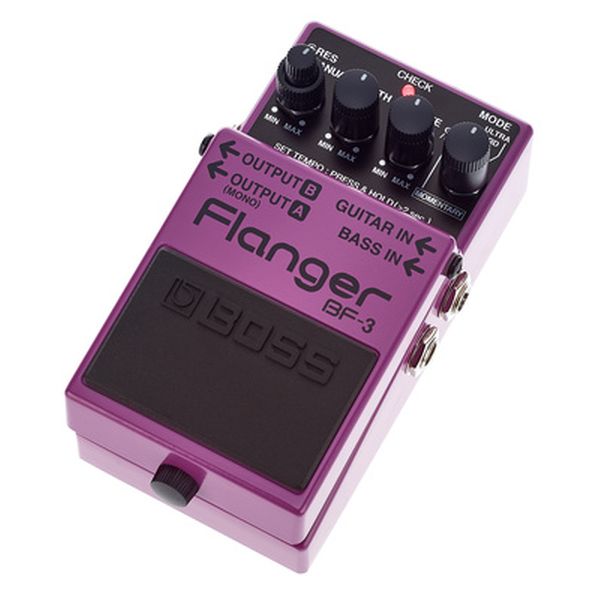
The BF-3 gives you four core knobs, Depth, Width, Resonance, and Manual, plus a mode switch. Resonance is basically your feedback control, cranking it pushes the effect from subtle into that screaming resonant peak territory. Manual shifts the base delay time, which changes the whole character of the sweep.
Where the BF-3 differentiates itself from the older BF-2 is in the extra modes. Ultra mode gives you an exaggerated, more dramatic stereo flange, while Gate/Pan mode chops and pans the effect rhythmically rather than sweeping continuously, which is a genuinely different sound, closer to tremolo territory than classic flanging.
Sound
From Subtle Shimmer To Jet Plane
At lower Depth and Resonance settings, this pedal does a surprisingly convincing subtle chorus-adjacent shimmer, useful for clean rhythm parts that need just a touch of movement without screaming „look, I’m using an effect.”
Crank everything up and you get the full jet-plane sweep the effect is famous for, dramatic, swirling, and genuinely fun on a slow chord progression or an ambient noodling session. If you’ve read my Ibanez TS9 write-up, you know I like pedals that cover a wide dynamic range from subtle to extreme, and the BF-3 absolutely delivers on that front.
Gate/Pan Mode Is Genuinely Different
The Gate/Pan mode deserves special mention because it’s genuinely unusual. Rather than the classic continuous sweep, it creates a rhythmic, almost stuttering panned effect that works great in a stereo rig or through a stereo pedal setup on a modern amp modeler. It’s not something you’ll use every day, but when the right song calls for it, nothing else in a typical pedal collection does quite the same thing. I’ve reached for it on exactly one track in the last year, and it was completely irreplaceable for that specific part, which is a strange thing to say about a pedal mode but there it is.
Build Quality
Boss builds these things to survive tour buses and basement gigs alike, and the BF-3 is standard Boss compact-pedal construction, metal chassis, rock-solid footswitch, the works. It’s a slightly larger footprint than the ultra-mini pedals flooding the market lately, similar in size to something like the Boss OC-5, so budget accordingly on a crowded board.
Genuinely useful extras here include tap tempo, which lets you sync the sweep rate to the actual tempo of a song rather than guessing with a knob, and a momentary mode that only engages the effect while you’re holding the footswitch down, great for one-off swells or transitions.
Separate guitar and bass inputs are a nice touch too, optimizing the input stage for each instrument’s frequency range rather than making bass players fight a guitar-voiced input. Stereo outputs mean you can run this into two amps or a stereo modeling rig for the full spatial effect the Ultra and Gate/Pan modes are designed around.
Playability And Use Cases
Power comes via 9V battery or the standard Boss PSA-series adapter, sold separately, the same setup you’d find on most Boss compact pedals, including the Boss OC-5 I covered separately.
Rhythm guitarists in funk, indie, and disco-leaning styles get enormous mileage out of subtle-to-moderate flange settings. It adds motion to a clean or lightly overdriven chord progression without turning it into a special-effects showcase.
Bass players are genuinely well served here too, thanks to that dedicated bass input. A gentle flange on a bassline adds a chorus-like thickness that sits nicely in a mix without competing with the guitars for sonic space.
Ambient and post-rock players will find a lot to love in the more extreme settings, especially combined with a reverb or delay pedal, similar to the kind of layered textures I’ve talked about when covering the EHX Nano POG for octave-based ambient sounds instead.
Who It’s Actually For
If you want one flanger pedal that covers the full range from subtle shimmer to over-the-top jet-plane sweep, plus a couple of genuinely different modern modes that older flangers don’t offer, this is hard to beat at the price. The tap tempo feature alone makes it worth considering over cheaper alternatives.
If you’re chasing one very specific vintage flange tone and nothing else, a more purpose-built boutique pedal might get you closer to that one sound, though you’ll pay considerably more and lose the versatility this box offers.
Honest Niggles
The size is a legitimate consideration if your board is already packed tight. This isn’t a mini pedal, and Boss hasn’t released a shrunk-down version of this particular model the way they have with some other classics.
No included power supply at this price point is a recurring Boss annoyance across their whole compact pedal lineup, not unique to this one, but still worth budgeting for if you don’t already have a Boss-compatible supply on your board.
The sheer number of controls and modes means there’s a real learning curve before you find your favorite settings. It’s not a plug-in-and-instantly-nail-it pedal the way a simpler one-knob modulation box would be. Spend an evening actually working through each mode and knob combination before a gig rather than trying to dial it in on the fly, future you will thank present you for the homework.
Boss BF-3 – Specs At A Glance
- Effect type: Flanger
- Controls: Depth, Width, Resonance, Manual
- Modes: Standard, Ultra, Gate/Pan
- Extras: Tap tempo, Momentary mode
- Inputs: Separate guitar and bass inputs
- Outputs: Stereo
- Power: 9V battery or DC adapter, sold separately
- Available since: 2002
Final Verdict
The BF-3 earns its spot as one of the most versatile flangers still on the market. It covers subtle chorus-adjacent shimmer, classic jet-plane sweep, and a couple of genuinely modern rhythmic modes that most competitors don’t bother offering.
It’s not the smallest pedal on the market, and it’s not the answer if you want one narrow, specific vintage tone above all else.
But as an all-around workhorse flanger that plays nicely with guitar or bass, covers a huge tonal range, and includes genuinely useful modern features like tap tempo, this is one of the smartest modulation pedal purchases you can make right now. IMO it’s worth every bit of board space it takes up.