Watch It First
Pitch shifting pedals used to be a nightmare. Glitchy tracking, weird latency, and prices that only made sense if you were touring with a headliner.
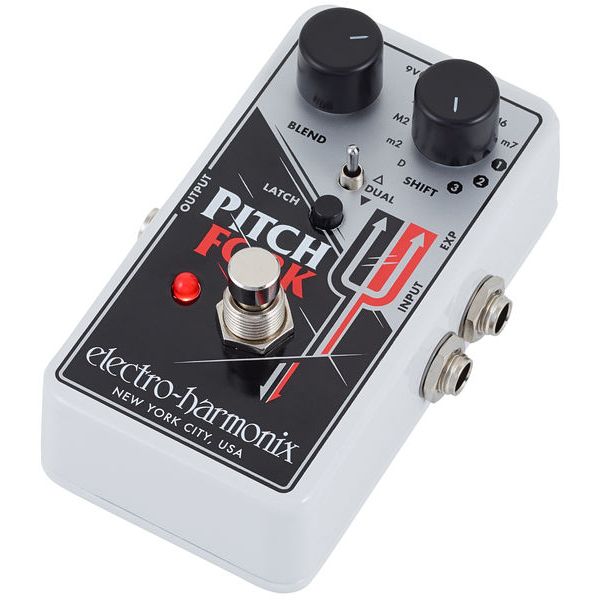
The EHX Pitch Fork changed that conversation almost single-handedly. It’s compact, it’s affordable, and it tracks fast enough that most players forget it’s even doing complex math in real time.
It’s been a pedalboard staple for over a decade now, and it’s still one of the first pitch shifters people recommend. Let’s get into why.
Why Electro-Harmonix, Specifically
EHX has been building weird, wonderful effects out of New York since the late 1960s, and pitch shifting is one of the areas where they’ve genuinely stayed ahead of the pack. The original Pitch Fork came out in 2014 and quietly became the benchmark that other budget-friendly shifters get compared against.
That matters because pitch shifting is hard to do well cheaply. Most manufacturers either cut corners on tracking speed or charge rack-unit prices for something that fits in your hand. EHX found a middle ground that’s held up remarkably well against newer competition.
What It Actually Does
At its core, the Pitch Fork shifts your signal up or down by a set interval, from a semitone all the way up to three full octaves. There are 11 preset intervals dialed in via a rotary switch, so you’re not fumbling with menus mid-set.
Three modes cover most use cases: Up, Down, and Dual, which blends your dry signal with the shifted one. The Dual mode is honestly where most of the magic happens — instant harmonies without a second guitarist.
There’s also an expression pedal input for real-time glissando effects, letting you sweep the pitch up or down like a mini Whammy pedal, if you’ve got a spare EXP pedal lying around.
Build Quality
- Classic EHX diecast enclosure, built to survive a tour bus floor
- 70 x 115 x 54mm — small footprint on a crowded board
- Runs off a 9V battery or the included power supply
- Latch and momentary modes for the EXP input
Real-World Use
Drop an octave down and it’s basically a poor man’s baritone guitar, minus the extra string tension and the new instrument purchase. Great for adding low-end weight to riffs without retuning.
Set it to a fifth or a third up in Dual mode and you get instant harmony lines that actually track well, even on chords, which is impressive for a pedal in this price range — a lot of cheaper polyphonic shifters fall apart the moment you strum more than one note.
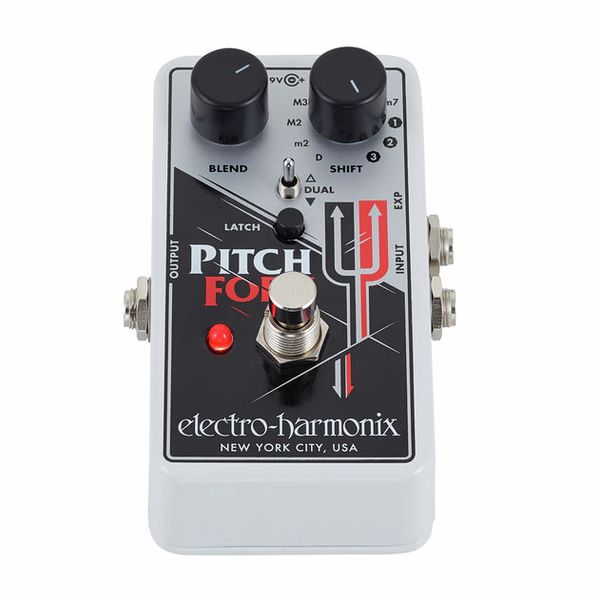
Tracking is genuinely one of the best you’ll find under this price point. It’s not flawless at the extremes — dial in a full three octaves down and you’ll hear a bit of digital wobble on fast lines — but for anything within a fifth or an octave, it’s rock solid.
Who It’s For
Anyone who wants harmony effects, drop-tuned tones without retuning, or those weird synth-adjacent textures without buying a full modeling rig. Prog, metal, ambient, even solo acoustic-electric performers use these for instant „band in a box” texture.
If you only need the occasional octave-down for a single song, it might be overkill — but if you like experimenting, this thing rewards experimentation more than almost any other pedal on your board.
Honest Niggles
- Extreme intervals (2-3 octaves) introduce audible tracking artifacts on fast passages
- No presets/memory — every setting change is manual
- Mono only, no stereo output for spreading harmonies wide
- The Pitch Fork+ exists now with dual engines if you need more flexibility, at a higher price
How It Compares
If you specifically want instant down-tuning rather than harmonies, our DigiTech The Drop review covers a pedal built exactly for that job. For expression-pedal-driven pitch bending, the classic DigiTech Whammy 5 is still the icon of the category.
Want an EHX pedal to pair it with? Their Freeze sustain pedal stacks beautifully with the Pitch Fork for ambient textures, and the Walrus Audio Fundamental Ambient Reverb rounds things out nicely at the end of the chain.
For drive into your harmonized signal, our Ibanez TS9 review is a classic pairing, and if your tuning discipline needs some help while you’re busy chasing intervals, check out the Boss TU-3W Waza Craft tuner.
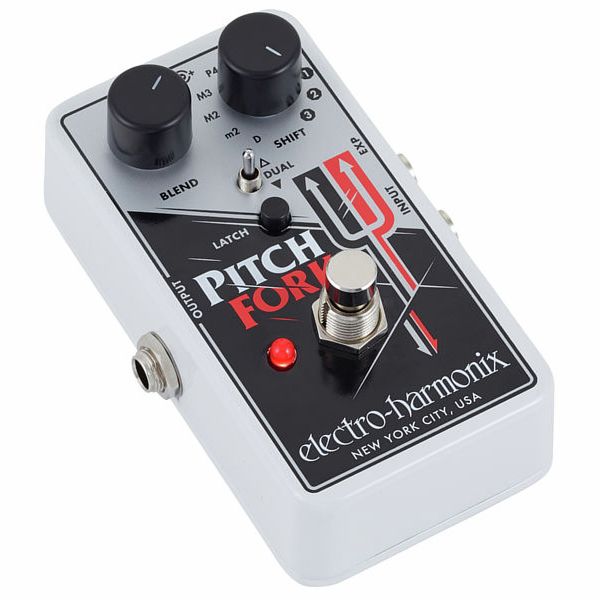
Worth noting too: unlike a lot of „set and forget” pedals, the Pitch Fork rewards actually sitting down and experimenting with it for an afternoon. Half the fun is stumbling onto interval combos you didn’t expect to like — a minor sixth up in Dual mode sounds completely different depending on whether you’re playing single notes or full chords.
Full Specs
- Type: Polyphonic pitch shifter
- Range: +/- 3 octaves
- Modes: Up, Down, Dual
- Intervals: 11 selectable via rotary control
- Expression input: Yes, for glissando control
- Power: 9V battery or included PSU
- Dimensions: 70 x 115 x 54mm
- Bypass: Buffered
Final Verdict
The Electro-Harmonix Pitch Fork earned its reputation the hard way — by just being reliably good for over a decade while competitors came and went.
It’s not the flashiest box on the market and it doesn’t try to be a full harmonizer with presets and MIDI. What it does is nail the fundamentals: fast tracking, simple controls, and a tone that doesn’t feel sterile or digital.
If you’ve been curious about pitch shifting but scared off by the price of the bigger rack-mount units, this is genuinely the easiest entry point. IMO it’s one of the best value pedals EHX currently makes, and that’s saying something given how deep their catalog is.
One last thing worth mentioning: resale on these is strong too, since so many players cycle through pedals looking for „the one.” If it doesn’t end up staying on your board permanently, you won’t have much trouble moving it on to the next curious guitarist.