Watch It First
Drop tuning used to mean carrying a second guitar, or stopping the set dead to retune by hand.
The DigiTech The Drop kills that problem with a single footswitch stomp — it shifts your whole guitar’s pitch down instantly and polyphonically, no capo, no re-tuning, no second guitar.
I’ve had one bolted to my board for a few months now, and honestly it’s changed how I think about tuning mid-set entirely.
What It Actually Does
On paper it’s simple: press the switch, your guitar drops in pitch. In practice it’s a bit of witchcraft.
The Drop uses the same polyphonic algorithm found in the Whammy DT, meaning it tracks full chords, not just single notes. Strum a full barre chord and drop it a fifth and it still sounds like a real chord, not a warbling mess.
If you’ve read our DigiTech Whammy 5 review, you already know DigiTech has serious pedigree with pitch-shifting hardware. The Drop is basically that tech, shrunk down and simplified into one job.
One Knob, One Footswitch
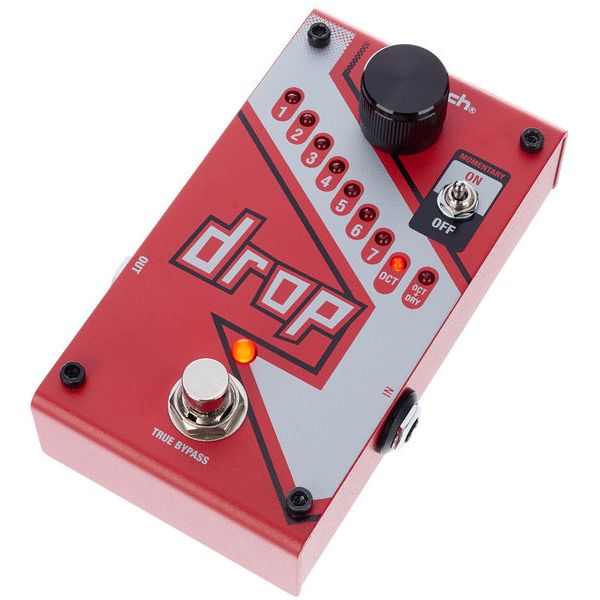
There’s a single rotary knob on top that selects the interval — semitone up to a full octave down, plus a couple of dry-blend modes. That’s it.
No menus, no presets to scroll through, no secondary functions hidden behind a long-press. You dial in the interval once and then it’s just stomp-on, stomp-off.
How It Sounds In The Room
This is not a subtle effect, and it’s not trying to be. When it’s on, your guitar is genuinely tuned down — the low end gets noticeably fatter and the whole thing feels heavier.
Where it gets genuinely useful is switching mid-song. Verse in standard, chorus dropped a whole step for extra weight, back to standard for the bridge. Try doing that with a tuning peg.
Compared to something like the TC Electronic Sub’N’Up Octaver, which is built for adding harmony layers underneath your note, the Drop is doing something different — it’s replacing your fundamental pitch outright, not stacking one on top.
Live Use vs Studio Use
On stage this thing is a lifesaver for anyone who plays sets that mix standard and drop tunings. No swapping guitars, no dead air while you retune.
In the studio it’s more of a fun toy, IMO — you can track a riff once and then drop it for a heavier alt take without re-recording anything. Great for demoing ideas fast.
If your rig already leans toward multi-effects boxes like the Zoom MS-50G+, the Drop still earns its own dedicated spot on the board — this isn’t a job a multi-fx unit does nearly as convincingly.
Who It’s Actually For
If you play one genre in one tuning forever, you probably don’t need this. Fair enough.
But if you’re the guy who plays a set with songs in standard, drop D, and dropped-C, or you’re in a band that likes to surprise the crowd with a heavier outro, this pedal solves a real problem.
It also pairs nicely with guitars already built for down-tuned abuse — something like the Schecter Banshee Mach-6 Evertune or an Ibanez S521 holds up fine even if you’re not physically down-tuning the strings, since the pedal is doing the heavy lifting.
Vs Just Buying a Second Guitar
Yes, a second guitar in an alternate tuning is the „purist” answer. It’s also expensive, heavy to lug around, and useless the second you want a third tuning.
The Drop costs a fraction of a decent guitar and covers a much wider range than one alt-tuned axe ever could. For gigging musicians on a budget, this math isn’t close.
Setting It Up
Getting it dialed in takes about thirty seconds. Plug in, pick your interval on the top knob, and you’re basically done — there’s no deep menu diving here.
Placement on the board matters a bit more than you’d think though. I run mine near the front, before drive pedals, so the pitch-shifted signal hits distortion the same way a normally tuned guitar would.
Put it after your gain stages instead and you’ll notice the tracking gets slightly less tight on chords, especially with the octave-down setting. Not a dealbreaker, just something worth experimenting with on your own board.
Board Space and Power
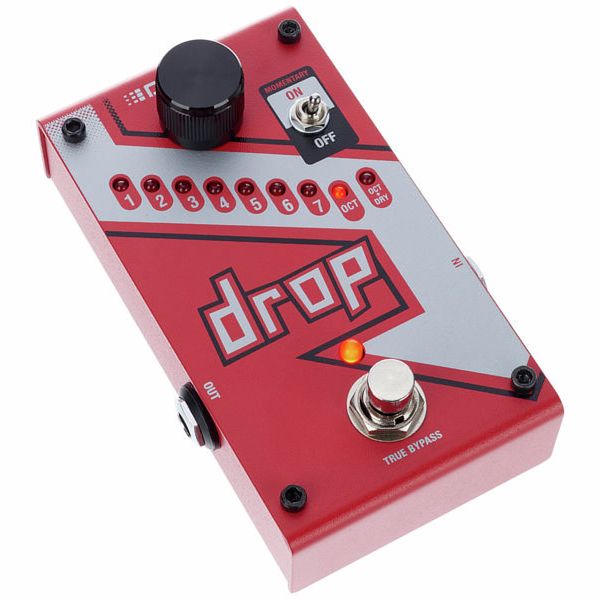
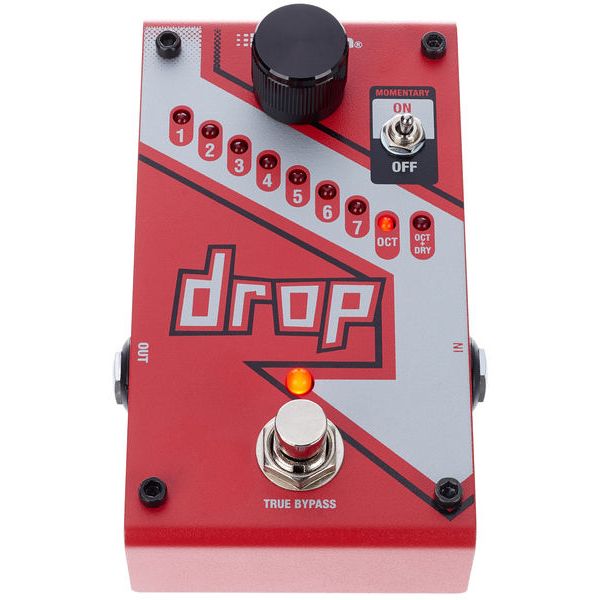
It’s a single, fairly compact enclosure — one knob, one switch, standard 9V center-negative power in. Doesn’t eat much real estate and doesn’t need anything exotic to run.
- Type: Polyphonic pitch-shifter / drop-tune pedal
- Range: Down 1 semitone to a full octave, plus a dry blend
- Tracking: Polyphonic (full chords, not just single notes)
- Bypass: True bypass, silent switching
- Power: Standard 9V DC center-negative, low current draw
- Build: Compact metal enclosure, single footswitch
The Catch
Tracking is excellent but not flawless — push it to a full octave down on a low, muddy chord and things can get a little synthy at the edges. That’s physics, not a design flaw.
It’s also a one-trick pedal. It does that one trick better than almost anything else out there, but don’t expect it to double as anything else on your board.
There’s also a small learning curve in your picking hand. Down an octave, low chords need a slightly lighter touch or they turn into low-end mush — again, that’s just physics catching up with the algorithm, not DigiTech’s fault.
If you’re running a baritone or an extended-range guitar already, like something in the ESP LTD H3-1000FR territory, you honestly might not need this as much — you’ve already got the low end covered mechanically. This pedal earns its keep most on a standard 6-string that needs to punch heavier without a guitar swap.
One more thing worth mentioning: this pedal also just works as a party trick. Drop the whole band a half step mid-song for a breakdown and watch the crowd’s faces. Cheesy? Maybe. Fun? Absolutely.
It’s the kind of gear that sounds like a gimmick until you actually own one, and then you wonder how you gigged without it.
A Quick Reality Check on Tracking
Let’s be real for a second — no pitch-shifting pedal is going to sound one hundred percent identical to an actually down-tuned string. There’s a tiny bit of digital sheen if you listen closely on headphones.
Through a loud amp on a stage, though? Nobody in the crowd is going to notice, and honestly most bandmates won’t either. It’s convincing enough that I’ve stopped worrying about it.
Single notes and power chords track basically flawlessly. It’s only when you get into dense jazz voicings or fast legato runs down an octave that you’ll hear the algorithm start to work a little harder.
For the average rock, metal, or blues player stomping between riffs and choruses, none of that matters. This thing was built for exactly that use case, and it nails it.
Final Verdict
The DigiTech The Drop does exactly what it says on the tin, and does it well. For anyone juggling multiple tunings live, it’s basically a cheat code.
It won’t replace your guitar tech, but it’ll make you look like you don’t need one. Worth a spot on the board if drop tuning is part of your sound.