Watch It First
A tuner pedal review. I know, I know — how exciting can a box that just tells you if you’re in tune actually be?
Turns out, with the Boss TU-3W Waza Craft, more exciting than you’d think. Not because the tuning itself is some revelation — it’s Boss, of course it tunes well — but because of what’s hiding under the hood.
This is the TU-3 platform rebuilt with a genuinely good buffer and some tone-conscious circuit design. That’s the whole pitch. Let’s see if it’s worth the step up.

What Waza Craft Actually Means Here
„Waza Craft” is Boss’s line for pedals rebuilt by their senior engineers with a focus on tone quality, not just features. On most Waza pedals that means analogue voicing tweaks. On the TU-3W it means something more specific: the buffer.
A tuner pedal usually sits at the very front of your signal chain, which means every ounce of tone-sucking or signal degradation it introduces gets passed down the rest of your pedalboard and into your amp. Boss redesigned the audio circuit here specifically to keep the signal path clean.
The Buffer
You get a switchable buffer — on for long cable runs or busy boards where signal loss is a real concern, off for a properly transparent true-bypass path when you don’t need it. It’s a small switch on the pedal, easy to miss on a shelf photo but genuinely useful in practice.
If your board already has a dedicated buffer somewhere (something like the buffer built into a Klon-style overdrive), you can leave this one off and just use the TU-3W as a straightforward true-bypass tuner. Nice to have the option either way.
Tuning Performance
Accuracy is rated at +/-1 cent, which is the same benchmark as the standard TU-3 — this isn’t a more accurate tuner, just a cleaner-sounding one. Reference pitch is adjustable from 436 to 445 Hz, which covers basically every tuning standard you’d realistically need.
Modes cover chromatic, guitar, bass, 7-string guitar, 6-string bass, and drop tunings down to -6 semitones. If you bounce between standard and dropped tunings across a set, this alone is worth having on the board instead of a basic clip-on.
Accu-Pitch and the LED Meter
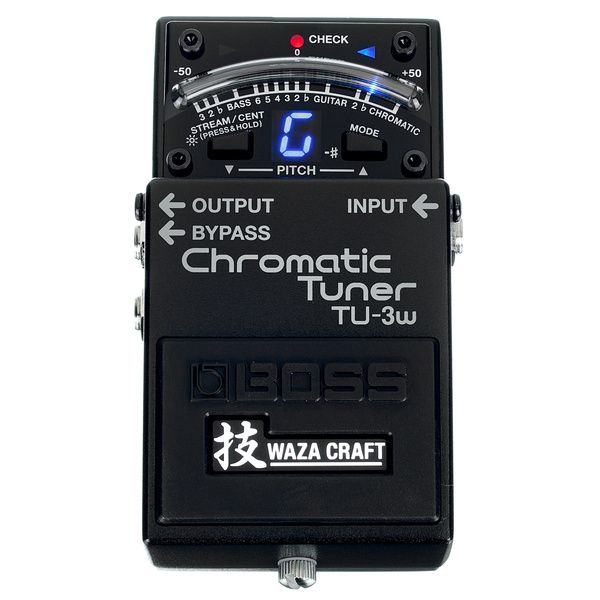
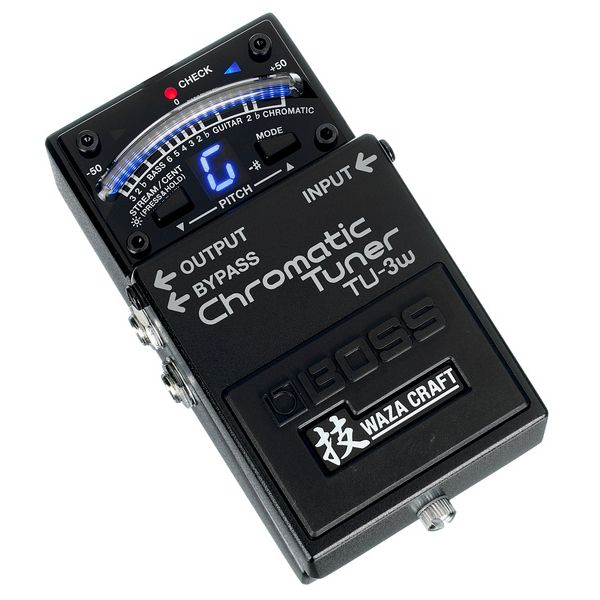
The 21-segment LED meter has adjustable brightness plus a high-brightness mode for outdoor gigs or bright stages, and the „Accu-Pitch” indicator gives you an unambiguous „yes, you’re in tune” signal rather than making you squint at a needle. On a dark stage mid-set, that clarity actually matters.
Switching between modes is quick too — a couple of button presses and you’re from standard chromatic into drop-D or further down, no digging through a menu system like some multi-function tuners make you do. For anyone who plays a mixed set spanning standard and dropped songs, that speed matters more than it sounds like it would on paper.
One more thing worth mentioning: the DC out jack means you can daisy-chain power to another pedal from here, which is a small but genuinely useful bonus if you’re tight on space on a small board and don’t want to run a separate power brick for every stompbox.
Who’s This For
Gigging players who care about tone purity and want their tuner to be a non-issue in the signal chain. If you’ve ever A/B’d your rig with and without a cheap tuner pedal in line and heard a difference, this is built to remove that variable.
It also makes sense on boards built around drop-tuning-heavy setups, since the dedicated drop-tuning mode saves you fumbling through a generic chromatic display mid-tune-change.
If you just want something functional and don’t care about the buffer situation, honestly, the regular TU-3 does the job for less. This is for the tone-nerd tier of player.
Honest Niggles
- It’s a meaningful step up in cost over the standard TU-3 for what is functionally the same tuning engine — you’re paying for the buffer and finish, not extra tuning accuracy.
- The bright green center LED can overpower the neighbouring blue segments in certain lighting, according to more than a few long-term owners — not a dealbreaker, but noticeable once you know to look for it.
- No built-in metronome or mic input — this is a pure instrument-in tuner, so if you wanted a hybrid clip-on/pedal solution, look elsewhere.
- Power supply not included — budget for a 9V PSU or battery separately if you don’t already have one on your board.
TU-3W vs the Plain TU-3
Worth addressing directly since they share a chassis and a name. The standard TU-3 is cheaper, does the tuning job just as accurately, and has been the industry-standard floor tuner for over a decade for good reason.
The TU-3W adds the switchable buffer, the more refined audio path, and a slightly classier looking blue-on-black finish. If your board is long, noisy, or passive-pickup heavy and you’re chasing every bit of tone, the buffer alone can justify the jump. If you’re just starting out or building a first pedalboard, honestly the plain TU-3 (or something even simpler) will serve you fine — spend the difference on a good amp or a drive pedal instead.
Specs at a Glance
- Type: Ground/floor pedal tuner
- Buffer: Switchable on/off (true bypass when off)
- Display: 21-segment LED meter, adjustable brightness + high-brightness mode
- Accu-Pitch Sign function for clear in-tune confirmation
- Tuning modes: Chromatic, guitar, bass, 7-string guitar, 6-string bass, drop tuning (down to -6 semitones)
- Accuracy: +/-1 cent
- Reference pitch: adjustable 436-445 Hz
- DC out jack for powering additional pedals
- Dimensions: 73 x 129 x 59 mm
- Power: 9V battery or 9V DC PSU (not included)
- Available since: August 2016
Final Verdict
The Boss TU-3W Waza Craft is a niche upgrade dressed up as a simple tuner pedal. The tuning itself isn’t more accurate than the standard TU-3 — what you’re actually buying is a genuinely good switchable buffer and a cleaner signal path wrapped in Boss’s usual tank-like build quality.
If that matters to your rig — long cable runs, passive pickups, a board full of true-bypass pedals bleeding tone — it’s a smart, mostly invisible upgrade. If you just need something that tells you you’re in tune, save the money and grab the regular TU-3 instead. Both are excellent. This one’s just for the pickier ears.