Watch It First
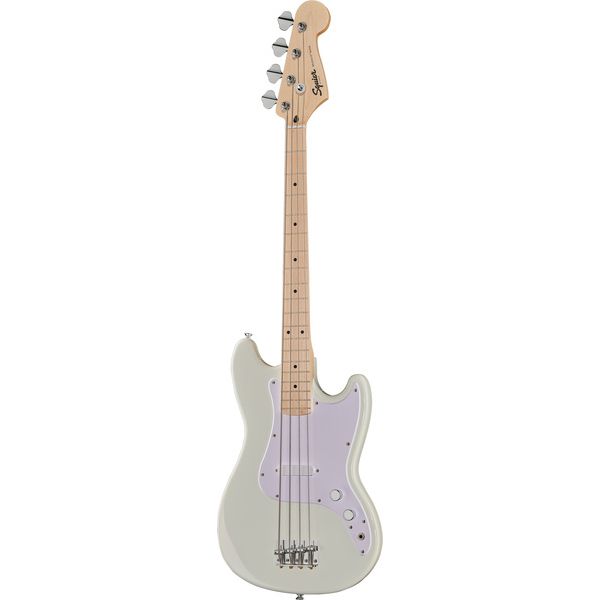
Not everyone wants a full-size 34″ bass strapped across them, and not every budget stretches to one anyway. The Squier Sonic Bronco Bass solves both problems at once – a genuine short-scale instrument at a price that barely registers as an investment.
At 30″ scale it’s roughly the same length as a Fender Mustang Bass, minus the reissue price tag. Smaller hands, students, or players just easing into bass after years of guitar tend to get on with it instantly.
It’s part of Squier’s budget-focused Sonic line, sitting right alongside the long-scale Sonic Precision. Different animal though – this one’s built around comfort and portability first, tone second (though it still delivers there too).
Short Scale, Big Tone – How Does It Actually Sound?
One ceramic single-coil pickup, one volume knob, one tone knob. That’s the whole electronics package, and it’s deliberately simple.
What surprises people is how full it sounds despite the smaller body and shorter string length. Short scale basses naturally have a slightly looser, warmer low end compared to long-scale P-Basses – think Hofner or the original Fender Mustang Bass tone rather than a modern hi-fi bass sound.
It’s not going to slap like a Jazz Bass or growl like a Warwick. But for indie, punk, dream pop, or just chunky rhythm parts, that woolier low end is genuinely charming rather than a compromise.
Rolling the tone knob back gives you a surprisingly convincing vintage thump for something this cheap. Leave it wide open and you get enough brightness to cut through a mix when you need to be heard, even through a modest amp.
Build Quality & Materials
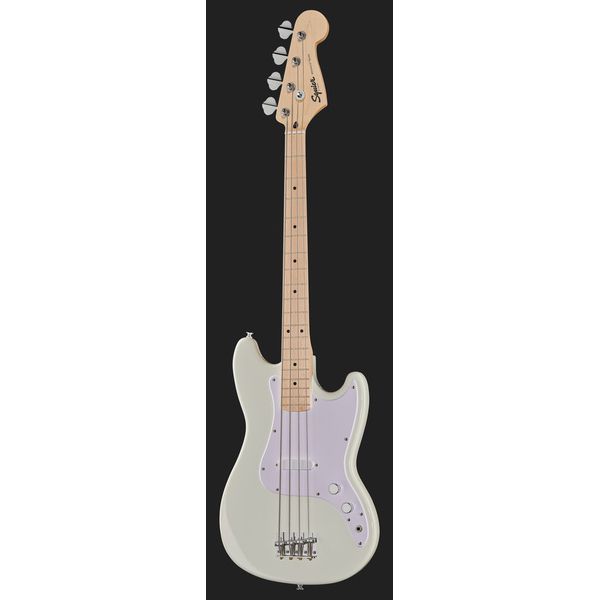
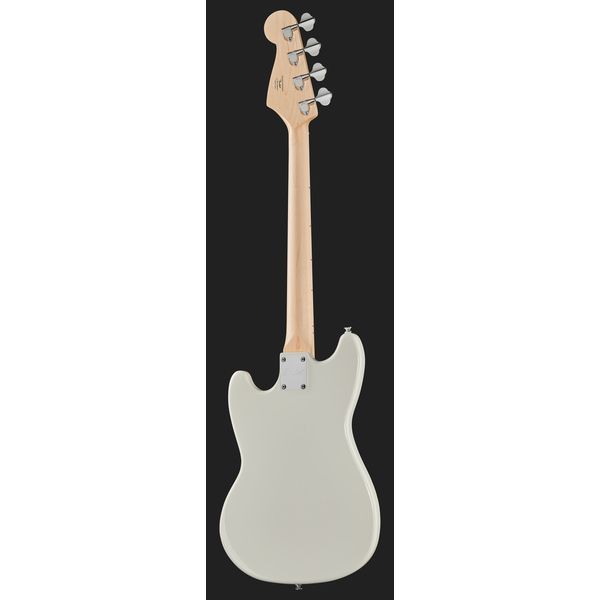
Poplar body, maple neck, maple fingerboard – all standard Squier Sonic-line fare, and all perfectly fine at this price. The 19-fret neck is noticeably stubbier than a standard bass neck, which takes a session or two to adjust to if you’re coming from a full-scale instrument.
One genuine upgrade over its long-scale Sonic sibling: this one gets sealed die-cast tuners rather than the vintage-style open-gear units. Tuning stability is noticeably better as a result, which matters more on a bass that’s likely to travel in a gig bag.
The finish work is tidy for the price too – no rough fret ends, no obvious lacquer runs on the review samples I’ve seen. Owners online report the occasional unit needing a truss rod tweak out of the box, which is fairly normal for anything at this price and easily sorted by a tech.
Weight-wise it’s noticeably lighter than a full-size bass too, which matters more than people expect once you’re two hours into a rehearsal with a strap digging into your shoulder. That alone wins over a lot of converts who came in skeptical about the shorter scale.
Playability & Who It’s For
This is the bass I’d point a guitarist toward if they wanted to dip a toe into bass without committing to a totally different-feeling instrument. The shorter neck and lighter overall weight make the whole thing far less intimidating than a full-scale P or J Bass.
It’s also a smart pick for smaller players, younger students, or anyone with wrist or shoulder issues that make a heavier long-scale bass uncomfortable over a full rehearsal. And for travelling musicians, it fits in overhead luggage in ways a 34″ scale bass simply doesn’t.
If portability is genuinely the priority, it’s worth comparing against something like the Höfner Shorty Bass, which goes even further down the compact route, or the Fender JMJ Mustang Bass if you want proper Fender pedigree at a similar scale length.
Amp & String Notes
Stock strings are fine for getting started but a touch dead-sounding after a few months – a cheap roundwound set brings noticeably more zing back into the single pickup’s voice. Worth doing before you write off the tone as „muddy.”
Through a small combo it sits nicely in a mix without much EQ fuss. Because there’s only one pickup and one tone control, there’s less to fiddle with live too – plug in, set the volume, play. For beginners still learning the instrument, that simplicity is honestly a feature, not a limitation.
Honest Niggles
A single pickup means a single tone – there’s no tonal variety here beyond rolling off the tone knob. If you want P/J flexibility, this isn’t your bass.
The factory setup benefits from the same ten-minute once-over as most budget Squiers – action tends to run a touch high from the box. And the single-coil pickup does pick up a bit of hum in noisy rooms, which is just physics at this price point rather than a specific flaw.
Small gripe, but worth knowing: shorter scale means slightly floppier string tension at standard tuning compared to a long-scale bass, especially on the low E. Some players love that feel, some don’t – worth trying before you commit if you can.
How It Compares
Against its own long-scale sibling, the Squier Sonic Precision Bass, this Bronco trades tonal versatility and traditional feel for genuine portability and comfort – it’s a different tool for a different job, not a straight downgrade.
There’s also the Squier Mini P Bass to consider if you want something even more compact with a slightly different tonal voice thanks to its split-coil pickup – worth cross-shopping if scale length matters more to you than pickup style. And compared to budget alternatives from other brands, the Bronco holds its own mainly because Fender-family quality control tends to be a notch more consistent than the ultra-cheap no-name short scales flooding the market right now.
If you want a full-scale beginner bass with more tonal range, the Squier Affinity P Bass PJ is the better all-rounder. If offbeat looks matter to you as much as tone, the Squier Affinity Jaguar Bass H is worth a look too.
Pair any of these with a compact practice amp like the Ampeg BA-108, or something with more punch for jam sessions like the Orange Crush Bass 50.
Specs at a Glance
- Body: Poplar
- Neck: Bolt-on maple
- Fingerboard: Maple, 241mm radius
- Scale: 30″ (762mm) short scale
- Frets: 19, narrow/high
- Pickup: Ceramic single coil
- Controls: 1x volume, 1x tone (passive)
- Bridge: 4-saddle standard, chrome
- Tuners: Sealed die-cast
- Nut: Synthetic bone, 38.1mm width
Final Verdict
The Squier Sonic Bronco Bass isn’t trying to be your forever bass, and that’s fine – it’s trying to be the easiest possible way into playing one. Comfortable neck, surprisingly warm tone, and a price that makes it a no-brainer as a second bass or first-ever purchase.
If you’ve got small hands, tight budget, or just want something that lives happily in a gig bag on public transport, this ticks every box. Just don’t expect P/J versatility – that’s not what it’s here for.