Watch It First
Every pedal company eventually makes their version of „Marshall in a box.” JHS’s take is called the Angry Charlie, and the name is not subtle.
It’s meant to get you into JCM800 territory without hauling an actual JCM800 anywhere.
Does it actually pull that off? Mostly yes, with a couple of asterisks worth knowing about.
What’s Under the Hood
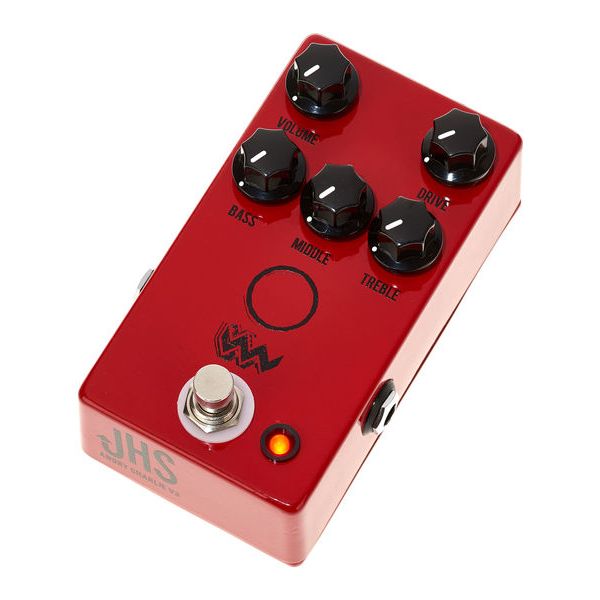
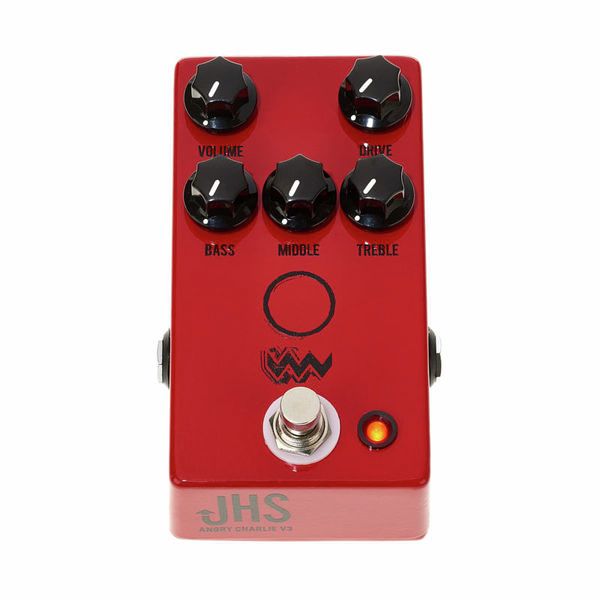
Layout is simple: Volume, Drive, Bass, Middle, Treble. A proper 3-band EQ on a distortion pedal is still rarer than it should be.
True bypass, jack in and out, powered by 9V DC only – no battery option, so plan your power supply accordingly.
It’s designed to emulate the sound of a cranked British high-gain amp being pushed hard, which is a very specific and very useful thing to have on tap when your actual amp can’t (or shouldn’t) get that loud.
Does It Sound Like a JCM800?
Close. Closer than most pedals in this price range manage, honestly.
There’s a thick, sagging mid-range that feels distinctly amp-like rather than fizzy-pedal-like. Scoop the mids and it edges toward more modern high-gain territory – some players compare it to a Friedman BE-OD in that setting, which is high praise for something this price.
Push the Drive knob and things get properly aggressive without turning to mush. It tracks pick dynamics well, which matters a lot if you’re switching between rhythm chugging and lead runs on the same setting.
If your amp’s already a bit dark or bass-heavy, like a lot of boutique valve combos can be, this pedal’s treble control gives you real room to brighten things up – unlike some fixed-voicing drives that just add gain and hope for the best.
Worth knowing: JHS liked this circuit enough to license a version of it to Boss for their JB-2 Angry Driver, which pairs it alongside a Blues Driver in one enclosure. That should tell you something about how well-regarded this specific gain structure is within the pedal world – it’s not just another Marshall clone, it’s the one other companies wanted to borrow.
Playing Feel and Build
It responds well to guitar volume knob cleanup, which any real amp-in-a-box pedal needs to nail. Roll back and you get a cleaner crunch, not a weird digital-sounding artifact.
Build quality is what you’d expect from JHS – solid metal enclosure, chunky true bypass switching, nothing fragile about it. This thing will survive a tour.
Works great with humbuckers on something like a Les Paul-style guitar for that thick rock crunch, but single coils hold up too if you want more definition and less mud.
Gain staging matters a lot with this pedal. Running it into an already-driven tube amp gets messy fast – it’s happiest either as your sole gain source into a clean channel, or stacked carefully with a low-gain boost in front for extra push. Treat it as the main event, not a garnish, and it behaves.
Who’s This For?
- Rock and metal players who want JCM800-style gain without lugging a stack
- Bedroom players who need high-gain tone at reasonable volumes
- Anyone using low-headroom amps who wants a genuinely amp-like drive
- Players who want real EQ control instead of a single tone knob
If you’re specifically chasing metal tones, it’s worth reading our roundup of the best tube amps for metal to see how a pedal like this slots into a bigger rig, or check our best amp heads for metal guide for the full picture.
One more thing that doesn’t get mentioned enough: the Middle control is doing more work than you’d expect from a single knob. Most cheaper „amp in a box” pedals fake a mid-range shift by messing with gain structure alone, but this one actually sweeps a proper mid frequency, so you can go from scooped metal voicing to boxy vintage crunch just by turning one dial. That flexibility alone justifies the asking price for a lot of players.
The Honest Niggles
It’s noisy. Not unusably so, but if you’re not gating or cutting the signal between phrases, you’ll hear hiss creep in, especially at higher gain settings. Worth knowing before you build a set around it.
The treble range, while useful, isn’t infinite – a couple of players have found it a bit dark paired with already-dark amps. Pair it with something brighter if that’s a concern for your rig.
It’s also currently a bit of a wait to get hold of one depending on stock, so if you need something today, have a backup plan.
And obviously, if what you actually want is transparent, low-gain overdrive rather than saturated distortion, this isn’t your pedal – something like the MXR Custom Shop Timmy lives in a completely different world tonally.
How It Stacks Up
Against other JHS drives it’s the heaviest hitter by a good margin – most of their lineup leans overdrive, this one leans distortion. If you’re pairing it with a wah for solos, the Dunlop Cry Baby is the obvious classic partner.
On a budget rock rig – say something built around an Ibanez GRGA120 – this pedal genuinely punches above its price bracket for tone quality.
Specs at a Glance
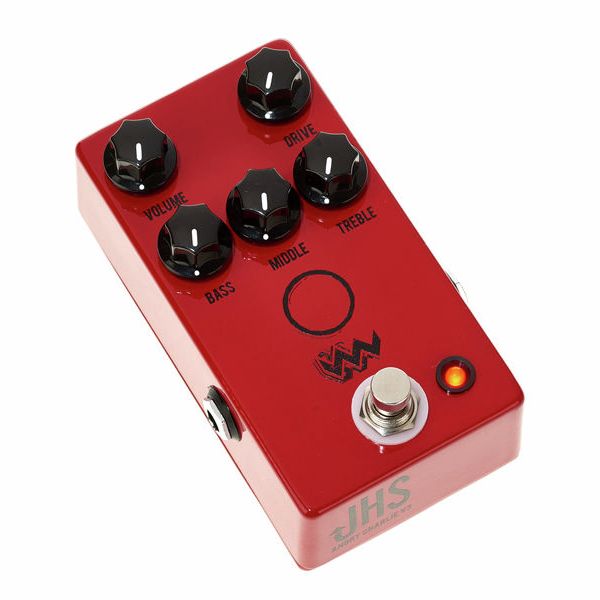
- Type: Distortion / amp-in-a-box
- Controls: Volume, Drive, Bass, Middle, Treble
- Bypass: True bypass
- Power: 9V DC (not included), no battery option
- Connections: Standard 6.3mm jack in/out
- Housing: Metal, made in USA
Final Verdict
The Angry Charlie V3 does what it says on the tin – proper British high-gain tone in a box, with enough EQ range to actually shape it rather than just turning up one knob and hoping.
It’s not the quietest pedal on the market and it’s not for anyone chasing subtlety. But if you want a JCM800-style roar without the volume, the weight, or the price of a real stack, this genuinely delivers.
For rock and metal players building a serious pedalboard, it’s a legit contender – just budget for a noise gate if you’re playing anything with quiet passages.