Watch It First
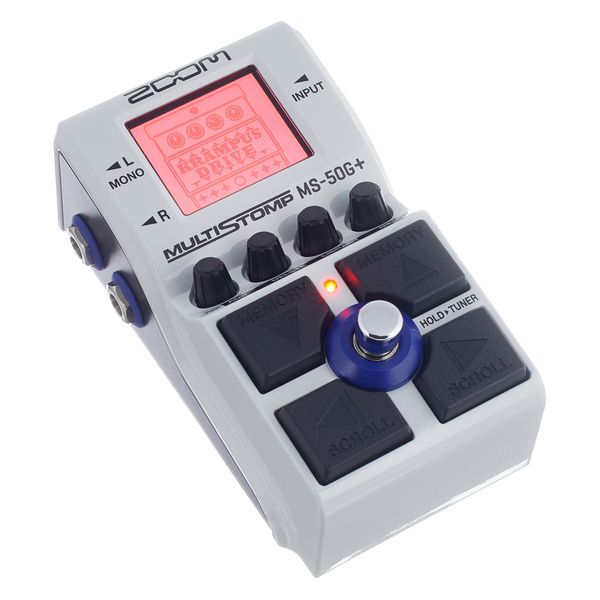
Quick heads up before we start: the original Zoom MS-50G has been replaced by the Zoom MS-50G+. Same tiny footprint, same „100+ effects in a box the size of a phone” pitch, but with a proper chromatic tuner and USB-C added in.
So that’s what we’re covering here — the current version you’ll actually find in stock, not a discontinued unit collecting dust in a warehouse somewhere.
And honestly? It’s still one of the best „one pedal to rule them all” options on the market, especially if your pedalboard budget is tight.
What You Actually Get in This Tiny Box
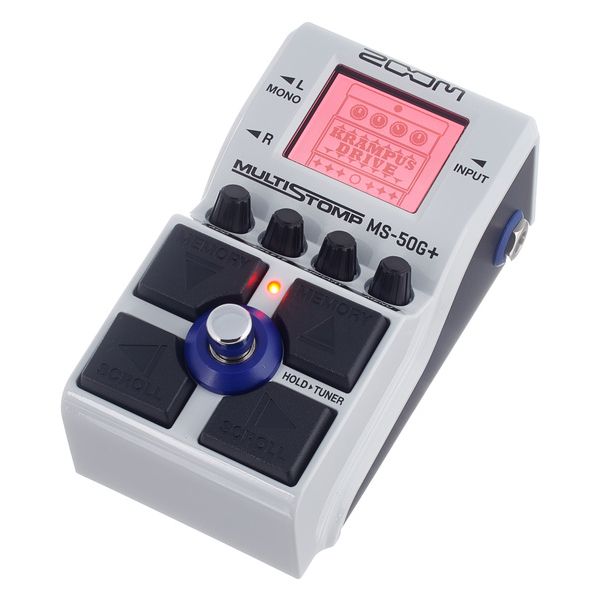
Zoom crammed drive, modulation, delay, reverb, compression, filters and a bunch of special effects into a single stompbox — up to 100 of them, drawn from Zoom’s much bigger multi-FX units. You can stack up to six at once.
That’s the whole appeal here. Instead of buying a separate overdrive, a chorus, a delay and a reverb — think something like the MXR Custom Shop Timmy plus three other boxes — you get a chunk of that tonal territory in one unit roughly the size of a deck of cards.
Is it going to sound identical to a boutique pedal chain? No, obviously not. But for the price, the breadth of usable tones is genuinely impressive.
The App Makes It Way Less Fiddly
Editing patches on the pedal itself with that small LC display can get tedious — small screen, small buttons, lots of scrolling. That’s where the Handy Guitar Lab app comes in.
Connect over USB-C, and you can build and edit patches on your phone screen instead of squinting at a 160×128 pixel display. It’s iOS only right now, which is a bit annoying if you’re on Android, but it’s a genuine quality-of-life upgrade over the old workflow.
On the Pedalboard
At 353g and a metal chassis, this thing feels way sturdier than its size suggests. It’ll survive being stomped on at a bar gig, which is more than you can say for some plastic-bodied multi-FX units twice its size.
You can run it off two AA batteries or a standard 9V center-negative PSU (not included — grab a Thomann NT 0910 or similar if you need one). Battery power is a nice touch for buskers or anyone who hates dealing with power supply chains.
Sound Quality — Is It Actually Good, or Just Cheap?
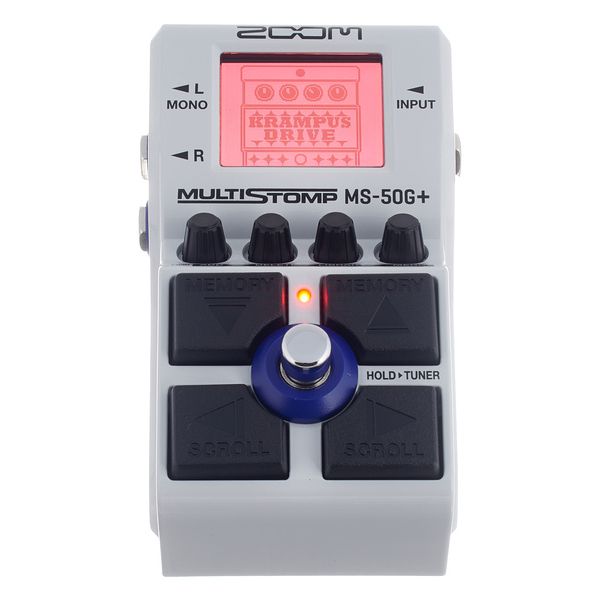
Here’s the honest take: the drive and distortion algorithms are decent but won’t fool anyone who’s used to a proper analog overdrive. The modulation effects (chorus, phaser, flanger) are genuinely strong though, and the delays and reverbs punch well above what you’d expect at this price.
Think of it less as a replacement for your dream pedalboard and more as a Swiss Army knife. If you want a dedicated pitch-shift effect that actually nails the job, something like the DigiTech Whammy 5 will still beat the MS-50G+’s built-in pitch effects. But for 90% of gigging and practice situations, this covers the ground just fine.
Reverb-heavy ambient textures, similar territory to something like the EHX Mel9 chases, are also surprisingly usable straight out of the box.
Great for Bedroom Players Too
You don’t need a full pedalboard to get value from this. Plug straight into an audio interface or amp, dial in a patch, and you’ve basically got a mini effects rack for practicing at home.
It’s a solid pickup if you’re building out your first real setup — check our roundups on pedals for jazz players or pedals for worship guitarists for context on where a unit like this slots in next to more specialized boxes.
How It Compares
The obvious rivals are the Valeton GP-5, Mooer’s Prime series, and Harley Benton’s DNAfx GiT. The Valeton and Mooer units generally offer more amp modeling depth, but the Zoom wins on build quality and that simple, tactile single-footswitch workflow.
Bass players have their own version too — the MS-60B+ — worth a mention if you’re shopping for a bandmate rather than yourself. It’s basically this same concept tuned for low end, in the same spirit as gear covered in our cheap bass pedals roundup.
Honest Cons
Single footswitch means patch changes require a bit of choreography if you’re mid-song and need to hit multiple effects fast — there’s no expression pedal input either, which some players will miss for wah or volume swells.
The Handy Guitar Lab app being iOS-only is a real miss for Android users. And a few reviewers report background noise when powering via USB-C instead of a proper 9V supply — stick to battery or PSU power for gigging.
Specs at a Glance
- Up to 100 effects: drive, modulation, delay, reverb, compressor, filter, special FX
- Up to 6 simultaneous effects
- Built-in chromatic tuner
- 160 x 128 pixel LC display
- USB-C for data transfer and Handy Guitar Lab app (iOS)
- Powered by 2x AA batteries or 9V DC PSU (center-negative, not included)
- Metal housing
- Dimensions: 133 x 79 x 61 mm
- Weight: 353 g
Setting Up Your First Patches
If you’ve never used a Zoom multi-effects unit before, give yourself an evening to actually dig into the patch editing before a gig. The stock presets are fine as a starting point, but they’re generic by design.
Spend some time building two or three go-to patches — a clean/chorus combo for verses, an overdrive/delay stack for leads, maybe a reverb-heavy ambient patch for intros. Once you’ve got those dialed in and saved, the single footswitch workflow stops feeling limiting and starts feeling efficient.
Worth noting too: because it’s USB-C powered for editing, you can leave it plugged into a laptop while you tweak patches on the couch, which is a nice change from earlier Zoom units that needed a separate editor cable.
Final Verdict
The Zoom MS-50G+ is exactly what it says on the tin: a stupidly compact multi-effects box that replaces a chunk of a pedalboard for not much money. It’s not going to replace a serious boutique drive or a dedicated delay for tone snobs, but that’s not really the point.
For gigging musicians who want backup options, bedroom players building their first rig, or anyone who just wants to experiment with 100 effects without spending 100 pedals’ worth of money — this is a genuinely easy recommendation.