Watch It First
The Vox AC30 chime is one of those tones every guitarist chases sooner or later. Jangly and glassy on clean, snarly and compressed once you dig in, it’s iconic for a reason.
Universal Audio’s Ruby ’63 crams that whole amp, cabs and mics included, into a stompbox you could lose in a gig bag pocket.
Does it actually nail it, or just get you close enough? Let’s dig in.
What’s Actually Inside the Box
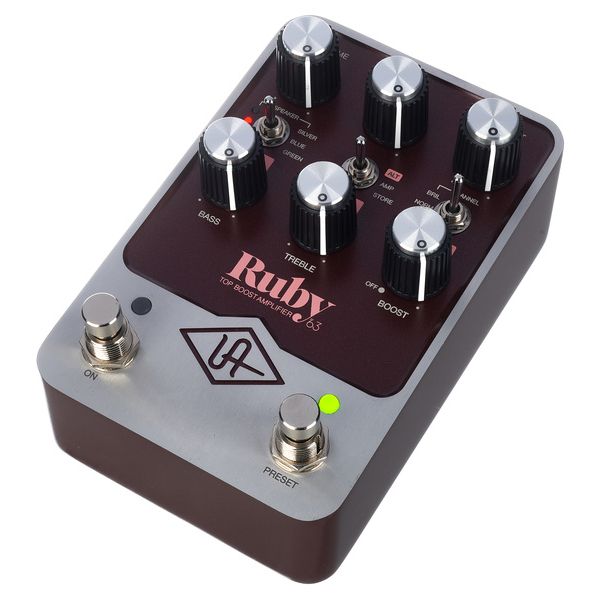
The Ruby ’63 isn’t your typical amp-in-a-box overdrive pedal. It’s a full amp and cabinet simulator built around UA’s Dynamic Speaker Modeling, the same tech that powers their standalone OX gear.
It models the Normal and Brilliant Top Boost channels from a real ’63 AC30, plus that wobbly, slightly seasick vibrato channel players either love or ignore completely.
You get three cab and mic pairings built right in – a genuinely rare Silver Celestion Bulldog, a Blue Bulldog, and a more modern-voiced G12H. Three very different flavors of Vox, all from one footswitch tap.
More Cabs Than You’ll Ever Actually Need
Plug into the free UAFX Control app and there’s more hiding underneath. An AC15 cab loaded with a Blue Bulldog. A Matchless 2×12 loaded with G12Hs. Even a Two-Rock cab loaded with Celestion Golds, for players chasing that boutique clean tone.
It’s the kind of cab depth that would normally cost you a rack of real cabinets and a small army of mic stands. Here it’s a scroll wheel and a tap.
If you’ve read our piece on the best overdrives for Vox amps, you already know how particular these amps are about what you put in front of them. Worth keeping in mind before stacking three drive pedals in front of the Ruby and wondering why it sounds thin.
Does It Actually Feel Like a Tube Amp?
Short answer: closer than you’d think, but not identical. Pick attack translates well – dig in hard and the Ruby compresses and breaks up roughly the way a real AC30 does once you push it past clean.
Where it can’t fully fake things is under your hands at bedroom volume. A real tube amp moves air and pushes back at you physically; a pedal running into your monitors or a DI just can’t replicate that, no matter how clever the modeling is.
That’s true of pretty much every amp-in-a-box, honestly, not a knock specific to UA. We ran into the same conversation testing the MXR Custom Shop Timmy against an actual tube gain stage – modeling gets you 90% of the way there. The last 10% is just physics.
Setting It Up Isn’t a Headache
Pairing the pedal to the UAFX Control app takes a couple of minutes over USB-C or Bluetooth, and from there it’s mostly drag-and-drop. Pick a cab, pick a mic position, save it to one of the onboard presets, done.
The two footswitches handle channel and boost by default, but they’re reassignable, so gigging players can set one up as a straight bypass if that’s more your workflow. Presets recall instantly – no MIDI rig required.
Build Quality and Control Layout
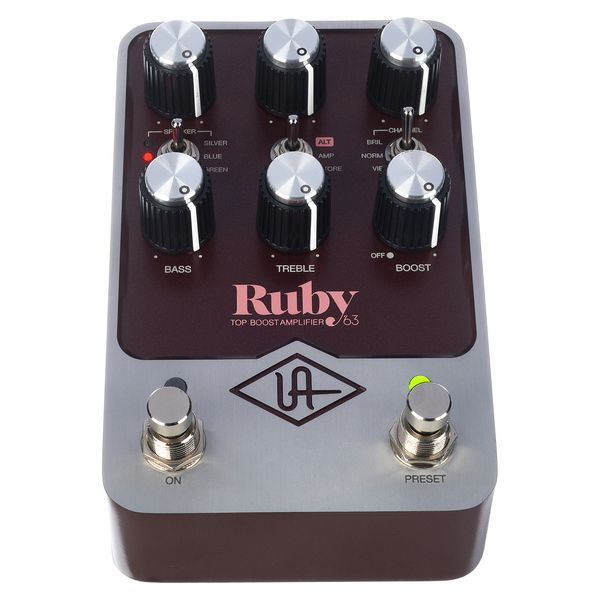
It’s a solid, all-metal enclosure that feels like it’ll survive actual gig use, not just bedroom noodling. Six knobs across the top cover Gain, Bass, Treble, Cut, Volume and Reverb, with a small LED per footswitch so you can see what’s active at a glance even under bad stage lighting.
Nothing about the layout feels cramped, which is more than you can say for a lot of multi-function pedals this size.
The Vibrato Channel Deserves Its Own Mention
It’s easy to overlook vibrato on a „clean tone” pedal, but the Ruby’s is genuinely usable, not just a novelty tacked on to tick a spec-sheet box. Depth and speed controls are responsive enough to go from a subtle wobble to full seasick surf territory.
Where the Ruby ’63 Comes Up Short
- No onboard power supply – you’ll need a separate 9V DC, 400mA supply with negative center. UA sells a matching one, but it’s not in the box.
- No expression pedal input, so there’s no swelling the vibrato depth live with your foot.
- Pricing sits well above a basic overdrive pedal, which stings if you just wanted a Vox-flavored boost rather than a full amp replacement.
- If you already own a great tube amp, this is a travel and silent-stage tool, not really an upgrade over what you’ve got.
Who Should Actually Buy This
Gigging guitarists who can’t or don’t want to haul a combo are the obvious audience. Pair it with IEMs or a powered wedge and you’re covered for most rooms.
Same goes for anyone building a shoegaze pedalboard – the Ruby’s vibrato and cab choices make a genuinely nice clean base to stack modulation and reverb on top of, without lugging an actual combo to practice.
Worship and covers players who need reliable, quiet-stage clean tones will get a lot out of it too. It pairs naturally with the kind of setups we cover in our worship pedalboard guide.
UAFX Ruby ’63 vs a Real AC30
If budget and space are no object, nothing fully replaces a real AC30 – the way it responds to a room, the sag, the actual moving air. But most of us don’t have a spare few grand and a van to haul it in.
For players who’d otherwise be shopping for a whole new amp just to chase this tone, the Ruby is a fraction of the cost and fits in a backpack pocket.
A Few Practical Notes
The USB-C port isn’t just for firmware updates – it also works as a direct interface into your DAW, handy if you lean on creative tools like a pitch-shifting pedal for layering recorded parts.
Battery operation isn’t an option here either, FYI – it’s DC power only, so factor that into your board planning if you’re used to running everything off 9V batteries in a pinch.
Ruby ’63 Specs at a Glance
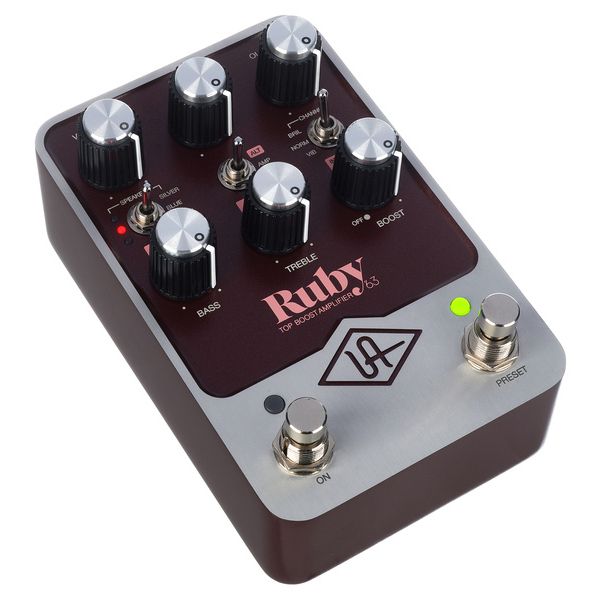
- Type: Stereo amp and cabinet emulation pedal
- Channels: Normal and Brilliant Top Boost, plus Vibrato
- Built-in cab and mic pairings: Silver, Blue and Green Celestion Bulldog combos
- Extra cabs via free app: AC15 with Blue Bulldog, Matchless with G12H, Two-Rock with Gold
- I/O: two 1/4″ inputs, two 1/4″ outputs, USB-C
- Power: 9V DC, 400mA, negative center (sold separately)
- Dimensions: 9.2 x 6.5 x 14.1 cm
- Weight: 567 g
Final Verdict
The Ruby ’63 isn’t trying to trick you into thinking there’s a real tube AC30 sitting behind you. It’s trying to get you 90% of that tone anywhere, anytime, without the weight, the volume complaints from neighbors, or the maintenance headaches of old tube gear.
For gigging players, home recordists, or anyone who’s ever wanted „that jangle” without hauling a combo up three flights of stairs, it does the job better than almost anything else this size on the market right now.
IMO it’s one of the smartest amp-in-a-box options out there – just budget for a decent power supply, because you’ll need one.