Watch It First
Real valve tone usually means a heavy box full of glass and high voltage. The Vox MV50 series throws that assumption out the window.
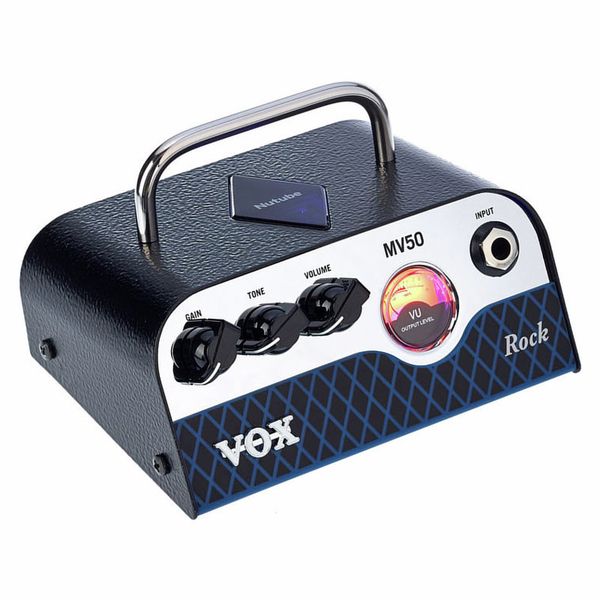
It’s a 50-watt amp head that weighs about as much as a phone charger, and it’s built around Korg’s tiny Nutube valve rather than a normal 12AX7.
I want to dig into how a genuine valve fits into something this small, how the Rock voicing actually sounds, and whether it’s a smart buy in 2026.
What’s Actually Inside This Thing
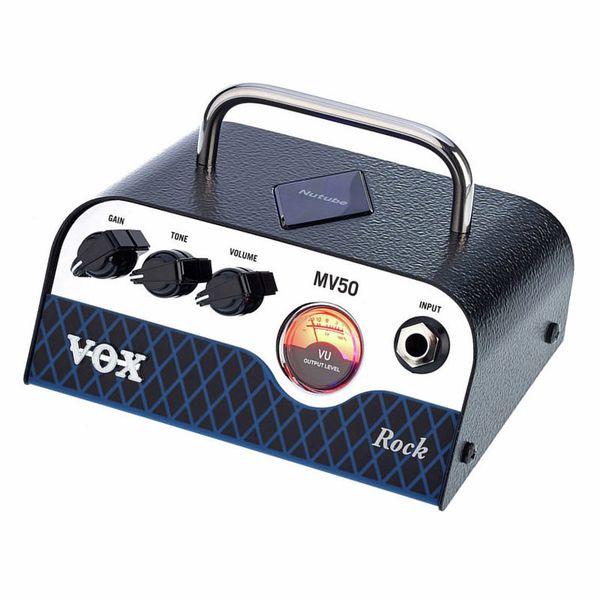
Nutube is a real, physical vacuum tube – it just happens to be built using flat-panel display manufacturing techniques instead of old-school glass-blowing. It’s genuinely tiny and sips almost no power compared to a standard preamp valve.
Vox pairs that Nutube preamp stage with a Class D power amp section, which is where the „cleverly” part of this whole thing comes in. You get real analogue valve character driving the tone shaping, then an efficient digital stage doing the heavy lifting for volume.
It’s Genuinely Tiny
We’re talking 135 x 75 x 100mm and 540 grams. It fits in a jacket pocket, sits on top of a cab with room to spare, and won’t add any meaningful weight to a gig bag.
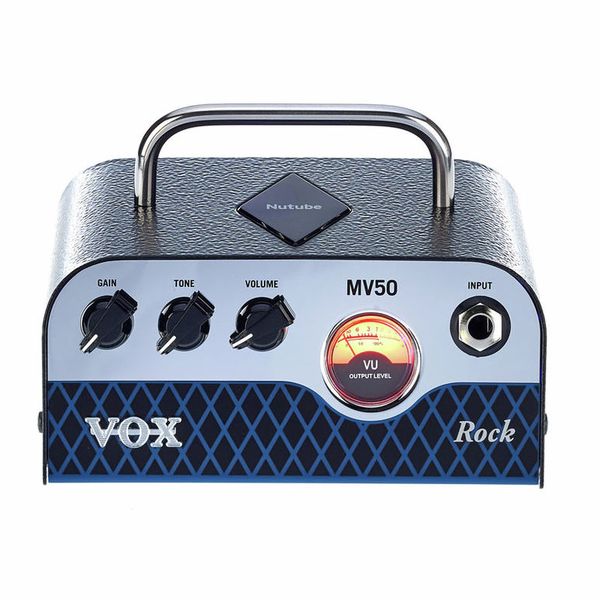
Controls are kept dead simple: gain, EQ, volume, an ECO mode switch, and a back-panel EQ switch to match it to your cab. No menus, no presets to scroll through.
How the Rock Voicing Sounds
The „CR Rock” model is voiced with more midrange push and a hotter gain structure than the Clean version, aimed squarely at classic rock and crunch tones.
Push the gain and it breaks up in a genuinely convincing, tube-like way – not the harsh digital clipping you sometimes get from cheaper modeling gear. There’s real touch sensitivity too, which is usually the first thing to disappear with fake valve tones.
You Still Need a Cab
Worth being clear on this: the MV50 is a head, not a combo. You’ll need a speaker cabinet to actually play through it, or you can use the built-in speaker-simulated headphone/line output for silent practice.
That headphone output is actually a genuinely good silent-practice option, similar in spirit to what we covered in our Orange amps roundup when comparing the Micro Terror – another tiny head that punches well above its size.
Setting It Up on Your Board
Getting the MV50 running takes about as long as it takes to unbox it. Plug your guitar into the input, run a speaker cable from the output to your cab, connect the included 19V power supply, and you’re playing.
The ECO mode switch is a nice touch for practical use – it dials back the power draw when you don’t need the full 50 watts, which also seems to smooth out the low end slightly at bedroom volumes.
The VU meter on the front isn’t just decoration either – it gives you a rough visual read on your output level, which is handy when you’re running direct to a PA or an interface and can’t rely on your ears alone to avoid clipping.
Build Quality
The retro-styled metal chassis feels far sturdier than the tiny footprint suggests. There’s a solid carrying handle on top, and the whole unit has the kind of reassuring heft-per-gram that makes you trust it on a gig.
Given it’s been on the market since 2017 and still sits at a 4.8-star rating, reliability doesn’t seem to be a concern here – these things just keep working, year after year.
Where This Fits in Your Rig
This is the kind of amp that makes sense as a second rig, not necessarily your only one. Backup for gigs, a grab-and-go option for jam sessions, or a way to run your existing cab without hauling a full head and power amp.
It also plays nicely with a pedalboard, since there’s no built-in modeling or effects to fight with your own pedals. If you’re the type who runs an overdrive like the MXR Custom Shop Timmy into your amp, the MV50 will just get out of the way and let your pedals do the talking.
Worship and church players who need low-volume stage rigs have also gravitated toward heads like this – it’s worth a look alongside our best pedals for worship roundup if that’s your world.
MV50 vs a Full Combo
If you want one box that does everything – amp, speaker, effects – something like the Boss Katana 50 Gen 3 is going to be the easier, more complete purchase for most players.
The MV50 makes more sense if you already own a cab, want genuine analogue tube tone in your signal path, or need something ultra-portable that still sounds like a real amp rather than a simulation of one.
One more thing worth mentioning: because it’s so light and small, it travels well. Musicians who fly to gigs regularly have adopted these as a way to bring „their tone” along without checking a full amp head as luggage.
Pair it with a small pedalboard and a lightweight cab, and you’ve got a genuinely gig-ready rig that fits in a backpack and a guitar case, rather than a van.
The Honest Cons
- Requires a separate speaker cabinet – not a complete rig on its own
- No onboard effects or reverb
- Only one voicing per model – buy Clean or Rock, not both in one box
- VU meter and retro styling are cool, but purely cosmetic
None of these are really flaws so much as trade-offs that come with the format. You’re buying a specialist tool, and it’s honest about what it is.
Vox MV50 CR Rock – Full Specs
- Type: Hybrid analogue/digital amp head
- Preamp: Nutube analogue valve technology
- Power amp: Class D, 50 Watts
- Controls: Gain, EQ, Volume, ECO mode, back-panel EQ switch
- Outputs: Speaker output, line/headphone output with speaker simulation
- Impedance select: 4, 8, or 16 Ohm
- Weight: 540g
- Dimensions: 135 x 75 x 100mm
Final Verdict
The Vox MV50 CR Rock is a genuinely clever piece of engineering. It takes something that used to require a heavy chassis full of components and shrinks it down to fit in your hand, without faking the valve part.
With a 4.8-star average from 24 reviews, the people who’ve bought one clearly agree it delivers. It’s not the amp for everyone, but for the right player – someone who wants real tube tone in the smallest possible package – it’s hard to beat.
If „analogue valve modelling done cleverly” is exactly the kind of gear that gets you excited, this one’s worth a serious look.