Watch It First
The Fender ’65 Princeton Reverb has been the quiet legend of the blackface family since 1965, and Fender never really messed with the formula.
It’s not the amp people show off on Instagram. It’s the one session players actually reach for once the tape starts rolling.
I got proper time on one recently, and yeah, it lives up to the reputation. Small box, big attitude.
What’s Actually Under the Hood
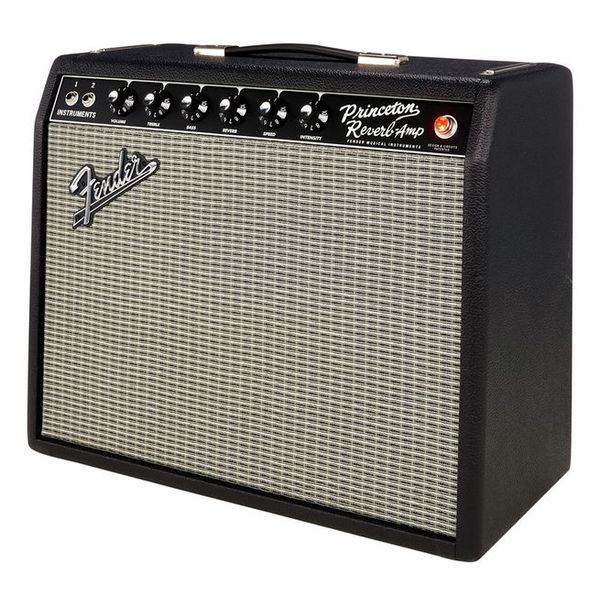
This is a Vintage Reissue, so it’s built to the same spec as the originals – not a modern reinterpretation with extra knobs bolted on.
You get 12 watts, one channel, and a single 10″ Jensen C-10R speaker doing all the work.
Power comes from a pair of 6V6GT tubes, the same combo that gives Fender’s small combos that slightly compressed, chimey breakup once you push past halfway.
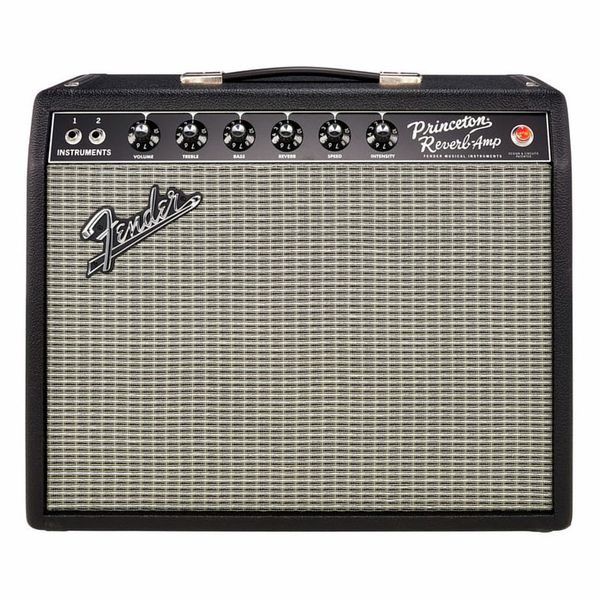
Controls are dead simple: Volume, Treble, Bass, Reverb, Speed, Intensity. That’s it. No mid knob, no channel switch, no gain stage to fiddle with.
The Reverb and Tremolo Are the Whole Point
Spring reverb on this thing is proper – not a digital emulation, an actual tank rattling away inside the cab.
Crank it and you get that surf-y, splashy decay that sounds like a 1965 studio, because it basically is that circuit.
Tremolo (Speed and Intensity) is the other half of the personality – warm, pulsing, and genuinely usable rather than a gimmick knob nobody touches.
Together they’re why this amp shows up on so many classic and modern recordings alike. It’s a one-trick pony, but it’s a really good trick.
Playing It: Clean, Then Breaking Up
Below about 5 on the volume knob you’re in gorgeous clean territory – glassy, articulate, with just enough compression to feel alive under your fingers.
Push past 6 or 7 and the 6V6s start to sag and crunch in that lovely blackface way. It’s never going to do metal, but for blues, indie, surf, and clean-to-crunch rock it’s genuinely special.
FYI, at 12 watts this thing gets loud before it breaks up properly – a lot louder than the wattage number suggests, because tube watts and solid-state watts are very different animals.
Worth noting: this isn’t a loud-stage amp on its own, and it was never meant to be. Fender built the Princeton for exactly the role it still fills six decades later – a grab-and-go combo for players who value tone over volume.
Build Quality and Look
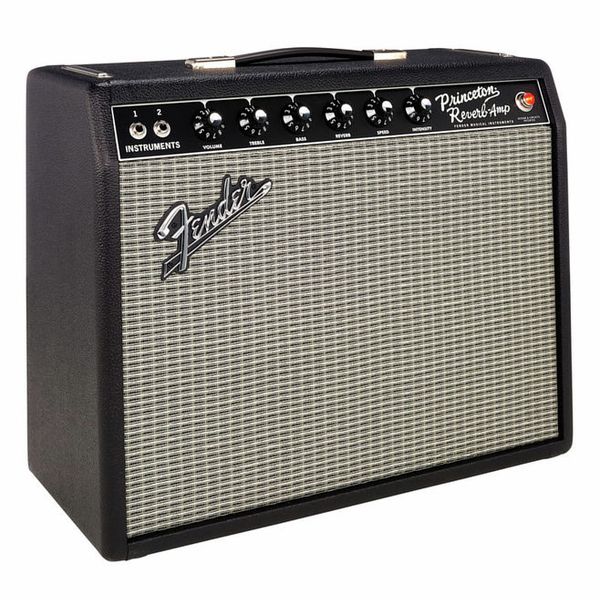
It’s got the classic black tolex, silver grille cloth, and that unmistakable Fender script logo – if you want your rig to look the part, this ticks every box.
Fit and finish is what you’d expect from Fender’s reissue line – solid, no rattles, nothing feels like it’s held together with hope.
At just under 16kg it’s genuinely portable for a tube amp this size. One hand, no problem, unlike its bigger Deluxe and Twin siblings.
Mic’d Up vs Bedroom Volume
In the room, the Princeton is lovely but modest. It won’t fill a big stage on its own.
Mic’d up in a studio or through a PA, though, it’s a completely different story – that’s genuinely why so many session engineers reach for it over bigger amps.
If you’re gigging small rooms and can mic it, you’ll get more usable tone out of this than a much louder solid-state combo.
Who Should Actually Buy This
Studio players and home recordists who want real blackface tone without hauling a Twin Reverb up the stairs.
Blues and indie players who live in clean-to-slightly-dirty territory and care more about touch response than gain.
Anyone who’s already tried a modeler or a Blues Junior-style amp and wants to hear what the „real thing” actually sounds like. If you want a cheaper way into that same neighbourhood first, my Fender Blues Junior IV review is a good place to start.
Basically: if you’ve ever wondered what all the fuss over „blackface tone” is actually about, this is the cheapest legitimate way to find out from the source rather than an emulation of it.
Where It Falls Short (Honest Cons)
One channel, no effects loop, no built-in overdrive channel. If you want high-gain tones you’ll need pedals or a different amp entirely.
12 watts of tube power is still genuinely loud at full clean headroom. Late-night bedroom practice at „amp sounds its best” volumes isn’t really realistic without an attenuator.
It’s not cheap for what is, circuit-wise, a pretty simple amp. You’re paying for the Fender name, the reissue spec, and the tone – not extra features.
No MIDI, no recording output, nothing modern. This is a 1965 amp built today with a twist of updated tolerances and nothing else.
How It Stacks Up
If your budget doesn’t stretch this far, the Blues Junior IV linked above gets you into similar blackface-adjacent territory for a lot less.
Prefer more headroom and a bigger stage sound? The Peavey Classic 30 is a solid, road-tested alternative that trades some of the Princeton’s delicacy for raw volume.
If you’re chasing gain rather than sparkle, this amp genuinely isn’t for you – check my roundup of the best tube amps for metal instead, the Princeton doesn’t even make that list.
Want a broader shortlist before committing to anything? My guides to the best amps for distortion and overdrive and the best amps for indie rock both cover very different territory to this one, worth a read for context.
Curious what a scaled-down single-tube option sounds like instead? The Harley Benton DC Junior review is a good comparison point at a fraction of the price – not the same league, but interesting context.
Specs at a Glance
- Series: Vintage Reissue (Blackface)
- Power: 12W
- Channels: 1
- Speaker: 1x 10″ Jensen C-10R
- Power tubes: 2x 6V6GT
- Controls: Volume, Treble, Bass, Reverb, Speed, Intensity
- Footswitch: included (2-button)
- Weight: approx. 15.7kg
Final Verdict
The Fender ’65 Princeton Reverb isn’t trying to be everything to everyone, and that’s exactly why it works.
It does blackface clean and light breakup better than almost anything else at this size, and the spring reverb and tremolo alone justify a lot of the asking price.
If your music lives in clean-to-crunch territory and you want the real deal rather than a simulation of it, this is about as close to definitive as it gets. IMO it’s one of those amps you buy once and never really want to sell.