Watch It First
Let’s be honest about what this is: the Harley Benton PB-50 is about the cheapest way to get a real, classic Precision Bass thump. And I mean properly cheap.
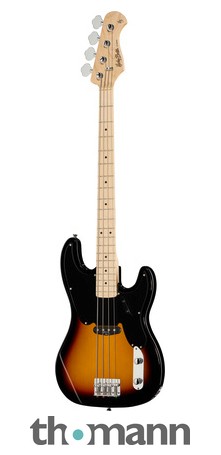
It’s a ’50s-style P-Bass – maple neck, maple board, split-style single coil, sunburst gloss – at a price that barely counts as a purchase. FYI, this is the bass people buy on a whim and then keep for years.
So how much corner-cutting is hiding behind that tiny price? Less than you’d think. Let’s dig in.
First Impressions
Straight out of the box, the 2-colour sunburst looks the part. The high-gloss finish is even, the maple neck is bright and clean, and it genuinely doesn’t scream “budget” from across the room.
Is it flawless? No. But for what it costs, the fit and finish is honestly a bit of a shock. IMO Harley Benton has this end of the market completely stitched up.
That All-Maple Look
The maple fingerboard is the star here. It gives that snappy, bright ’50s vibe both visually and tonally, and it feels fast under the fingers.
The basswood body keeps it light, and the C-profile neck is comfortable with a sensible 42mm nut. It’s an easy bass to spend an evening with.
The P-Bass Thump, On a Budget
Plug in and there’s that familiar Precision voice. The Roswell Alnico-5 split-style pickup does the classic P thing – warm, round, thick lows and a solid punch that sits right in a band.
It’s not going to fool anyone into thinking it’s a vintage Fender, but blindfolded in a mix? It gets shockingly close. For rock, blues, punk and pop, it just works.
What it does well:
- Classic P-Bass thump for rock and punk
- Warm fingerstyle for blues and soul
- A cracking first bass that won’t hold a beginner back
- A cheap, dependable backup or project bass
The Perfect Modding Platform
Here’s the fun part. Because it’s so cheap, the PB-50 is the go-to canvas for tinkerers. New pickup, new bridge, fresh strings, a proper setup – and suddenly you’ve got a bass punching way above its money.
Even totally stock, though, it’s gig-able. The upgrades are a fun option, not a requirement, and that’s exactly how a budget bass should be.
How It Plays
Out of the box it usually needs a setup – that’s true of basses costing ten times as much, so no complaints there. A truss tweak, a bit of action and intonation, and it plays really nicely.
The dual-action truss rod is a genuinely useful touch at this price, making that setup easy. Fretwork on mine was tidier than expected, with no nasty sharp ends.
It’s a simple, honest instrument – one volume, one tone, no surprises. Plug in and thump.
The Niggles
The stock strings are basic and the pickup, while good, is the obvious first upgrade if you get bitten by the modding bug.
The hardware is fine but not fancy – the tuners and bridge do the job without feeling premium. Again, at this price, that’s completely fair.
You will almost certainly need to set it up yourself or pay a tech, so factor that in if you’ve never done it before.
Who Should Buy One?
Total beginners who want a real P-Bass without the risk. Guitarists who need a bass for recording. Anyone after a cheap, fun modding project or a knockabout backup.
If you can stretch a bit, the Sire Marcus Miller P5 is a serious step up in P-Bass land, and the Squier Sonic Bronco is a lovely short-scale for smaller hands.
Fancy something with more bite? The Epiphone EB-3 and Warwick RockBass Streamer 4 both bring the growl, while the Schecter Stiletto Stealth-4 and the Höfner Club Bass Ignition SE cover the modern and retro ends respectively.
The Specs
- Body: Basswood
- Neck: Canadian maple, bolt-on, C profile
- Fingerboard: Maple, dot inlays
- Frets: 20
- Scale: 34″ (864 mm)
- Nut width: 42 mm
- Truss rod: Dual-action
- Pickup: 1 Roswell Alnico-5 PB-style split single coil
- Controls: Volume, tone
- Hardware: Chrome, standard bridge, PB-style tuners
- Finish: 2-colour sunburst, high gloss
How Does It Compare to a Squier?
This is the classic budget face-off. A Squier will usually give you slightly nicer hardware and that famous headstock logo, and it costs a fair bit more.
The Harley Benton undercuts it hard while getting you 90% of the way there tonally. If you want a name on the headstock, buy the Squier. If you want the most bass for the fewest pennies, the PB-50 wins on pure value.
Honestly, for a first instrument or a project, that maths is hard to argue with.
A Quick Word on Setup
If you’re new to this, don’t panic when it arrives feeling a little stiff or buzzy. Budget basses ship with a generic setup, and ten minutes of adjustment transforms them.
Drop the action, set the intonation, pop on a fresh set of strings, and the PB-50 suddenly plays like something far pricier. It’s the single best upgrade you can make, and it’s free.
Left-Handed and Other Options
Nice touch: the PB-50 comes in a left-handed version too, which is rare at this price and a real gift for lefty beginners. There’s also a fretless-style option in the range if you fancy something different.
Whichever you pick, you’re getting the same honest, no-nonsense P-Bass recipe underneath. That consistency is a big part of why these things sell by the truckload.
Verdict
The Harley Benton PB-50 is almost silly value. It looks right, it thumps like a P-Bass should, and it costs about as much as a night out.
No, it’s not a vintage Fender, and yes, you’ll want to set it up and maybe upgrade a part or two down the line. But as a first bass, a backup, or a modding platform, it’s hard to think of anything that offers more for the money.
If you’ve ever fancied a classic P-Bass and didn’t want to risk much to get one, this is the easiest yes on the whole budget shelf.