Watch It First
Reverb is one of those effects everyone uses but almost nobody talks about.
It’s not flashy. Nobody posts a video bragging about their reverb settings. But take it away and your tone suddenly feels flat and lifeless.
The TC Electronic Skysurfer Reverb has quietly become one of the most popular budget reverb pedals out there, and after spending time with one, I get why.
Three Reverbs, One Simple Interface
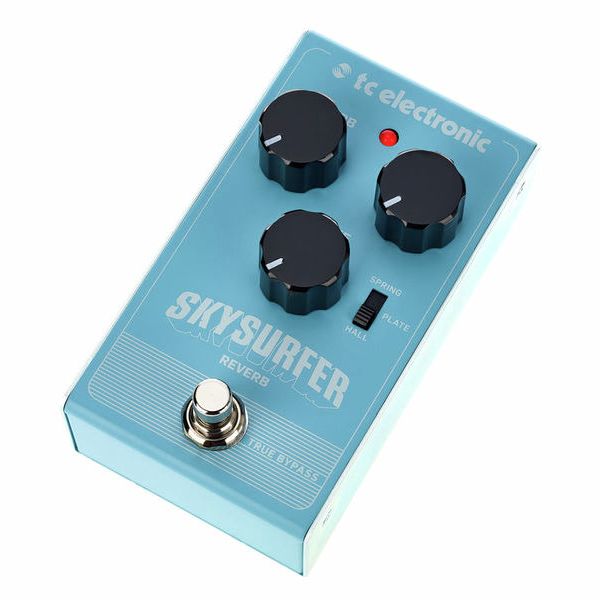
This is a tiny pedal with a genuinely simple job: give you three classic reverb types in a compact, affordable box.
You get Spring, Plate, and Hall reverbs, selectable with a mini toggle, plus three knobs: Reverb, Mix, and Tone. That’s the whole interface, and honestly, that’s exactly what most players actually need.
No hidden menus, no presets to scroll through, no manual required. Plug in, pick your reverb type, dial in the amount, done.
Spring, Plate, and Hall Explained
Spring mode gives you that classic surf and blues twang, the kind of drippy, splashy reverb that sounds like it’s coming out of a vintage tube amp’s built-in tank.
Plate mode is smoother and more studio-like, less „boingy” and more like a wash that sits behind your tone without drawing attention to itself.
Hall mode is the big one, a spacious, cathedral-like reverb that works beautifully for ambient playing, slow builds, or anything where you want your notes to bloom and trail off into the distance.
Having all three in one tiny footprint pedal is genuinely impressive for the price. A lot of budget reverbs give you one flavor and call it a day.
The Tone Knob Is The Secret Weapon
The Tone knob deserves a mention too. It rolls off high frequencies on the reverb trail, which stops your wash of reverb from turning into a harsh, digital-sounding mess at higher mix settings.
That’s a detail a lot of cheap reverb pedals skip entirely, and it makes a real difference in how natural this pedal sounds compared to some of its competitors.
Build Quality And Power
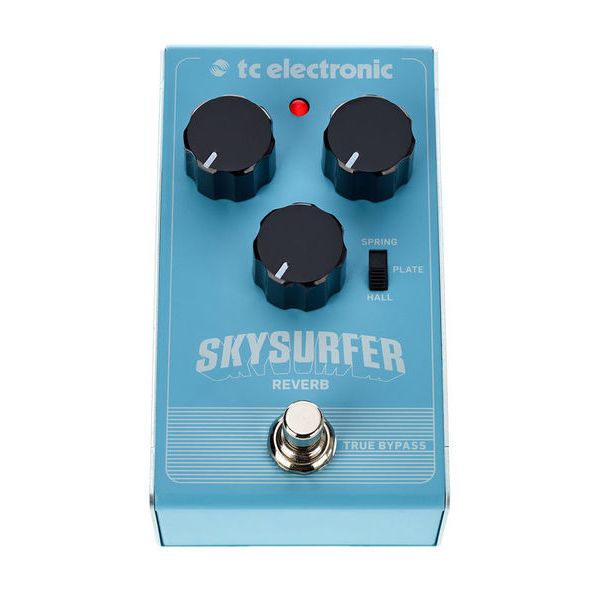
At 0.5 kg and roughly the size of a deck of cards, this thing barely takes up any room on a pedalboard.
It’s true bypass, so when it’s off, your tone passes through completely unaffected. No tone-sucking, no weirdness, no compromise elsewhere in your signal chain.
Build is simple but solid, a compact metal enclosure that’s clearly built to survive pedalboard life rather than sit pretty in a display case.
One thing worth flagging: this pedal runs on a standard 9V power supply only, not included in the box, and there’s no battery option. Budget for a power supply if you don’t already have a spare output free.
Quick spec rundown:
- Three reverb types: Spring, Plate, Hall
- Controls: Reverb, Mix, Tone
- True bypass
- Compact footprint, 0.5 kg
- Mono in / mono out
- 9V DC powered only, no battery, PSU not included
- 4.2 out of 5 from 667 Thomann customer reviews
Who This Pedal Is Actually For
If ambient or shoegaze tones are your thing, a good hall reverb is basically mandatory gear. I’ve got a whole guide covering the best guitars for shoegaze and ambient playing that pairs naturally with a pedal like this.
TC Electronic has built a strong reputation for budget-friendly pedals that outperform their price tag, and this one fits right into that lineup. My roundup of the best TC Electronic pedals covers more of their catalog worth checking out.
It also plays nicely alongside other TC gear on a board. If you’re stacking effects, something like the TC Electronic Sub’N’Up Octaver pairs well tonally, especially for ambient or post-rock style layering.
If you already own an amp with a great built-in reverb, like my review of the Fender 65 Princeton Reverb covers, you might wonder if you need a pedal on top. The honest answer is: it depends on whether you want more reverb types than your amp’s single spring tank offers. This pedal adds real versatility there.
For players chasing chimey, vintage-inspired clean tones, the UAFX Ruby 63 review covers a great amp-in-a-box option that this reverb pedal would slot in front of beautifully.
If you’d rather have reverb built into a bigger multi-effects unit, the Zoom MS-50G+ has reverb algorithms too, though obviously with less hands-on immediacy than a dedicated three-knob pedal like this.
A Few Honest Caveats
Now, some honest caveats. The 4.2 out of 5 rating is a bit lower than some other pedals I’ve reviewed, and reading through customer feedback, a common complaint is that the reverb can get very ambient and washy quite quickly once you push the Reverb knob past halfway.
If you want subtle, barely-there reverb for tight rhythm playing, you’ll likely be using this pedal in the lower quarter of its range. That’s not necessarily a flaw, but it’s worth knowing before you buy so your expectations are set correctly.
It’s also mono in, mono out, so if you’re chasing a wide stereo reverb spread for recording or a big live sound, this isn’t the pedal for that job. Look at something with stereo outputs instead.
Signal Chain Placement
A quick word on placement in your signal chain. Reverb pedals like this generally work best at the very end of your chain, after any drive, modulation, or delay pedals.
That way the reverb wraps around your whole tone rather than getting distorted or modulated itself, which can turn into a muddy mess if you get the order wrong. If you’re new to building a pedalboard, this is a simple rule worth remembering.
Worth noting too: because this pedal is true bypass and doesn’t buffer your signal, running it at the end of a long chain of other true bypass pedals with long cable runs could introduce some treble loss. A buffer earlier in your chain solves that problem if you notice your tone getting dull with everything engaged.
The Verdict
None of that changes the core value proposition here though. For the price, you’re getting three genuinely usable, good-sounding reverb types in a pedal small enough to fit anywhere on your board.
IMO this is one of those pedals that just quietly does its job without demanding attention, which, honestly, is exactly what reverb should do. If you don’t already have a dedicated reverb pedal, this is a low-risk, high-reward way to fill that gap.
None of this is a dealbreaker, just the kind of practical detail that separates a good pedalboard from a frustrating one. Once it’s dialed in properly, this little reverb pedal earns its spot and mostly gets left alone, which is exactly the point of a good utility effect like this.