Watch It First
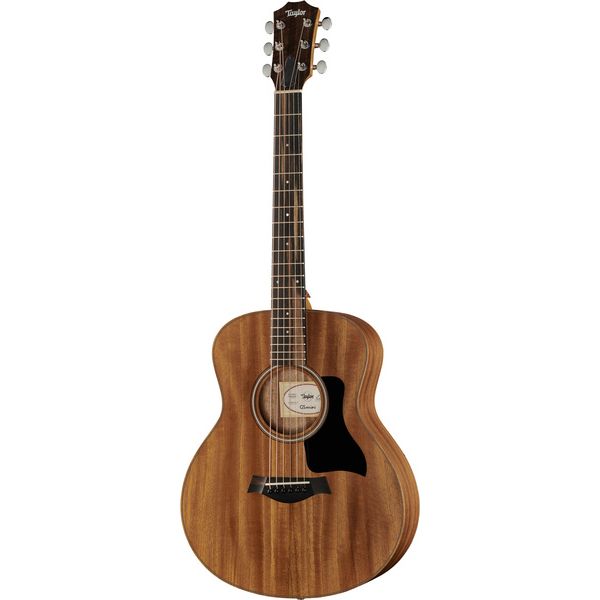
Small guitars usually mean small sound. That’s the deal you accept when you buy a travel acoustic, right? Except the Taylor GS Mini never got that memo.
It’s shaped like a scaled-down Grand Symphony, sized for backpacks and overhead bins, and somehow still sounds like a full-size dreadnought when you dig in.
The Mahogany version specifically has become a bit of a cult favorite. Here’s why people keep reaching for this one over guitars twice its size.
A Bit of Backstory
Taylor launched the original GS Mini back in 2010, and it basically created its own category overnight. Before that, „travel guitar” mostly meant „compromise guitar” — thin-sounding, uncomfortable, an afterthought.
The GS Mini flipped that idea on its head by scaling down a proper Grand Symphony body instead of just shrinking a dreadnought and hoping for the best. That’s a big part of why it still sounds full despite the smaller footprint — the proportions were designed from scratch, not just shrunk in a spreadsheet.
The Mahogany version came later as a tonal alternative to the original sapele-top model, aimed at players who wanted a bit more midrange growl and a touch less sparkle on top.
Build and Specs
The GS Mini uses a solid mahogany top, which is the key difference from the standard sapele-top model. Solid mahogany tends to push forward more midrange warmth and a slightly quicker, punchier attack than spruce.
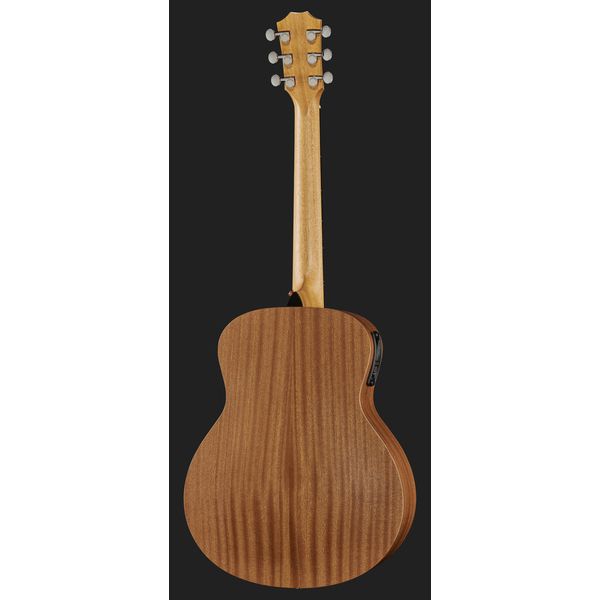
Back and sides are layered sapele, the neck is sapele too, and the fretboard is ebony. Taylor’s X-bracing pattern with a Relief Rout keeps the small body resonant instead of choked off.
The „e” in the name means it comes loaded with Taylor’s ES-B pickup system, so you’re not stuck miking it up if you need to plug into a PA or an acoustic amp.
Dimensions That Actually Matter
- Small Body (GS Mini) shape, roughly 3/4 the size of a dreadnought
- 20 frets, 597mm scale length
- 42.8mm nut width — close to full-size, so your fretting hand doesn’t need to relearn anything
- Comes with a Taylor soft gig bag
Playability and Tone
This is where the GS Mini earns its reputation. It doesn’t feel like a „kids’ guitar” or a downgrade from a full-size instrument. The nut width is nearly identical to Taylor’s full-size models, so chord shapes and fingerstyle patterns transfer straight over.
Strum it hard and it genuinely surprises people who haven’t played one. There’s real low-end there, not just jangly top-end like a lot of parlor-sized guitars.
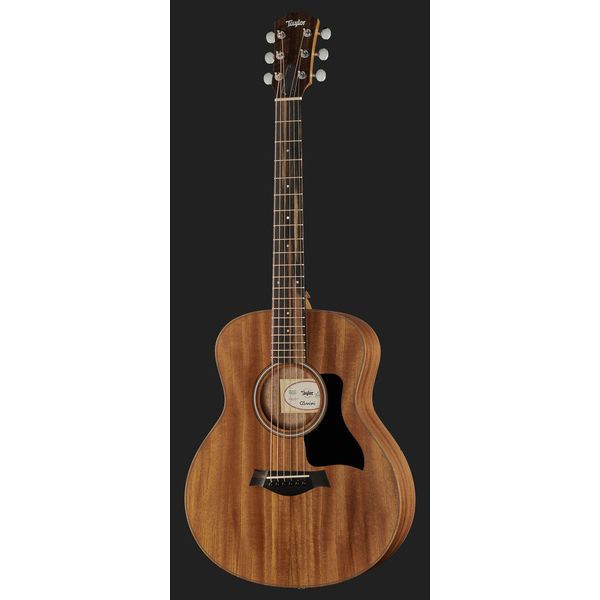
Plugged in, the ES-B system is honestly one of the better under-saddle systems at this price. It’s not going to replace a good mic in a studio, but for open mics, campfires and small gigs it’s more than usable straight out of the box.
Who It’s For
Travelers, songwriters who want a couch guitar, gigging musicians who need a reliable backup, and honestly, anyone who wants one great acoustic without the bulk of a full dreadnought in a small apartment.
It’s also a genuinely good first „real” guitar for an intermediate player who’s outgrown a beginner instrument but isn’t ready to drop dreadnought money yet.
Honest Niggles
- It’s still a small-body guitar — it won’t out-boom a proper dreadnought unplugged
- No cutaway, so upper fret access is a stretch
- The soft gig bag is fine but not proper flight-case protection if you check it as luggage
- Some players find the mahogany top a touch darker/less sparkly than the sapele version — personal preference more than a flaw
How It Compares
The obvious rival in this space is the Little Martin LX1E, which goes even smaller and cheaper but gives up some low-end in the trade.
If you want something between a mini and a full dreadnought, our Martin 000CJR-10E review covers a solid middle-ground option, and if you’d rather go bigger and louder from the start, our guide to the best jumbo acoustics is worth a browse.
Curious what mahogany actually does to your tone versus other tonewoods? We break it down in our mahogany tonewood guide. And if a mahogany-topped acoustic in general appeals to you, the Epiphone Hummingbird is another one worth a look, albeit in a totally different size class.
Need an amp to plug the ES-B pickup into for gigs? Our Fender Acoustic SFX II review covers a solid option built specifically for acoustic-electrics like this one.
Full Specs
- Body shape: GS Mini (Small Body)
- Top: Solid mahogany
- Back and sides: Layered sapele
- Neck: Sapele
- Fretboard: Ebony
- Scale: 597mm
- Nut width: 42.8mm
- Frets: 20
- Electronics: Taylor ES-B pickup system
- Includes: Taylor soft gig bag
Resale value is another quiet selling point worth mentioning. Taylors in general hold their value well on the used market, and the GS Mini line is one of the most in-demand used acoustics out there — so even if it doesn’t work out for you, it won’t be hard to move on.
A Word on the Mahogany Version
Taylor sells the GS Mini in a few tonewood flavours, and the mahogany top is the one people argue about most. It swaps the brighter, more scooped spruce voice for something warmer and more compressed – closer to an old parlour guitar than a modern dreadnought. Some players find it a bit too polite for aggressive strumming.
For fingerstyle or quieter campfire playing though, that compression works in your favour – notes blend instead of fighting each other. If you already own a bright spruce-top acoustic and want something different for variety rather than a direct replacement, the mahogany top makes a lot more sense than buying a second spruce guitar that just does the same job.
Final Verdict
The Taylor GS Mini-e Mahogany is one of those rare guitars that actually deserves the hype it gets in every acoustic forum thread ever written. It’s not a compromise guitar, it’s just a smaller one.
If you need something you can throw in a car, a plane’s overhead bin or the corner of a small room and still have a genuinely great-sounding instrument waiting for you, this is about as close to a sure thing as acoustic guitars get.
It’s not the cheapest travel guitar out there, but IMO it’s one of the few where the price actually tracks with what you get. Once you’ve played one, going back to a „regular” travel guitar feels like a downgrade.