Watch It First
Lunchbox heads had a moment a while back, and most of them faded into „yeah that was fine I guess” territory. The Orange Rocker 15 Terror didn’t.
It’s still one of the amps people bring up when someone asks „what’s a small tube head that actually sounds like a real amp?” There’s a reason for that.
I’ve spent a good chunk of time with one plugged into everything from a 1×12 cab to a full stack just to see where it falls apart. Spoiler: it mostly doesn’t.
What’s Actually Inside
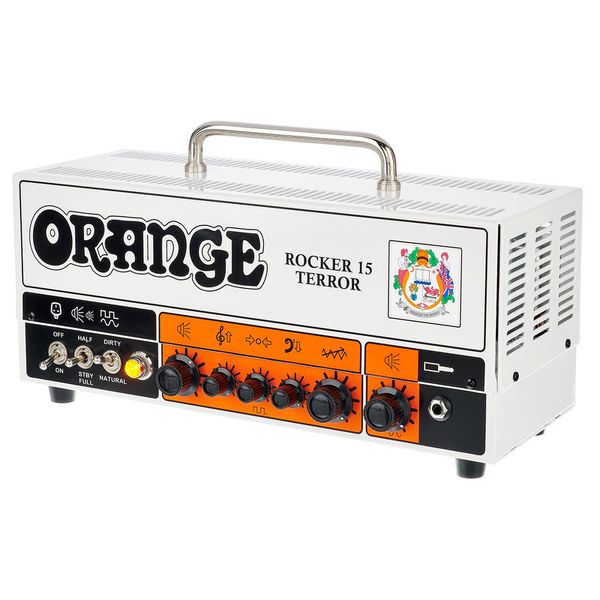
Three ECC83s, one ECC81, and a pair of EL84s doing the power stage work. That’s a proper tube complement, not some hybrid solid-state thing dressed up to look vintage.
Power switches between 15, 7, 1, and 0.5 watts. That last setting is the real party trick here, you can get genuine tube breakup at a volume that won’t get you evicted.
Two channels: Natural and Dirty. Natural is your clean-ish, pedal-friendly platform. Dirty is where the amp’s actual personality lives.
The Dirty Channel
This is the whole reason people buy this thing. It’s not a metal amp, don’t go in expecting scooped djent tones. It’s a British-flavored, slightly fuzzy, mid-forward crunch that sits perfectly for rock, garage, stoner, and blues-adjacent playing.
Turn the gain up past noon and it starts to saturate in a really satisfying way. Pick attack still comes through, chords don’t turn into mush, and palm mutes actually thump instead of farting out.
Compared to something like the Marshall DSL1CR, the Orange leans a bit darker and woolier, while the Marshall stays a touch more scooped and classic-rock voiced. Both are excellent, it just depends which flavor you’re after.
Home Use And Bedroom Volumes
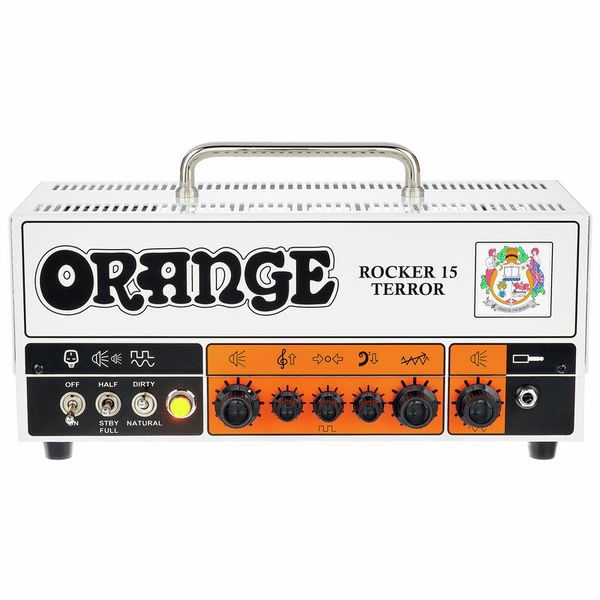
This is honestly where the Rocker 15 Terror earns its keep the most. At 0.5 watts you can crank the gain and actually push the power tubes into breakup without it being painfully loud.
That’s not something a lot of modeling or solid-state amps fake convincingly. If your comparison shopping list includes something like the Peavey Vypyr X2 or the Positive Grid Spark 2, know that you’re choosing between two very different philosophies: real tube dynamics versus flexible digital modeling.
There’s no reverb built in and no footswitch included, so budget for a boost or reverb pedal if you want more texture. FYI the FX loop is mono, which is fine for most delay and reverb pedals but worth knowing if you run stereo rigs.
Build Quality And Portability
At 6.4kg this thing is genuinely easy to carry around, and it ships with a gigbag which is a nice touch at this price point. The chassis feels solid, the knobs have a good amount of resistance, nothing feels flimsy.
If you want something with onboard reverb and a slightly higher headroom ceiling, the Blackstar HT-20R MkIII is worth cross-shopping. It’s a different tonal camp (British-voiced but cleaner and glassier) so it really comes down to which sound you gravitate towards.
Who Should Buy This
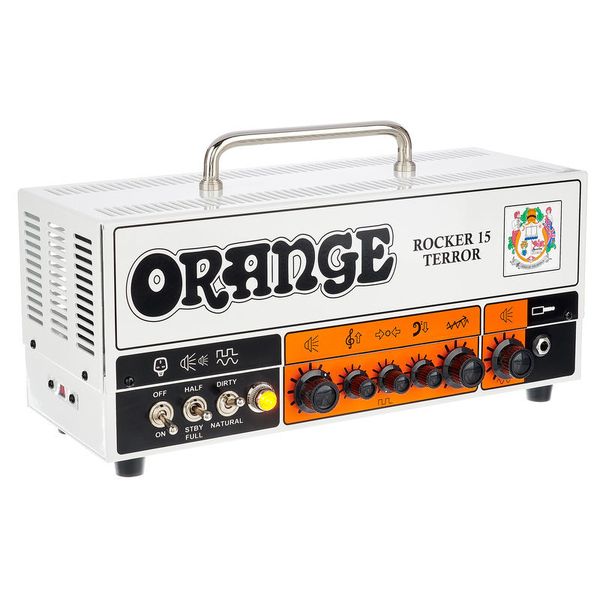
Anyone who wants real tube tone at home without needing a power attenuator setup. Anyone who loves that British mid-forward crunch and doesn’t need scooped high-gain tones. Anyone who wants a genuinely gig-capable amp that also works for quiet apartment practice.
If you want built-in effects, footswitchable channels, or a super versatile clean platform, this isn’t really built for that. It’s a one-trick amp, but it’s a really, really good trick. Something like the Boss Dual Cube LX or the Blackstar Amped 1 covers a broader range of tones if that’s what you actually need.
Quick Specs
- Power: 15W RMS, switchable to 15/7/1/0.5W
- Channels: 2 (Natural, Dirty)
- Tubes: 3x ECC83, 1x ECC81, 2x EL84
- Controls: Natural-Volume, Gain, Bass, Mid, Treble, Dirty-Volume
- FX Loop: Mono
- Speaker outputs: 1x 16 ohm, 2x 8 ohm
- Weight: 6.4kg
- Includes: Gigbag
The Niggles
No reverb, no footswitch in the box (channel switching is done manually or with a separately purchased footswitch), and the Natural channel isn’t actually squeaky clean at higher volumes since it’s still a tube preamp stage.
A few owners report occasional tube microphonics after long warm-up sessions, which seems to be a known quirk rather than a defect, but it’s worth knowing going in. And if you’re the type who needs a ton of onboard versatility, the two-channel simplicity might feel limiting after a while.
Cab Pairing And Mic Options
Since the head doesn’t come with a cab, what you plug it into matters a lot. A closed-back 1×12 like the Orange PPC112 tightens up the low end and gives you a punchier, more focused thump, while an open-back 2×12 spreads things out and adds a bit more shimmer on top.
For recording, a single dynamic mic on the speaker (something like an SM57 off-axis) captures that Orange growl surprisingly well without needing much EQ afterward. If you’re running direct into an interface instead, a decent IR loader will get you 90% of the way there for late-night takes when you can’t mic up a cab.
Final Verdict
The Orange Rocker 15 Terror does one job and does it brilliantly: real, dynamic, British-voiced tube crunch at volumes that actually work for real life. It’s not trying to be everything to everyone, and that focus is exactly why it’s stuck around this long as a genuine favorite.
If your pedalboard already does your clean and ambient stuff, and what you actually need is an amp that makes your dirt pedals (or just the amp itself) sing, this is an easy one to recommend. Pair it with a decent 1×12 cab and you’ve got a rig that’ll cover home practice all the way up to small and medium gigs without breaking a sweat.
Worth every bit of the hype it still gets, honestly.