Watch It First
Gibson’s odd-shape guitars have had a good run lately. We have the 70s Explorer and the 70s Flying V covered, and both are exactly what you expect them to be.
The Firebird has always been the third one. The weird one. The shape that never quite caught on, played by people who did not care that it never quite caught on.
And now there is a version called the Platypus, which is possibly the least metal name Gibson has ever put on a headstock. Stay with me, because it turns out to be the smartest Firebird in years.
Why „Platypus”?
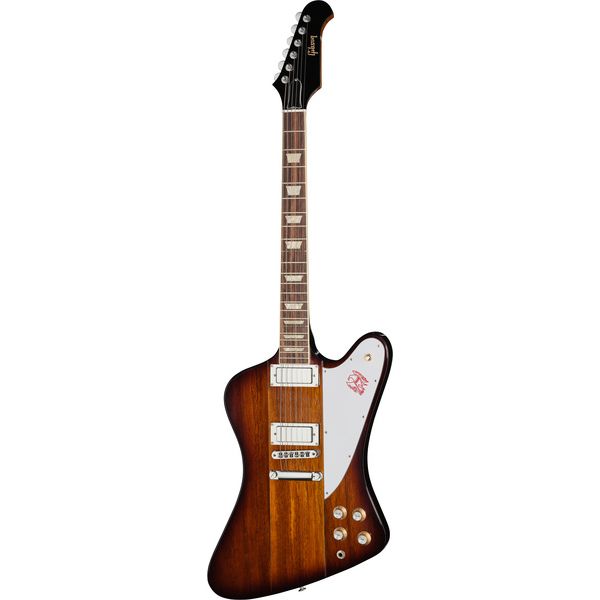
Because it is a mash-up animal. A Firebird body wearing a lot of Les Paul parts, which by traditional Gibson logic should not work at all.
The classic Firebird is a neck-through guitar with a nine-piece laminated mahogany and walnut neck running the length of the body. Beautiful, expensive, and a nightmare to repair if you ever snap the headstock.
The Platypus throws that out and uses a conventional set neck instead. Mahogany body, mahogany neck, glued in, exactly like a Les Paul.
It also runs a 628 mm (24.75″) Gibson scale with trapezoid inlays and white fretboard binding. This is a Firebird built the way Gibson builds everything else.
That makes it cheaper and, frankly, better
Neck-through construction is the single most expensive part of a real Firebird. Losing it drops the price into normal-Gibson territory rather than boutique territory.
It also means the neck heel is where your hand expects it to be, and the upper frets are easier to get at than on a vintage-spec Firebird.
Does it sound different? A bit. There is slightly less of that glassy, endless sustain the neck-through models are famous for, and slightly more woody midrange. I prefer it, but I would understand if you did not.
The mini-humbuckers are the real Firebird bit
Two Firebird mini humbuckers, and this is where the DNA lives. They are not PAFs and they are definitely not P90s.
Mini-humbuckers sit somewhere between the two: tighter and clearer than a full-size humbucker, fatter and quieter than a single coil. That slightly nasal, cutting quality is the whole reason people fall for Firebirds.
Through a cranked amp they get a snarl that a Les Paul simply cannot do. Cleans are chimey without being thin. Compared to the P90s in the SG Special they are less raw but a lot more usable at volume.
Details that show somebody was paying attention
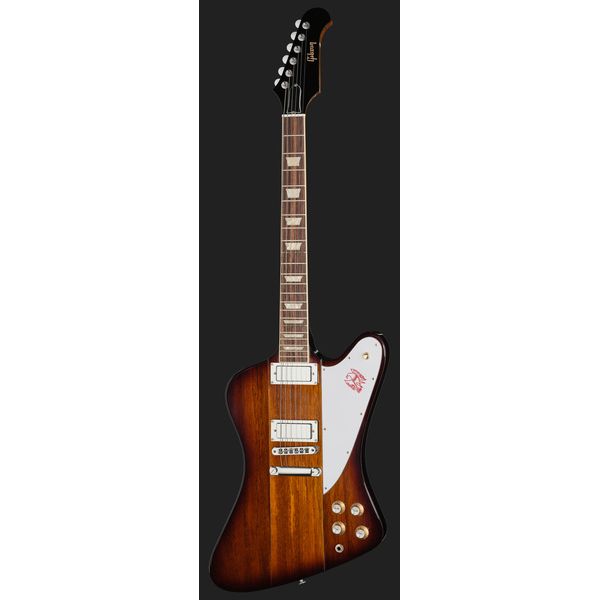
The bridge and stop bar are aluminium, not zinc. Lighter, brighter, and the historically correct choice.
The nut is Graph Tech, which is a properly practical decision on a guitar with a long headstock and a lot of string behind the nut.
The frets get a cryogenic treatment — chilled to harden the metal so they wear more slowly. It is a small thing and it is not marketing nonsense; cryo frets genuinely last longer.
Grover mini machine heads, Slim Taper neck profile, 22 frets, and it ships in a case. Made in the USA.
The niggles, and there are real ones
It is still a Firebird, which means the body is long, the headstock is long, and the strap button placement means it wants to dive. Not as badly as a vintage one, but it dives.
Sitting down is awkward. The upper horn is small and the body is thin, so it slides off your leg unless you are quite deliberate about where you put it. Classical position or nothing.
Twenty-two frets, not twenty-four. If you play up there a lot, this is not your guitar.
And gig bags do not fit. Neither do most standard cases, which is presumably why Gibson includes one — but it is a bulky thing to carry on public transport, IMO.
Where it sits next to the other odd shapes
The Explorer is the aggressive one, all angles and attitude. The Flying V is the theatrical one. The Firebird is the one that thinks it is a Les Paul but dresses like a Cadillac.
If you are shopping the shape rather than the badge, the Epiphone Explorer does the odd-shape thing for a fraction of the money, and the Epiphone Flying V 70s is the value pick in that corner.
But none of them sound like a Firebird, because none of them have mini-humbuckers. That is the whole argument.
How it plays after a few weeks
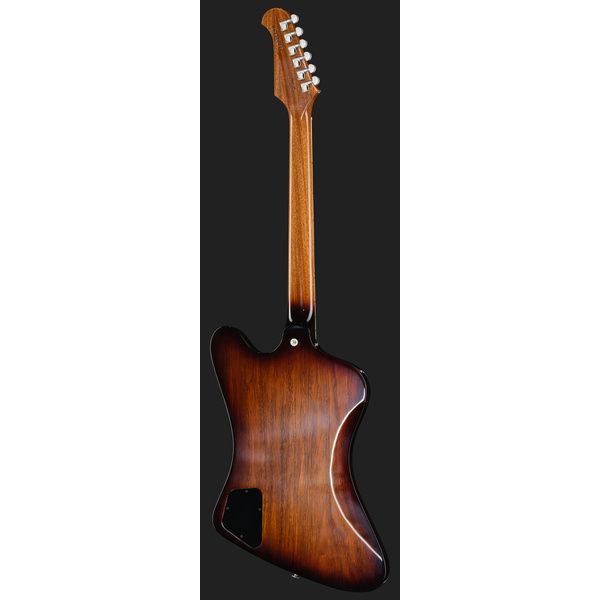
The Slim Taper neck is the familiar modern Gibson profile and it suits this guitar well. Not as thin as a superstrat, nowhere near as chunky as a 50s Les Paul.
Because the neck is glued rather than run through the body, the heel is a proper Gibson heel. That takes a little getting used to if you have played a vintage-style Firebird, where the neck-through means there is almost nothing in the way at all.
Weight is reasonable for a mahogany guitar. Not light, but a long way from Les Paul Custom territory, and the long body spreads it out so it does not feel like it is all hanging off one shoulder.
What it is good for
Loud rock, mostly. Mini-humbuckers cut through a band mix in a way that full-size humbuckers sometimes struggle to, especially when there is a second guitarist involved.
Slide players should also pay attention. The clarity and the sustain suit it, and the long upper horn gives you somewhere to hold on to.
It is a less obvious choice for anything that needs a fat, dark neck-pickup tone. If that is your thing, the Les Paul Standard 60s remains the correct answer and always will be.
Specs
- Body: Mahogany
- Neck: Mahogany, set neck, Slim Taper profile
- Fretboard: Rosewood with trapezoid inlays and white binding
- Frets: 22, cryogenically treated
- Scale: 628 mm (24.75″)
- Nut: Graph Tech, 43 mm
- Pickups: 2 x Firebird mini humbuckers
- Bridge: Aluminium Nashville Tune-O-Matic with aluminium stop bar
- Tuners: Grover mini
- Finish: Tobacco Sunburst (other colours available)
- Case included, made in USA
Final Verdict
The Gibson Firebird Platypus is the version of this guitar I have been quietly waiting for.
It keeps the two things that make a Firebird a Firebird — the shape and the mini-humbuckers — and quietly drops the one thing that made it expensive and fragile.
It still dives on a strap and it still will not sit on your knee properly. Those are Firebird problems and no amount of clever engineering is going to fix them.
But as a way into the strangest shape Gibson makes without paying custom shop money, it is genuinely hard to fault. The odd bird finally makes sense.