Watch It First
If you went hunting for a Squier 40th Anniversary Telecaster and came up empty, you are not imagining things – that run has quietly dried up and it is not coming back.
Good news though. The guitar you actually wanted is still sitting on the shelf. The Classic Vibe 50s Telecaster does the same job, it is a permanent line item, and arguably it plays better.
I have spent a decent amount of time with one. Here is the honest version, hum and all.
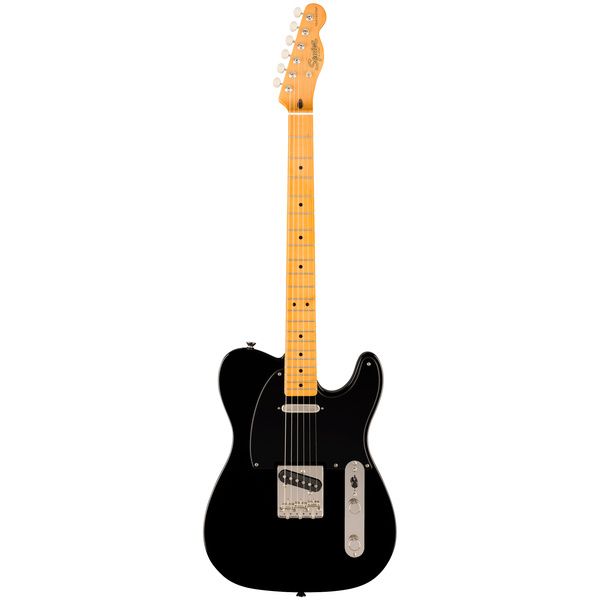
What Makes It a Classic Vibe and Not Just a Cheap Tele
The Squier ladder goes Sonic, then Affinity, then Classic Vibe. Each rung buys you real hardware, not just a nicer paint job.
Classic Vibe is the rung where you stop compromising. Alnico pickups, a bone nut, vintage-style barrel saddles and strings through the body. Those are the parts that genuinely change how a guitar sounds.
Compare it to the Squier Sonic Telecaster, which is a perfectly good first guitar but runs ceramic pickups and a synthetic nut. The gap between them is wider than the price difference suggests.
The 40th Anniversary models sat roughly at this level too, just with a gold anodised pickguard and a satin body finish to mark the occasion. Lovely, but cosmetics.
The Pickups Are the Whole Point
Two Fender-designed Alnico single coils. No hot-rodding, no modern voicing, no attempt to be clever about it.
The bridge pickup does the thing. That glassy, nasal, slightly rude spank that makes a Tele a Tele – and crucially it stays articulate when you push it into a driven amp instead of turning to fizz.
The neck pickup is warmer and rounder than you would expect from a maple-board Tele. Honest enough for blues and for the jazzier end of things.
Middle position is the sleeper. Hollow, chimey, and perfect for rhythm parts that need to sit underneath a vocal without fighting it.
- Bridge, clean – sharp country twang with real bite
- Bridge, driven – cutting rock rhythm that never gets woolly
- Middle – hollow and jangly, the secret weapon
- Neck – warm and vocal, surprisingly good for blues
And Yes, It Hums
Single coils. Two of them. Under stage lighting or anywhere near a computer monitor you will get mains hum, exactly as the design intended back in 1952.
If that is going to irritate you, look at a humbucker-loaded Tele shape instead. The ESP LTD TE-200 is a sensible place to start that conversation.
How It Actually Plays
Neck and Frets
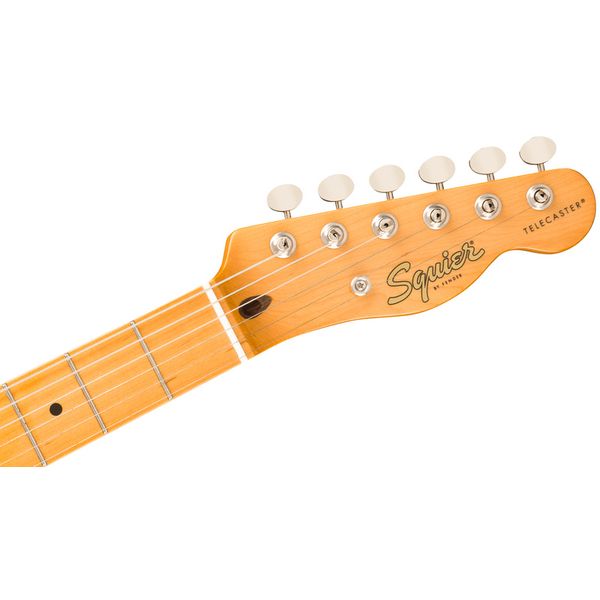
C profile, 241 mm (9.5 inch) radius, 21 narrow-tall frets and a bone nut.
That radius is properly vintage – flatter than a true 50s reissue but rounder than any modern superstrat. Chords feel excellent. Enormous bends above the 15th fret can choke slightly if your action is very low.
It is 21 frets rather than 22. Not an issue for most people, mildly annoying if you are used to reaching for that top note.
The bone nut is a genuinely meaningful inclusion at this money. A bad nut is the single biggest reason cheap guitars will not stay in tune, and here it has simply been dealt with.
The Bridge
Three barrel saddles, strings through the body. Vintage correct, which also means intonation is a compromise by design – two strings sharing each saddle.
You can get it close. You cannot get it perfect. Plenty of people swap in compensated saddles for roughly the price of a decent cable and that fixes it entirely.
Through-body stringing gives you the extra sustain and stiffness under the pick that makes this feel like a proper Tele rather than an impression of one.
Build Quality: The Honest Bit
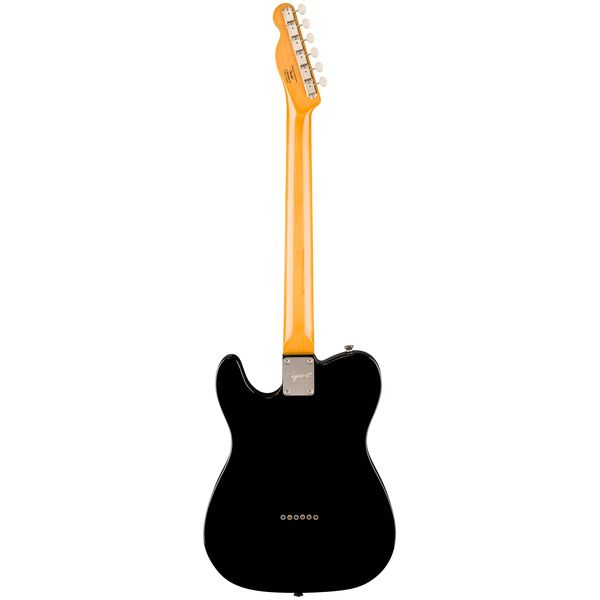
Poplar body, not ash or alder. It is lighter, a bit softer, and sits tonally somewhere between the two. Under a solid black finish nobody is ever going to know.
Fretwork on mine was good but not flawless. A couple of ends could have used more attention, though nothing snagged a hand or a sleeve.
The factory setup was properly playable straight out of the box, which is genuinely rare at this end of the market. I dropped the action a fraction and that was the whole job.
- Three-saddle bridge means intonation is always a slight compromise
- Single coil hum, obviously and unavoidably
- Poplar is functional rather than characterful
- Fret end finishing is decent rather than immaculate
- 21 frets, not 22
- Gloss black shows every fingerprint you have ever had
Where It Sits Against Everything Else
Against the Fender Player II Telecaster you give up a Mexican build, better pickups and more finish choices. You also spend a lot less, and honestly the gap in sound is far smaller than the gap in price.
Against the Vintera III 50s Telecaster, the Classic Vibe is the sensible sibling. The Vintera is more authentic, more resonant and considerably more expensive.
If you want something less traditional wearing a Squier logo, the Paranormal Troublemaker Telecaster Deluxe is the humbucker-and-Bigsby answer to the same question.
And if you are still deciding between shapes rather than models, my Squier Affinity Stratocaster piece covers the other side of that argument.
Who Should Buy One?
Anyone who wants the real Telecaster experience without spending real Telecaster money. That is the entire pitch, and it delivers on it.
It is also a brilliant modding platform. The bone nut and decent tuners are already sorted, so drop a set of boutique pickups in later and you have something special for not much outlay.
Country, indie, rock, blues, funk – all completely at home. Modern metal, no. Obviously.
Specs at a Glance
- Body: poplar
- Neck: bolt-on maple, C profile
- Fretboard: maple, 241 mm (9.5”) radius, black dot inlays
- Frets: 21 narrow tall
- Scale: 648 mm (25.5”)
- Nut: bone, 42 mm (1.65”)
- Pickups: 2x Fender-designed Alnico single coils
- Controls: master volume, master tone, 3-way switch
- Pickguard: single-ply black
- Bridge: 3-saddle vintage-style, strings through body, chrome barrel saddles
- Tuners: vintage-style, nickel hardware
- Strings: .009 – .042 nickel-plated steel
- Finish: Black
- Thomann article number: 642700
Final Verdict
The 40th Anniversary Teles were lovely things, but they were a limited run with a fancy pickguard. This is essentially the same guitar without the countdown clock attached.
The Classic Vibe 50s Telecaster punches so far above its money that it has quietly become everyone’s default recommendation – and defaults usually get that way for a reason.
Buy it, spend ten minutes on the setup, learn to live with the hum, and enjoy owning a guitar that would have cost a month’s wages in 1954.
Easy recommendation. IMO it is still the best value Tele on the market.