Watch It First
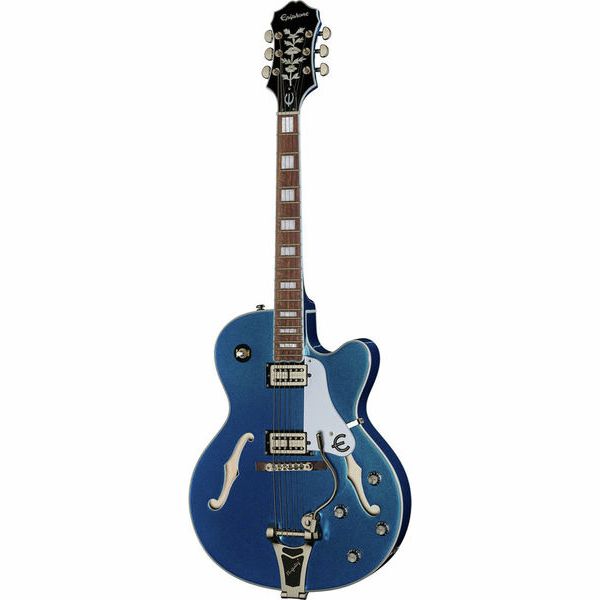
Some guitars are tools. The Epiphone Emperor Swingster is a costume, a mood and a personality disorder, and I mean that as a compliment.
It is a big laminated maple hollowbody with a Bigsby bolted to the front, and it exists to make one very specific noise that nothing else in Epiphone’s catalogue makes.
I spent a fortnight with the Delta Blue one. I did not want to give it back, and my neighbours have views about that.
The Guitar Epiphone Has No Business Making
Epiphone’s bread and butter is Les Pauls and SGs. Sensible, dependable, everybody-owns-one guitars.
The Swingster is none of that. It is a full-depth archtop aimed straight at the rockabilly and western swing crowd, and it lands in territory Gretsch normally owns outright.
Which raises the obvious question – why buy this instead of the Gretsch G2420 Streamliner? Stick around, because the answer is more interesting than I expected.
Big Body, Loud Personality
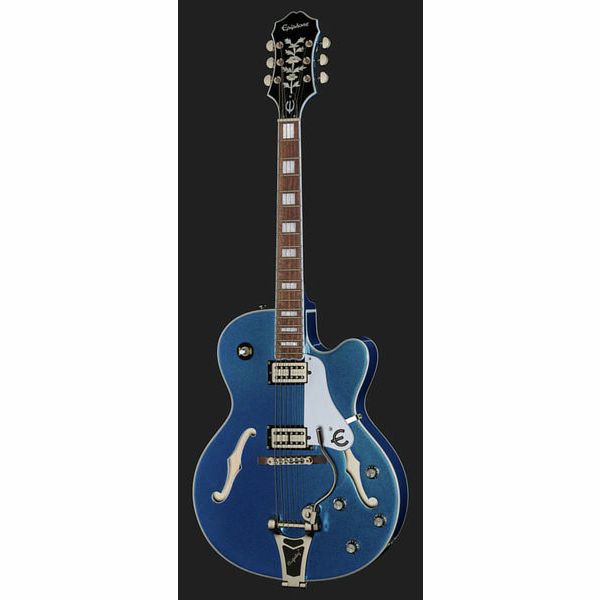
Five-ply laminated maple body and top, fully hollow, with seven-layer binding around the edge. No centre block, no compromise, no hedging.
Unplugged it is genuinely loud. You can practise on the sofa without an amp, which is a party trick the semi-hollows never quite manage.
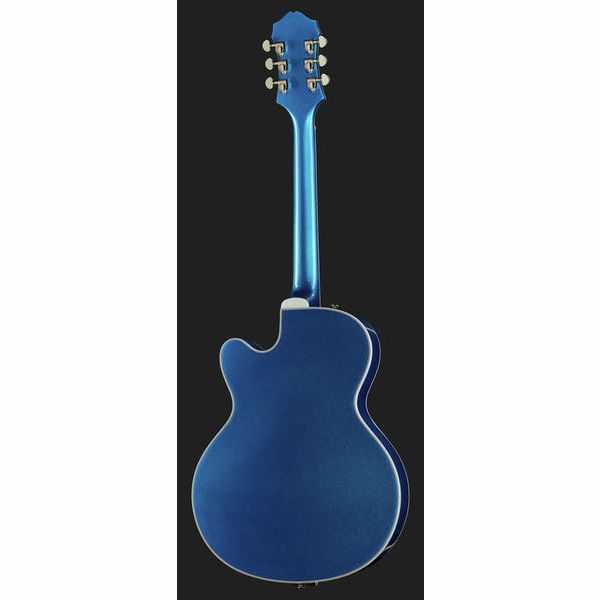
The Delta Blue Metallic finish is deeply silly and I love it. It catches light like a 1957 fridge, and the gold-ish hardware plays along nicely.
Neck and Feel
Mahogany neck with a SlimTaper profile, Indian laurel board, big pearloid block inlays. It is a shallower neck than the vintage aesthetic suggests, which catches people off guard.
Scale is 628 mm – the short Gibson-ish measurement – with a 43 mm nut. That combination means light-gauge bends are effortless and chords sit close together.
If you have played an Epiphone ES-335, the neck will feel like home. The body absolutely will not.
SwingBuckers, and the Knob Trick Nobody Mentions
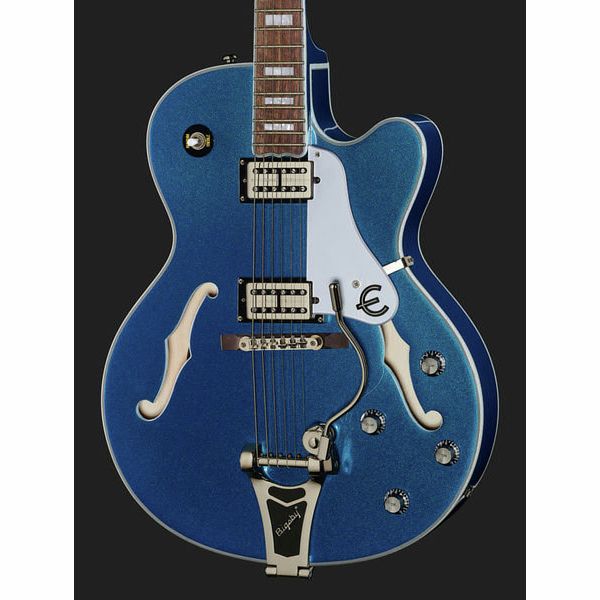
Two Epiphone SwingBucker humbuckers, two volumes, two tones, three-way switch. Standard enough on paper.
Except both volume pots are push-pull, and they switch the coils between series and parallel rather than doing a straight coil split. That is a meaningfully different sound.
Series is your fat, loud humbucker. Parallel is thinner, chimier and much closer to the twang you came here for, but without the volume drop and thinness a coil split usually dumps on you.
That single feature is the reason I would take this over some of the Gretsch competition. The G2622 Streamliner has a lovely voice, but it does not have four usable pickup flavours before you touch a pedal.
How It Sounds
Clean, on the neck pickup in parallel, this is the sound of a country record made before anyone had a compressor plugin. Woody, hollow, slightly boxy in a good way.
Bridge in series with a bit of grit gets genuinely aggressive. Not metal, obviously – but Brian Setzer territory is right there, and so is early Beatles chug if you back off.
Both pickups together with the volumes staggered is where I spent most of my time. That is a classic archtop move and this guitar rewards it.
The Bigsby Is Real, and Real Bigsbys Have Opinions
Licensed Bigsby, LockTone Tune-o-matic on a wooden base, Grover Rotomatic tuners. Solid parts, no corners visibly cut.
Restringing a Bigsby is a two-handed, mildly profane exercise and nobody should pretend otherwise. Buy the little pin gadget, thank me later.
Tuning stability is decent for what it is. Gentle wobble, fine. Big dramatic dips, and you will be reaching for the tuner between songs like everyone else who owns one.
Specs at a Glance
- Body and top: 5-ply laminated maple, fully hollow
- Neck: mahogany, SlimTaper profile
- Fingerboard: Indian laurel with pearloid block inlays
- Binding: 7-layer
- Scale: 628 mm (24.72″)
- Nut width: 43 mm (1.69″)
- Frets: 22
- Pickups: 2 x Epiphone SwingBucker humbuckers
- Controls: 2 volume (push/pull series-parallel), 2 tone, 3-way switch
- Bridge: LockTone Tune-o-matic on wooden base
- Tailpiece: licensed Bigsby
- Tuners: Grover Rotomatic
- Finish: Delta Blue Metallic
Feedback, and Other Facts of Hollowbody Life
This is a fully hollow guitar with no centre block. At volume, in front of an amp, it will howl. That is not a fault, it is the design.
Standing off-axis from the cab solves most of it. Stuffing a bit of foam through the f-holes solves nearly all of it, at the cost of some acoustic bloom.
If you play loud and dirty and cannot be bothered managing that, a centre-block guitar is the sane choice. The Gretsch G2655T Streamliner Jr does that job neatly and it is a smaller body too.
Living With Something This Big
Sitting down, the lower bout wants to slide off your leg. Standing up it is fine, but it takes up real estate on a small stage.
It is lighter than it looks – hollow bodies usually are – so the strap is not the problem. The problem is walking past a cymbal stand without incident.
No case or gigbag included, and finding a case that fits a body this deep is not a five-minute job. Factor that in.
The Niggles
The wooden bridge base is not pinned. Take all six strings off at once and it goes for a walk, taking your intonation with it. Mark its position with tape before you restring.
The SwingBuckers are a bit polite for my taste. They are clear and balanced, but they lack the slightly rude, spitty edge that Filter’Tron-style pickups have. Some people will prefer that. I mostly did not.
Four knobs and a switch on a curved top means you will knock a volume control with your forearm at some point during a gig. Ask me how I know. lol.
And it is not cheap by Epiphone standards. This sits above the Les Paul money and close to guitars that have solid-wood tops, so you are paying for the concept as much as the parts.
Who Should Buy One?
Rockabilly, western swing, jump blues, retro country, sixties pop – if any of that is your Saturday night, this guitar is built for you specifically.
If you want P-90 bark in a hollow body instead, the Epiphone Casino is the cheaper and grittier route, and I have written about that one plenty.
And if you want something quieter, more modern and flame-topped, the Ibanez AS93FM covers that ground for less drama.
Final Verdict
The Emperor Swingster is a specialist, and it is unapologetic about it. It will not be your only guitar and it is not trying to be.
What it will do is make you play differently. I wrote two things on it that I would never have written on a Les Paul, and that is worth more to me than another perfectly sensible instrument.
The push-pull series-parallel wiring makes it more versatile than its looks suggest, the Bigsby is the real deal, and the build quality holds up under a hard look.
Buy it because you want that noise, not because you need another workhorse. On those terms it is a very easy yes.