Watch It First
Seagull is one of those brands guitar forums adore and guitar shops forget to stock. Ask for acoustic recommendations anywhere online and someone always pipes up with „just get a Seagull.”
Then the thread moves on and nobody actually explains why.
So here is the why, using the model I keep pointing people at: the Entourage Autumn Burst CW. Cutaway dreadnought, solid spruce top, cherry back and sides, Fishman electronics, and – the bit that matters – built in Canada.
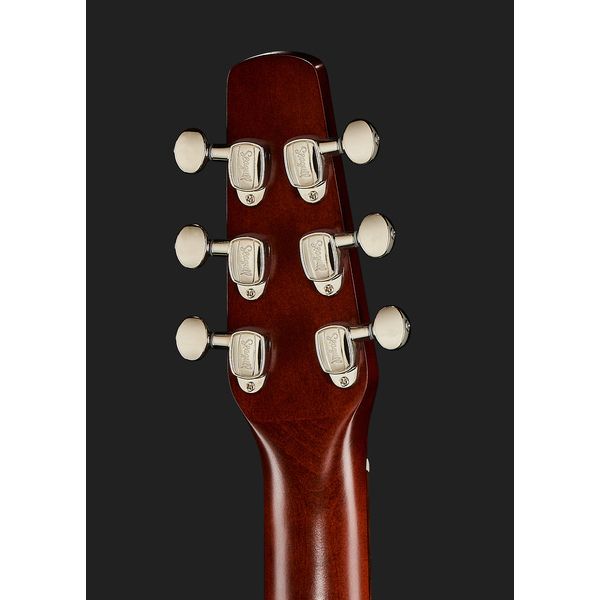
Made in Canada, and That Still Counts
Almost everything else in this price bracket comes out of a Chinese or Indonesian factory. Nothing wrong with that – plenty of those guitars are superb – but Seagull builds these in La Patrie, Quebec, in the same workshop family that produces Godin and Art & Lutherie.
What you get from that is consistency. I have played a handful of Entourages over the years and never met a dud. Fret ends tidy, action sane out of the box, nothing buzzing where it should not.
That is not a small thing. Buying an acoustic online is a lottery, and this brand shortens the odds considerably.
The Cherry Back Is the Part Nobody Mentions
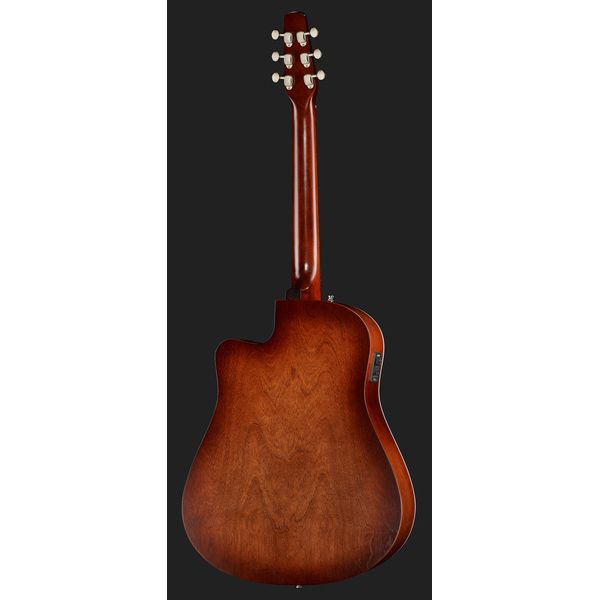
Cherry is not a tonewood most players can name, and Seagull has been quietly using it for decades.
It lands somewhere between mahogany and maple – a little of mahogany’s warmth, a little of maple’s snap and clarity. In practice that means notes stay separated instead of smearing into each other.
The top is solid spruce, not laminate. That is the spec that actually determines whether a guitar opens up over the next ten years or just stays exactly as it sounded in the box.
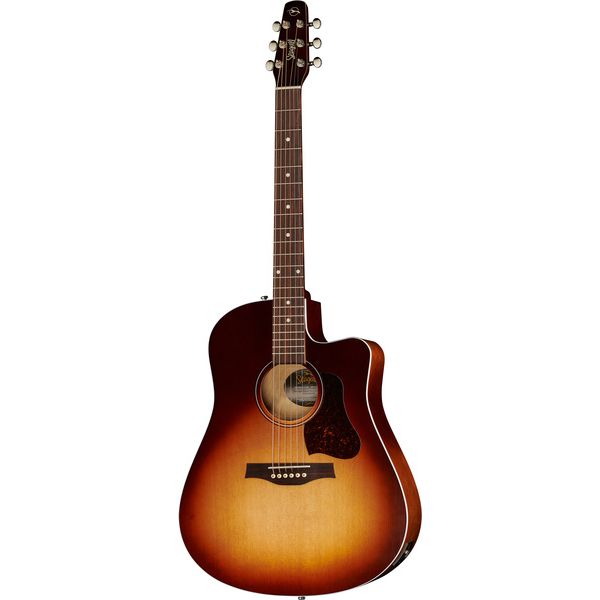
How It Actually Sounds
Unplugged, it is louder than I expected. Cutaways normally cost you a bit of body volume – this one barely seems to notice.
The voice is bright-ish without being brittle. Fingerpicked it is clear and separated; strummed hard it holds together rather than turning to mush.
If you want a huge, boomy, bass-forward dreadnought, this is not quite that guitar. It is tidier and more focused than something like the Guild D-240E, which trades precision for sheer wall-of-sound.
Which of those you want says more about your right hand than about either guitar, FYI.
Plugged In: The Fishman Presys II
Onboard you get a Fishman Presys II – undersaddle pickup, three-band EQ, tuner, phase switch.
It is honest rather than exciting. Straight into a PA you get a usable acoustic-electric tone with no fuss, and there is enough EQ range to tame the quack when the room fights you.
One niggle owners raise repeatedly: the built-in tuner is flaky. It works, it just drifts and hesitates. Keep a clip-on in the case and stop thinking about it.
Playing It
Scale length is 631 mm (24.8 inches), noticeably shorter than a Martin-style dread. Slightly slacker string tension, slightly easier bends, and your fretting hand thanks you after an hour of open mic.
Nut width is 43.7 mm – middle of the road. Not the wide fingerstyle neck some other Seagull models get, but perfectly comfortable for chord work.
The neck profile is chunkier than a modern Yamaha. If you learned on something slim like the Yamaha F310, this will feel like more guitar in your hand. IMO that is a feature, not a bug.
A Note on Setup and Strings
It ships with lights, and lights suit it. Drop to extra lights and you lose some of the low-end authority that makes the cherry back interesting in the first place.
Mine wanted a very small truss rod tweak after the first few weeks – normal for a solid-top guitar settling into a new climate. One owner review makes exactly this point: give it time and it keeps improving.
The Stuff I Would Moan About
The Autumn Burst finish is genuinely lovely in person, but it is semi-gloss and it collects fingerprints and belt-buckle scuffs faster than a satin finish would.
No gigbag or case included either, which stings slightly when a much cheaper Fender CD-60SCE often ships with something to carry it in.
And the tuner. Yes, the tuner again.
Last one: the Seagull range on sale in Europe is tiny – three models, sometimes fewer. You cannot really A/B your way through the line before committing, so you are buying partly on reputation.
Who This Is Actually For
The player who has outgrown a first acoustic and wants one guitar that will handle open mics, campfires and the sofa without complaining.
Also anyone who fancies a solid-top acoustic-electric that is not the same Takamine GN71CE or Epiphone J-45 Studio EC that everyone else at the open mic brought.
If you specifically want a non-cutaway with a rounder, bigger voice, look at its sibling instead – the Seagull S6 Original does a slightly different job in the same family.
The Specs
- Type: dreadnought with cutaway
- Top: solid spruce
- Back and sides: cherry
- Neck: maple
- Fretboard and bridge: rosewood, dot inlays
- Scale: 631 mm (24.8 inches)
- Nut width: 43.7 mm
- 21 frets
- Electronics: Fishman Presys II with three-band EQ and tuner
- Finish: Autumn Burst
- Made in Canada
How It Stacks Up Against the Cheaper Stuff
The obvious question is whether a solid top and a Canadian build are worth stepping up for at all, now that laminate-top acoustics have got genuinely decent.
Short answer: for a first guitar, no. For a keeper, yes. A laminate top sounds the same in year ten as it did on day one, and the Entourage audibly does not.
Play one next to a budget dread after both have been gigged for a couple of years and the gap is not subtle. The Seagull gets rounder through the low mids and the top end loses its glassy edge.
Living With the Cutaway
I am usually lukewarm on cutaways for acoustics – you pay in body volume and most of us rarely go above the twelfth fret anyway.
This one shifted my thinking a bit. The access is genuinely handy for the little melodic runs that turn up in singer-songwriter material, and the volume penalty is small enough that I stopped noticing it inside a week.
Final Verdict
The Entourage CW is not the flashiest acoustic you can buy, and it is not trying to be. What it offers is a properly built, solid-topped, North American guitar at a price where almost nothing else is properly built or North American.
Live with the fiddly tuner and the fingerprint-friendly finish and you have a guitar that will still be getting better in a decade.
If a forum ever tells you to just get a Seagull – this is the one they mean. 😉