Watch It First
Big hollow guitars used to come with big hollow price tags. Then Gretsch launched the Streamliner line and quietly wrecked that rule.
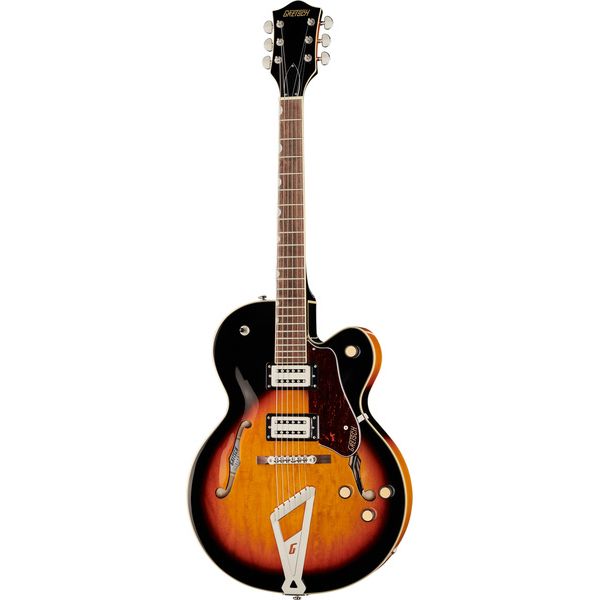
The G2420 is the single-cut, full-depth, no-Bigsby one. Chromatic II tailpiece, two Broad’Tron humbuckers, and a body you could almost serve dinner on.
I have spent enough time around these to know exactly where they shine and exactly where they get on your nerves. Both lists matter, so here we go.
It Is a Genuinely Big Box
This is not a semi-hollow. There is no centre block at all – the G2420 is fully hollow, with an arched laminated maple top, back and sides, and parallel tone bars running inside.
Unplugged it is loud. Properly loud. You can sit on the sofa and hear chord voicings clearly without ever reaching for an amp, which is not something you can say about an ES-335 copy.
The f-holes are enlarged compared with older Gretsch designs. That helps projection and, honestly, it just looks better.
Fit and finish for the money
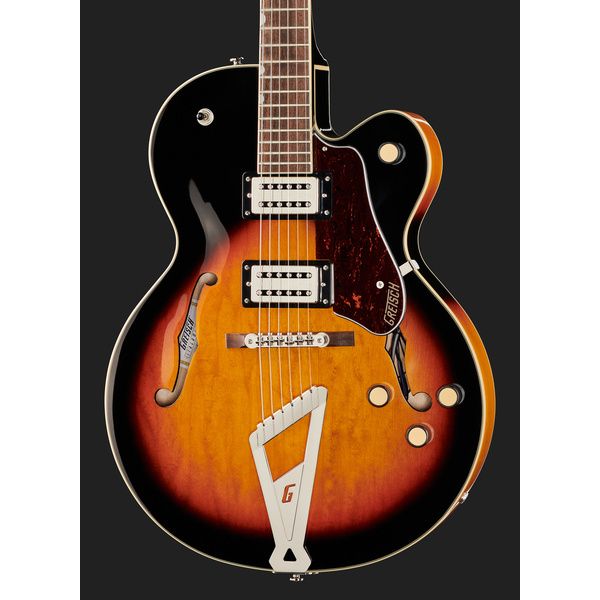
Aged white binding with upgraded purfling, a three-ply tortoise pickguard, nickel hardware and that gold-coloured Gretsch logo on the scratchplate. From three feet away it looks like a much more expensive guitar.
Get closer and you will find the usual budget tells. A slightly proud fret end here, a binding seam there, maybe a tiny finish blemish inside a cutaway.
Nothing that ruins the instrument. Just do not expect the standards of a Japanese-built Gretsch that costs five times as much.
Those Broad’Trons Are Not Filter’Trons
This is the single most important thing to understand before you order one. The Broad’Tron BT-3S pickups are not trying to be vintage Filter’Trons. They are hotter, thicker and far more modern-humbucker in character.
The BT-3S generation mixes Alnico 5 and Alnico 2 magnets, and it is a genuine improvement on the muddy first-run Broad’Trons that shipped in the earliest Streamliners. Tighter lows, clearer highs, stronger mids.
The neck pickup is warm and round – jazz comping, Beatles-flavoured rhythm parts, that sort of job. The bridge has real bite and will happily handle rockabilly, surf or a fuzzy garage riff.
The coil split changes everything
Pull up the master tone knob and both humbuckers split. Suddenly you are in twangy, hollow, chimey territory that sits a lot closer to what most people mean when they say “Gretsch sound”.
FYI this is the most useful control on the guitar, and roughly half the owners I have met have never once pulled it.
If you want that jangle-first flavour in a smaller, more manageable package, the centre-block G2622 Streamliner is the obvious sibling to cross-shop.
Playability Is Better Than You Expect
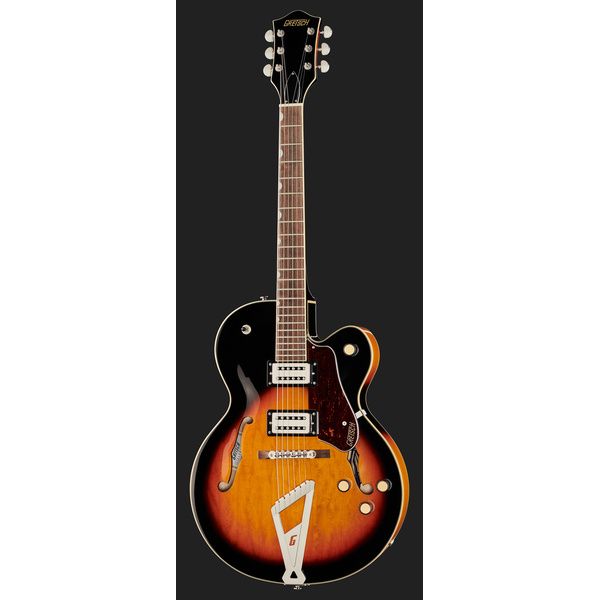
The neck is nato with a soft C profile, a 305 mm (12 inch) laurel fingerboard and 22 medium jumbo frets. Not a baseball bat, not a shred neck – a sensible middle.
Scale length is 625 mm, that Gretsch-ish halfway house between a Strat and a Les Paul. Bends feel easy and string tension is relaxed, which suits the hollow body character nicely.
The bone nut is a genuinely nice touch at this money. Most rivals in this bracket give you cheap moulded plastic and hope you do not notice.
Body depth is the real adjustment. If you have only ever played solidbodies or thinline semis like the Ibanez AM73G, sitting down with this thing takes a couple of sessions to get comfortable.
Where It Gets Annoying
Feedback is a real thing
Fully hollow plus high gain equals squeal. That is physics, not a manufacturing fault, but if your plan was doom riffs at stage volume then you are shopping in the wrong aisle.
At sensible crunch levels it behaves itself. Push a cranked amp and you will spend the gig learning exactly where you can and cannot stand.
The Chromatic II tailpiece
It looks fantastic. It is also mildly irritating to restring, and the ball ends can rattle against the frame if you are careless about seating them.
No Bigsby is a plus for tuning stability and a minus if wobble is your whole personality. Choose your variant accordingly.
It arrives needing attention
Every one of these I have handled came with a serviceable but uninspiring factory setup. A truss rod tweak, a bridge height adjustment and a fresh set of strings transform it.
Budget an hour of your own time or one visit to a tech. Do not judge the guitar until that has happened.
Who Should Actually Buy One
Rockabilly, rock and roll and surf players are the obvious crowd. That is the sound this shape was born for and it delivers it for a fraction of the usual entry fee.
Indie and alt players get a lot out of it too, particularly with the coils split and a bit of spring reverb behind it.
Jazz-curious guitarists should try one. The neck pickup rolled back does a very passable archtop impression for the money.
Beginners? Only if you are certain you want this sound. It is a bigger, more opinionated guitar than something like a standard budget solidbody, and it will not suit every learner.
What Else Would I Look At?
The Epiphone ES-335 is the obvious cross-shop. Smaller, semi-hollow, far more feedback-resistant, and considerably less visual drama.
Want P90 grunt in a Gretsch shell instead? The G5210-P90 Electromatic Jet heads in a completely different direction.
For proper full-hollow vintage weirdness there is the Guild Starfire I DC. And if the Streamliner formula wins you over enough to want the low end too, the Streamliner Jet Club Bass exists as well.
Specs at a Glance
- Type: fully hollow body, single cutaway
- Body and top: laminated maple with parallel tone bars
- Neck: nato, soft “C” profile, high gloss finish
- Fingerboard: laurel, 305 mm (12”) radius, pearloid Neo-Classic thumbnail inlays
- Frets: 22 medium jumbo
- Scale: 625 mm
- Nut: bone, 42.9 mm wide
- Pickups: 2x Broad’Tron BT-3S humbuckers
- Controls: Volume 1, Volume 2, Master Tone with push/pull coil split, Master Volume
- Switching: 3-way toggle
- Bridge: Adjusto-Matic with Chromatic II tailpiece
- Tuners: die-cast sealed, nickel
- Finish shown: Aged Brooklyn Burst gloss
Final Verdict
The G2420 is not a cheap Gretsch pretending to be an expensive one. It is its own thing – a big, loud, slightly unruly hollow body with hot humbuckers and a coil split that unlocks the classic tones when you want them.
It punches enormously above its money on looks, on unplugged volume and on sheer character. It gives ground on fine finishing details, on feedback control at gain, and on out-of-the-box setup.
If you know you want a hollow body and you are not chasing a museum-accurate 1959 tone, this is one of the best value electrics on the shelf right now. Buy it, set it up properly, and enjoy the fact that nobody else in your local scene has one.