Watch It First
There’s a reason the Boss SD-1 has been in continuous production since 1981. It’s on more records than most guitarists realize.
It’s not glamorous. It’s a yellow box with three knobs. But it does one job extremely well, and it’s cheap enough that not owning one feels almost stubborn.
Let’s talk about why this thing refuses to go out of style.
Build Quality
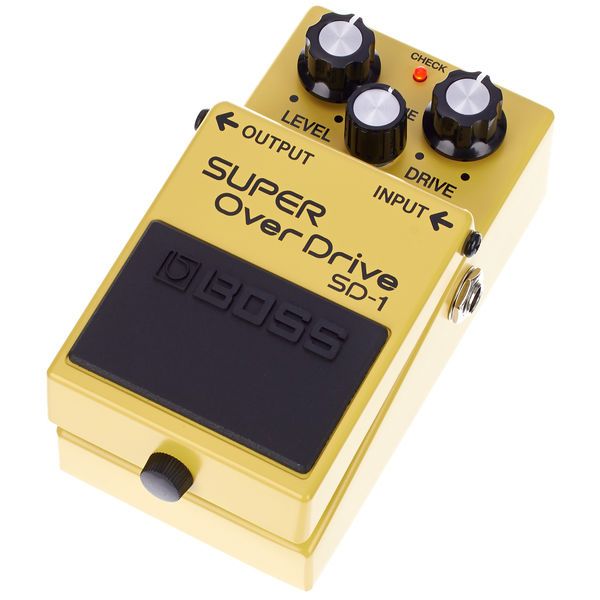
Boss compact pedals are basically the standard everyone else gets measured against. Tank-like casing, a footswitch rated for a stupid number of presses, and a design that hasn’t needed to change in over 40 years.
Battery access is a pain because you have to unscrew the baseplate (classic Boss compromise), but realistically you should just run it off a 9V DC supply anyway.
At 400g and a small footprint, it fits on literally any pedalboard, even one already crammed with a tuner, a delay, and whatever else you’ve collected over the years.
Tone and Sound
Three knobs: Level, Tone, Drive. That’s it. And somehow that’s plenty.
The SD-1 is warmer and slightly more compressed than an Ibanez TS808-style Tube Screamer, with a bit less of that mid-hump honk. Some players prefer it for that reason, others miss the honk. Horses for courses.
As a Boost Into a Dirty Amp
This is the SD-1’s superpower. Drive rolled back to almost nothing, Level pushed up, and it becomes a clean-ish boost that tightens up your amp’s own gain channel.
Rhythm guitarists have been doing this trick forever because it works. Your riffs get punchier without turning into mush.
As a Standalone Overdrive
Into a clean amp, the Drive knob gets you from barely-there grit to a fairly saturated, singing lead tone. It’s not high-gain, and it’s not trying to be.
If you want that, look at something like a MXR Fullbore Metal instead – different tool for a different job.
Playability and Usability
Dead simple. Three knobs, one footswitch, no menus, no presets to dig through. Anyone can dial in a usable tone in about thirty seconds.
It responds well to your guitar’s volume knob too, cleaning up nicely when you back off, which matters more than people give it credit for.
Who It’s For
Basically everyone who plays electric guitar should own an overdrive like this at some point. Blues players, classic rock players, even metal players who want to push their amp’s front end.
If you’re chasing a very specific boutique tone, sure, there are pricier options. But for the money, it’s hard to argue with.
Honest Niggles
The battery compartment thing is genuinely annoying if you ever need to swap a battery on the fly at a gig. Budget an adapter, it’s cheap and removes the whole issue.
It’s also not the most „exciting” pedal on paper. If you’re the type who wants twelve knobs and three footswitches, the SD-1’s simplicity might feel limiting rather than liberating.
And yeah, it’s been the same design forever, so if you want something with USB updates and app control, this obviously isn’t it 😉
How It Stacks Up Against Alternatives
Compared to a budget-friendly option like the Fender Hammertone Breakup Driver, the SD-1 has decades more of a track record and a slightly warmer voicing, though both do a similar job for similar money.
Against a do-everything modeler like the Boss OD-200, the SD-1 obviously has way fewer options – but that simplicity is exactly why so many players never bother upgrading.
If your style leans more toward jazz, check out our roundup of best guitar pedals for jazz – the SD-1 can work there too on a very light touch, but it’s not the first pedal I’d reach for in that context.
A Few Settings to Try
For that classic „always on” boost trick, set Drive to about 9 o’clock, Tone around noon, and push Level until your amp’s front end wakes up. Barely sounds „on” but changes everything.
For a bluesy lead tone, push Drive to 1-2 o’clock and back off Tone slightly so it doesn’t get shrill on the top strings.
For rhythm crunch on a clean amp, split the difference – Drive around noon, Tone slightly bright, Level matched to unity so it doesn’t jump out in the mix.
Takes minutes to explore all three, and that’s kind of the point – no rabbit hole, just tone.
A Bit of Backstory
The SD-1 arrived in 1981 as Boss’s answer to the Tube Screamer craze, and it’s genuinely wild that the exact same circuit is still in production over four decades later.
Plenty of famous guitarists have used one at some point, usually stacked in front of an already-dirty amp rather than as their main distortion source. That’s the trick most people miss when they first buy one.
Boss has never really needed to change the formula because the demand never dried up. That’s rare in an industry that loves reissuing things every few years with a „new and improved” sticker slapped on.
Key Specs
- Type: Overdrive pedal for electric guitar
- Controls: Level, Tone, Drive
- Bypass: Footswitch bypass
- Connections: 6.3mm jack in/out
- Power: 9V battery or 9V DC adapter (not included), ~6mA draw
- Dimensions: 73 x 130 x 60 mm, weight 400g
Final Verdict
The Boss SD-1 isn’t exciting to talk about, but that’s honestly the whole appeal. It just works, on every rig, in every genre that needs a bit of push.
Whether you use it as an always-on boost or your main dirt sound, it’s one of those pedals that quietly earns its spot and never gets sold off in a gear purge.
Budget-friendly, road-proven, and genuinely useful. Hard to go wrong here.