Watch It First
Let’s get the obvious question out of the way: no, this does not make your Strat sound like a real Martin dreadnought. Nothing that plugs into a 6.3mm jack ever will.
What the Boss AC-3 actually does is take your electric guitar’s signal and reshape it into something convincingly acoustic-ish, complete with body resonance and a built-in reverb. For gigs, demos, and „I forgot my acoustic at home” emergencies, it’s shockingly useful.
I’ve used mine more for songwriting sessions and quick recordings than live gigs, honestly, and it’s earned its keep. Here’s the full breakdown.
Four Modes, Four Guitar Personalities
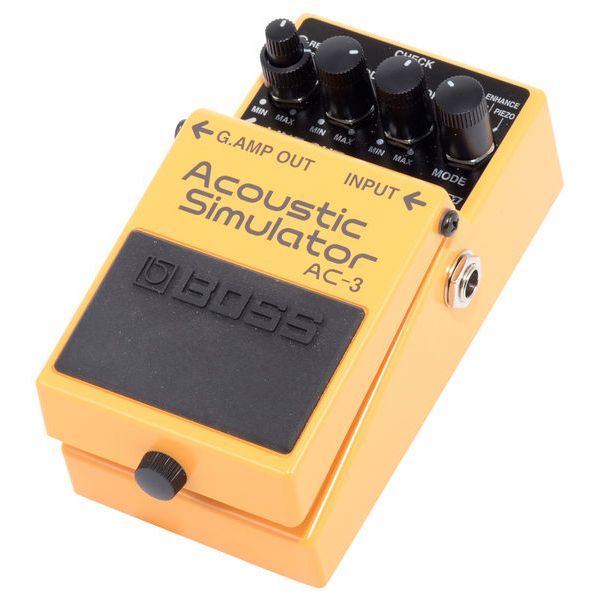
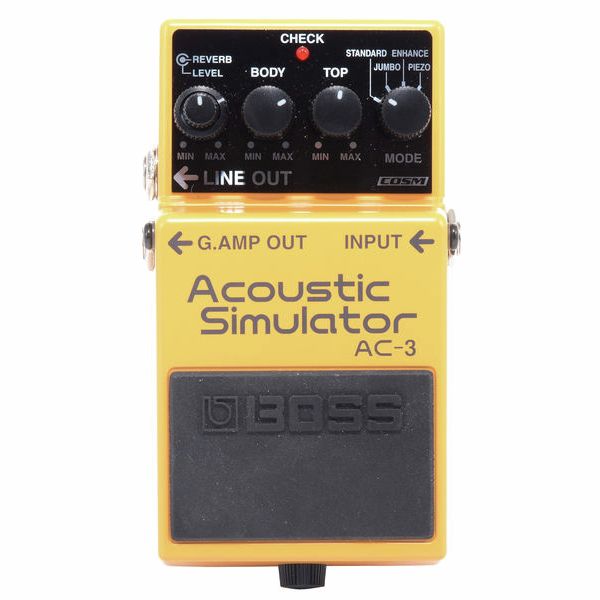
The AC-3 gives you four simulation modes: Standard, Jumbo, Enhanced and Piezo. Standard is your general-purpose acoustic tone, Jumbo pushes toward a bigger, boomier dreadnought character, Enhanced adds a bit of shimmer and detail to help it sit in a mix, and Piezo emulates the slightly quacky, bright character of an actual piezo pickup under the saddle.
On top of Mode, you’ve got Top and Body knobs to shape the simulated top-end brightness and body resonance separately, plus a built-in Reverb knob and overall Level. That’s a genuinely deep amount of shaping for a single compact pedal.
Playability And Controls
Five knobs total (Mode, Top, Body, Reverb, Level) is more than your average Boss compact, but the layout is intuitive enough that you’re not constantly checking labels. It’s 73 x 125 x 55mm and about 440g, so still very much a standard-footprint pedal.
Bypass is true Boss buffered bypass, quiet and reliable, and the LED clearly shows when the simulation is active — handy since the tonal shift is dramatic enough that you really don’t want to forget it’s on.
How It Actually Sounds
With Single Coils
This is where the AC-3 shines brightest. Single-coil pickups translate into something genuinely close to a strummed acoustic, especially in Standard or Enhanced mode with a touch of reverb. It’s convincing enough that people in the room will do a double take.
With Humbuckers
Still usable, but a bit more „processed” sounding — less transparent, more obviously a pedal doing pedal things. Jumbo mode with the Top knob rolled back a touch tends to tame some of that artificial edge.
Through A PA Or Acoustic Amp
This is genuinely the sweet spot. Run it through a flat PA or a dedicated acoustic amp rather than a guitar combo, and the illusion holds up remarkably well. Through a standard guitar speaker cab, it can sound a bit thin and papery — not the pedal’s fault, just physics.
Build Quality
Standard bulletproof Boss construction. Metal casing, solid pots, the kind of footswitch that shrugs off years of stomping. Power draw is 39mA off a 9V battery or the usual Boss adapter (sold separately).
Who It’s For
- Electric players who need a convincing acoustic tone without buying (or carrying) a second guitar
- Solo acoustic-style performers using an electric with piezo or magnetic pickups
- Songwriters who want to quickly sketch acoustic ideas without switching instruments
- Home studio owners who want acoustic-ish textures layered into a mix
If you already own a great acoustic and mic it up properly, this obviously isn’t going to replace that. It’s a tool for a specific problem — no acoustic on hand, or no time to switch guitars mid-set.
Honest Niggles
The „magic” wears off a little with heavy chords or aggressive strumming — it’s at its most convincing with lighter fingerstyle and mid-tempo strumming, and starts sounding more synthetic the harder you dig in.
A few users online mention noise or hiss at higher gain settings, and honestly I’ve noticed a bit of it myself with the Level pushed high. Keep your levels sensible and it’s a non-issue, but don’t expect studio-silent operation if you crank everything.
Where To Put It In Your Chain
Put it first, right after your guitar, before any drive or modulation pedals. It’s modeling an acoustic signal, so anything before it (compression aside) tends to confuse the simulation. A little EQ after it can help it sit better in a full-band mix if the low end feels boomy.
Recording With The AC-3
In a home studio setup, the AC-3 is genuinely handy for demoing song ideas fast. Instead of switching guitars, retuning, and re-micing between an electric part and an acoustic-sounding part, you can print both from the same instrument in the same session.
It’s also a solid trick for layering. Double-track a real acoustic take with an AC-3’d electric part panned to the opposite side, and you get a wider, more textured acoustic bed than either guitar could give you alone — a cheap way to make a demo sound bigger than the gear budget suggests.
Just monitor with decent headphones or flat studio monitors while dialing it in. On bright computer speakers the simulation can sound more convincing than it actually is, and you’ll be disappointed later when you check the mix elsewhere.
Specs At A Glance
- 4 simulation modes: Standard, Jumbo, Enhanced, Piezo
- Built-in reverb
- Controls: Mode, Top, Body, Reverb, Level
- Connectors: 6.3mm input/output, 9V DC adapter input
- Power: 9V battery or 9V DC adapter (not included), 39mA draw
- Dimensions: 73 x 125 x 55mm
- Weight: approximately 440g
Final Verdict
The AC-3 is a niche pedal that does its niche job really well. It won’t fool a sound engineer with a good pair of ears staring right at your electric guitar, but through a PA at a coffee shop gig or layered into a home recording, it’s a legitimately useful trick to have available.
For the price of a decent set of strings, it solves a very specific problem that a lot of gigging and recording guitarists actually run into. IMO that alone makes it worth a spot in the pedal drawer, even if it’s not on your board every single show.
If acoustic tone is what you’re chasing, it’s also worth comparing against a real acoustic like the Seagull S6 or the budget-friendly Cort Earth 100 — sometimes the real thing is still the simplest answer.