Watch It First
Quick heads up before we start: the Epiphone Masterbilt Texan this article was originally slated to cover has quietly vanished from Thomann’s lineup. Discontinued, no restock in sight.
So instead, let’s talk about the Epiphone Dove Studio – a similarly vintage-flavoured, similarly priced acoustic that’s actually in stock right now.
If the Hummingbird is Epiphone’s rock-and-roll acoustic, the Dove is its slightly fancier, wing-adorned cousin. Here’s whether it’s worth your money.
That Instantly Recognisable Look
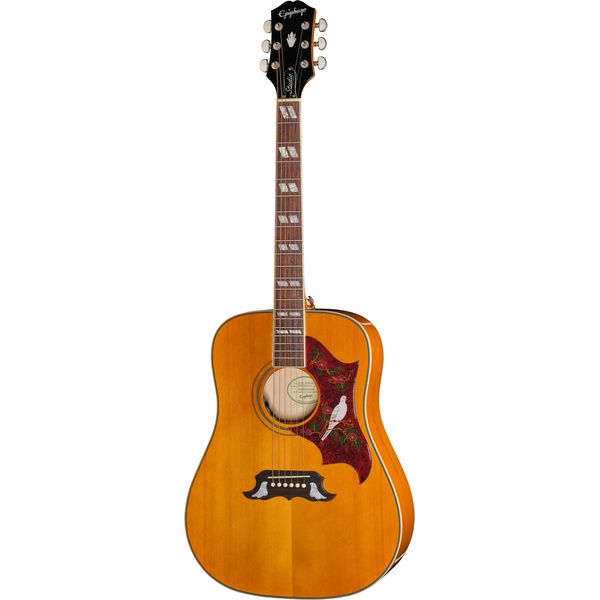
You either love the wing pickguard or you find it a bit much. There’s not much middle ground, and that’s kind of the appeal – it’s a guitar with actual personality, not another beige dreadnought.
The Dove shape has been around since the late 1960s, and Epiphone’s Studio version keeps the signature bird-wing pickguard and split parallelogram fretboard inlays intact.
It’s a jumbo-adjacent dreadnought body, so it’s a bit bigger and boomier in the lower end than a standard dread. Not a small-bodied guitar by any stretch.
Natural gloss finish here, tortoise pickguard, Grover Rotomatic tuners up top. It looks considerably more expensive than it is.
Gibson’s original Dove goes all the way back to 1962, named for the birds carved into its bridge. Epiphone’s Studio version is the affordable way into that lineage without needing a Gibson budget.
Build and Specs
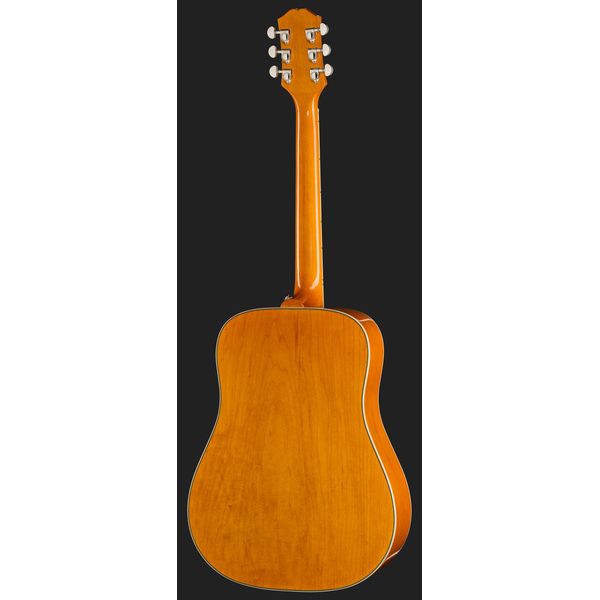
Solid spruce top paired with maple back and sides – maple gives a brighter, more scooped-mid tone than the mahogany you’ll find on most budget acoustics.
Neck is mahogany, fretboard is rosewood with 20 frets, and the whole thing is finished with 6-layer binding on the top and 4-layer on the back – genuinely nice detailing for this price bracket.
Neck and Scale
Scale length is 648mm (25.5″), nut width sits around 43mm (1.69″). Comfortable, standard-feeling dreadnought dimensions, nothing surprising here.
A gigbag ships in the box too, which the Masterbilt Texan this piece was originally going to cover never actually included either. So no real loss there.
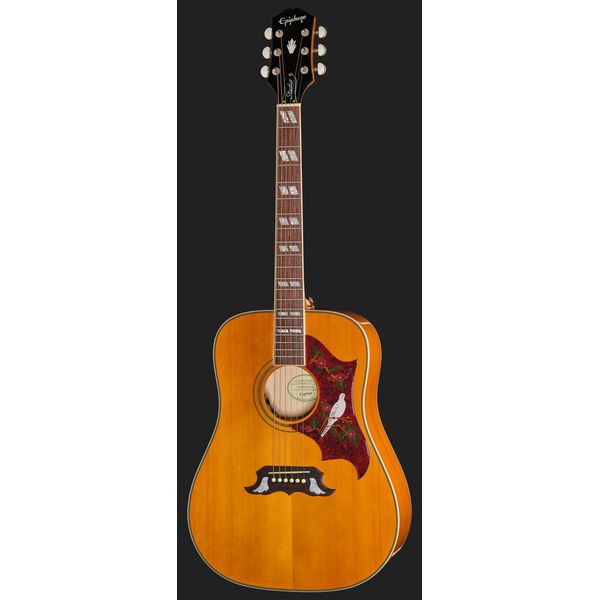
Fun detail: this Studio Acoustic Collection line is a relatively recent addition to Epiphone’s catalogue, and the fit and finish shows it – tighter tolerances and better fretwork than older budget Epiphones from a few years back.
Tone and Plugged-In Performance
Unplugged, the maple back and sides push the tone toward bright and articulate rather than warm and boomy. Chords ring clearly without turning to mud.
Plugged in, the Fishman S-Core pickup does a competent job – not the most nuanced piezo on the market, but perfectly usable for open mics, church gigs, or home recording.
Strummers will probably enjoy this more than dedicated fingerstyle players – the bigger body and brighter tonewood combo favors full chords over delicate picking patterns.
Who’s This For?
Also worth flagging for beginners: the bigger jumbo-adjacent body means more airspace and more resonance, but also more weight and bulk to lug around. If you’re gigging weekly and hauling gear yourself, factor that in.
- Players who want a distinctive, recognisable acoustic that doesn’t look like every other dreadnought on stage
- Strummers and singer-songwriters who need a big, bright, chord-friendly voice
- Anyone chasing vintage Epiphone/Gibson aesthetics without vintage Gibson pricing
If you’re mainly a fingerstyle player after warm, intimate tones, look elsewhere in Epiphone’s range – a mahogany-bodied model will suit you better.
It also suits players who just want to stand out visually. Walk into any open mic with a Dove and you’ll get questions about it – that pickguard shape is genuinely eye-catching, IMO more so than most acoustics in this price range.
Case in point: home recording folks who like a naturally scooped, jangly rhythm sound will get along with this guitar immediately – it sits in a mix differently than a typical mahogany dread, in a good way.
Honest Niggles
The big jumbo-ish body isn’t the most comfortable for smaller players or seated practice sessions – it’s a genuinely large instrument.
Only 20 frets and no cutaway on this particular finish, so upper-fret access is limited. Not really what this guitar is built for anyway.
The Fishman S-Core, while solid, isn’t going to wow anyone used to premium under-saddle systems with dedicated preamps and onboard EQ.
Setup out of the box is generally solid based on owner feedback, though as always with budget acoustics, a proper professional setup after a few weeks of settling in will get the most out of it. Strings, humidity, and a fresh setup make a bigger difference than people expect on any guitar in this range.
How It Compares
Against the Epiphone Hummingbird, the Dove is brighter and bigger-bodied thanks to the maple back and sides versus the Hummingbird’s mahogany.
If body size is a dealbreaker, the Little Martin LX1E sits at the complete opposite end of the spectrum – tiny, travel-friendly, much less volume.
For a smaller-bodied vintage-style alternative, the Martin 000CJR-10E is worth cross-shopping too.
Fans of Takamine’s electronics should also check the Takamine P5DC – a very different tonal character but a strong alternative in a similar price zone.
We’ve also rounded up more big-body options in our best jumbo acoustic guitars guide if the Dove’s size is what’s drawing you in.
Specs at a Glance
- Body type: Jumbo-style dreadnought
- Top: Solid spruce
- Back and sides: Maple
- Neck: Mahogany
- Fretboard: Rosewood, split parallelogram inlays
- Scale length: 648mm (25.5″)
- Nut width: ~43mm (1.69″)
- Frets: 20
- Pickup: Fishman S-Core
- Tuners: Grover Rotomatic
- Includes: Gigbag
Final Verdict
The Epiphone Dove Studio isn’t the guitar we set out to review, but it’s a genuinely strong stand-in for anyone chasing vintage Epiphone character on a budget.
The maple back and sides give it real tonal identity instead of just being another mahogany dreadnought clone, and the build quality punches well above its price tag.
If you strum more than you fingerpick and want something visually distinctive, this deserves a serious look. Recommended.
Just don’t expect the exact vibe the original Texan promised – this is a different guitar with a different voice, and that’s honestly fine.