Watch It First
Marshall’s MG line gets a rough ride online. „Not a real Marshall,” people say, usually the same people who’ve never actually plugged into one. Fair enough, it’s solid-state, not valve, and it’ll never replace a JCM800. But that’s not really what the MG30GFX is trying to be.
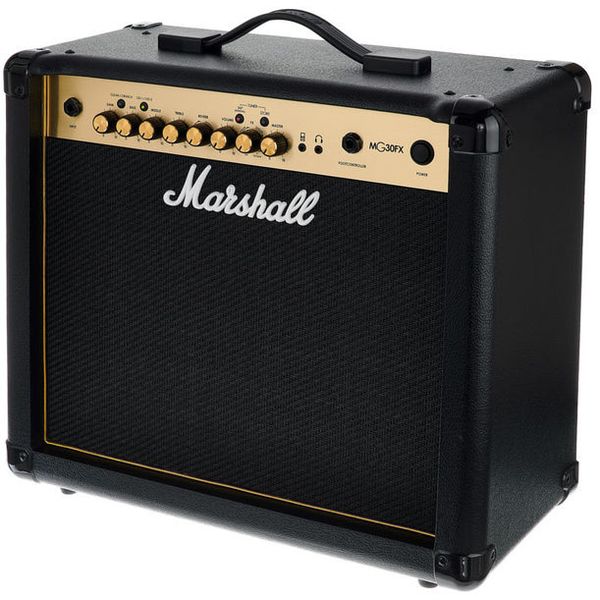
This is the gold-grille, 30-watt combo with a 10″ speaker, four channels, and a built-in FX section – reverb, delay, chorus, flanger, phaser. It’s aimed squarely at bedroom players and small rehearsal rooms who want that Marshall look and enough of the Marshall attitude without tube-amp money or maintenance.
I spent a good while running through all four channels with a Strat and a humbucker guitar to see whether it holds up as an actual practice tool, or whether it’s just a logo slapped on a generic solid-state box. Short answer: it holds up better than expected.
Channels and Controls
Four channels: Clean, Crunch, OD1 and OD2, each with its own gain and a shared 3-band EQ (bass, middle, treble). There’s an optional 4-way footswitch (sold separately, article 223005) that lets you jump between them mid-song, which honestly should just come in the box at this point, but that’s a Marshall thing across the whole MG range, not unique to this model.
Clean is genuinely clean, not „clean-ish with a hint of fizz” like a lot of budget solid-state amps. Crunch nails that Bluesbreaker-adjacent grind at lower gain settings – good for classic rock rhythm work. OD1 and OD2 push further into hard rock and metal territory, and OD2 in particular has enough gain on tap for palm-muted riffing without falling apart into mush.
If you’re weighing this up against Marshall’s bigger sibling, our MG50GFX review covers the same channel layout with more headroom and a bigger speaker – worth a read if 30 watts feels like it might be tight for your space.
One thing worth calling out: the gain doesn’t just get „louder” as you move from Crunch to OD1 to OD2, the character actually shifts too. Crunch keeps a fair bit of pick attack and note definition, which makes it genuinely useful for classic rock and blues-rock rhythm parts rather than just being a stepping stone to the higher-gain channels. It’s the channel I ended up leaving the amp on most of the time.
The Built-In Effects
Digital reverb (studio and „emulated spring”) plus a single assignable modulation/delay effect slot cover most of what a bedroom player needs. They’re not going to replace a real pedalboard – the reverb especially can sound a little glassy at higher mix levels – but for practicing at home or noodling with headphones plugged into the sim-loaded headphone out, they do the job.
Speaking of headphones – the headphone output uses a cab simulation rather than just muting the speaker, which is a nice touch most amps in this price range skip entirely. Late-night practice sessions without annoying anyone: sorted.
Volume, Weight, and Real-World Use
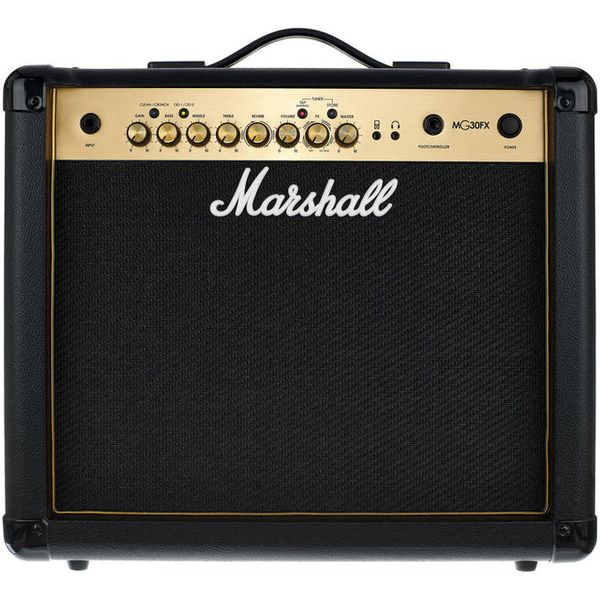
30 watts through a single 10″ doesn’t sound like a lot on paper, but solid-state watts are deceptively loud – it’ll comfortably fill a bedroom or small rehearsal space, and it’d survive an unplugged acoustic gig at a small pub if you really pushed it. It won’t keep up with a live drummer without mic’ing it, but that’s true of basically anything in this price and wattage bracket.
At 10.8kg it’s genuinely portable – one hand, one trip, no dolly required. Compare that to lugging a tube combo up two flights of stairs for a rehearsal and you’ll appreciate it more than you’d think.
If you eventually want to go the modelling-amp route instead of channel-switching solid-state, it’s worth comparing this against something like the Marshall Code 50, which trades the classic MG layout for 100 amp/cab presets and an app. Different philosophy, similar price bracket.
Who Should Buy This (And Who Shouldn’t)
Buy it if you’re a beginner-to-intermediate player who wants a proper Marshall-branded practice amp with usable gain across genres, and you don’t want to deal with tube maintenance or premium pricing. It’s also a solid grab-and-go option for small acoustic-adjacent gigs or jam sessions where you need something louder than a 15-watt practice amp but don’t want to commit to a tube head and cab.
Skip it if tube warmth and amp-in-the-room feel is non-negotiable for you – in that case our Marshall DSL5CR review is a better starting point, albeit at a real step up in price. And if you already run a modeller or multi-FX pedal into a flat power amp, adding another set of onboard digital effects here is redundant – our Zoom G2 Four review talks through that kind of setup.
The Honest Niggles
- No footswitch included – you’ll want one eventually if you use more than one channel per song, and it’s a separate purchase.
- Onboard reverb can get a bit swishy/artificial once you push it past „subtle.”
- No effects loop, so inserting external pedals between preamp and power amp isn’t possible – everything goes in the front.
- No Bluetooth or USB, so if you want backing-track playback you’re stuck with the 3.5mm line/MP3 input.
Specs at a Glance
- Power: 30W into 1x 10″ speaker
- Channels: Clean, Crunch, OD1, OD2 (4-way footswitch sold separately)
- 3-band EQ (bass, middle, treble)
- Digital effects: studio reverb, emulated spring reverb, plus one assignable modulation/delay effect
- Headphone output with speaker cab simulation
- MP3/line input for jamming along
- Dimensions: 480 x 420 x 225 mm, Weight: 10.8 kg
- Finish: black/gold
Worth mentioning too: build quality feels a notch above what the price suggests. The control panel doesn’t wobble, the jacks feel solid, and the grille cloth and gold trim actually look the part on a stage or in photos – not something you’d be embarrassed to bring to a jam session.
Final Verdict
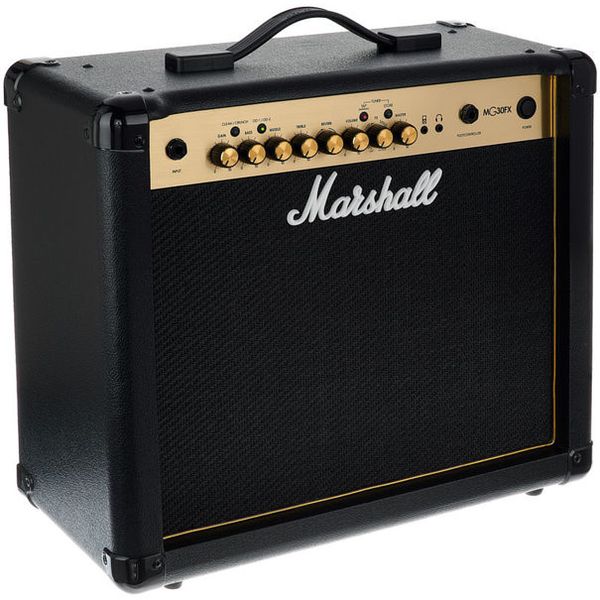
The MG30GFX isn’t trying to fool anyone into thinking it’s a boutique tube amp, and that’s exactly why it works. It’s an honest, budget-friendly practice combo that happens to wear the Marshall script logo and back it up with usable tones across four genuinely distinct channels.
For bedroom players, students, or anyone who wants a grab-and-go amp for small rehearsals, it’s hard to argue with the value here. Just budget for the footswitch, and maybe check our Fender Frontman 10G review too if you want to see how it stacks up against the cheapest alternative in the category before you decide.