Watch It First
Big Muff pedals are a rabbit hole. There are dozens of versions, each one with its own cult following and its own weird quirks.
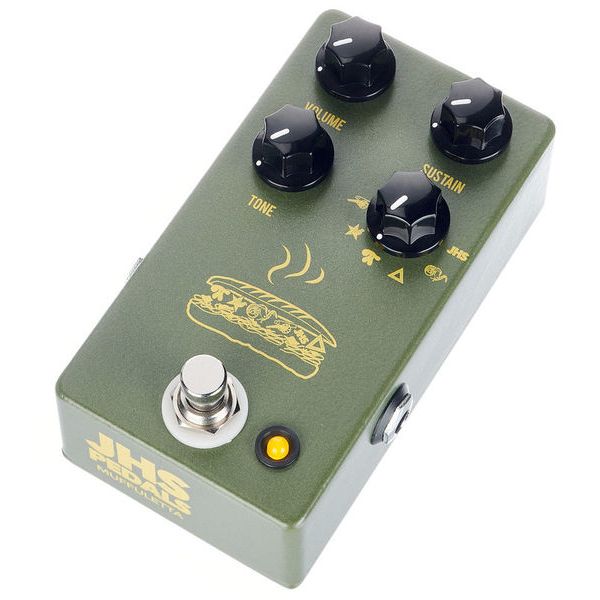
The JHS Muffuletta tries to solve that problem by cramming six different Big Muff voicings into one box. Ram’s Head, Triangle, Pi V3, Russian, Civil War, and JHS’s own house blend.
I was skeptical going in. Multi-mode pedals usually feel like compromises. This one mostly isn’t.
The Pitch: Six Big Muffs In One Box
Here’s the pitch: instead of buying six vintage Big Muffs and hauling them all to a gig, you get one footswitch-sized box that switches between fully analog circuits for each mode.
That last bit matters. JHS didn’t digitally model these fuzz tones. Each mode is a genuinely separate analog circuit, selected with a rotary switch, and digital control just handles the switching logic behind the scenes.
It’s a clever bit of engineering wrapped in a pedal that still just works like a normal stompbox.
The Six Modes, Explained
Turning the selector switch feels like flipping through a museum of fuzz history.
Ram’s Head mode is warmer and more vocal, a favorite for solos. Triangle mode is the earliest, fuzzier and less polished, closer to the original 1970s circuit. Pi V3 sits somewhere in the middle, a bit more modern and aggressive.
Russian mode gets darker and more compressed, that classic Soviet-era Sovtek grind. Civil War splits the difference between Ram’s Head and Russian tonally. JHS Mode is their own custom voicing, tuned to be a bit more usable in a mix than some of the vintage originals.
Six modes sounds like a gimmick until you actually A/B them back to back. They’re genuinely different pedals in personality, not just EQ tweaks on the same fuzz.
Controls Are Refreshingly Simple
Controls are dead simple: Volume, Sustain, and Tone. No paradox of choice here, which is refreshing given how many options the mode switch already gives you.
Sustain is really your gain knob, and it goes from mild grit to full-on wall-of-fuzz depending on the mode you’re in.
One reviewer on Thomann made a fair point: switching modes mid-song isn’t really practical since each mode needs its own Volume/Tone balance. Think of this less as a tap-dancing pedal and more as a way to dial in your perfect Big Muff once, then leave it there.
Build Quality and Power
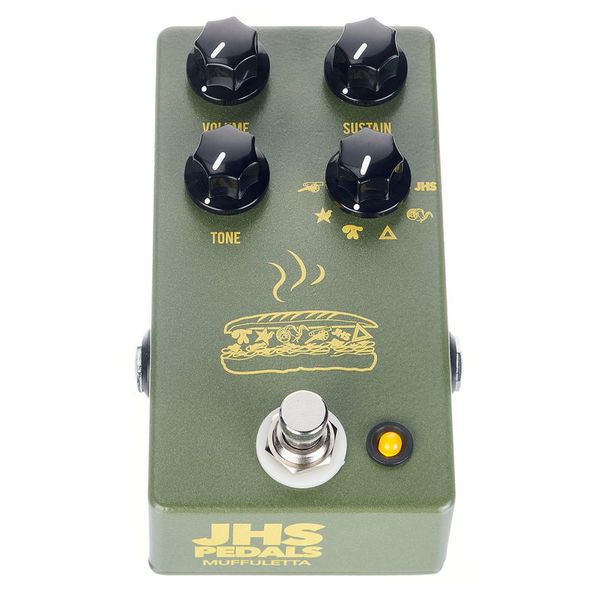
Build quality is what you’d expect from JHS: a proper metal enclosure, true bypass, a clear status LED, and it’s made in the USA.
It runs on standard 9V DC power only. No battery option here, so make sure you’ve got a spot on your power supply free before you buy.
Quick spec rundown:
- Six selectable Big Muff-style fuzz/distortion voicings
- Fully analog circuit per mode, digitally controlled switching
- True bypass
- Volume, Sustain, and Tone controls
- 9V DC powered only (not included), no battery option
- Made in the USA
- 4.8 out of 5 from Thomann customers
Who This Pedal Is Really For
If you’re into thick, wall-of-sound guitar tones, this pedal is basically tailor-made for you. Fans of shoegaze and ambient textures in particular get a lot of mileage out of Big Muff style fuzz, and I cover some of my favorite gear for that sound in my guide to the best guitars for shoegaze and ambient playing.
It’s also a great fit if you’re chasing grunge and stoner rock tones. My roundup of the best pedals for grunge rock leans heavily on fuzz just like this, and the Muffuletta would slot right in.
If fuzz isn’t really your thing and you’re after something with more headroom and less compression, the Wampler Belle Overdrive is a completely different flavor worth reading about, a low-gain, amp-like drive rather than a wall of fuzz.
Running this pedal through a smaller combo changes its character quite a bit compared to a bigger rig. I found it particularly fun paired with something like the Orange Crush 12, where the natural amp breakup stacks with the fuzz for a genuinely nasty tone.
If you’d rather have all this in a multi-effects box instead of a dedicated pedal, the Zoom MS-50G+ has fuzz modes too, though obviously nowhere near as authentic or three-dimensional as six real analog circuits.
Not A Novelty Pedal
Honestly, the biggest compliment I can give the Muffuletta is that it doesn’t feel like a novelty. A lot of „many pedals in one” boxes end up feeling like none of the individual sounds are quite right.
This one nails the assignment because JHS didn’t try to digitally fake anything. Every mode is a real circuit, and it shows in how each one reacts to your playing dynamics.
Is it cheap? No, not really, it sits at a premium price point compared to a single-mode fuzz. But compare that to buying six separate vintage-style Big Muffs, and it starts to look like an absolute bargain.
Worth mentioning: JHS makes a companion pedal called the Packrat that does the exact same trick but for Proco Rat-style distortion instead of Big Muff fuzz. If you love the concept behind the Muffuletta but Rat tones are more your speed, it’s worth a look too, same idea, different flavor of grit entirely.
A Few Honest Downsides
A few honest downsides before you commit. The pedal is noticeably bigger than a standard single-mode fuzz, so it’ll eat more space on a crowded board.
It’s also not the cheapest option in the fuzz world, and if budget is tight, a basic Electro-Harmonix Big Muff reissue will get you close to one of these six tones for a fraction of the price.
There’s also a learning curve. With six modes and three knobs that behave differently depending on which mode you’re in, it takes longer to dial in your tone than a typical one-trick fuzz pedal. Give yourself an evening with headphones before your first gig with it.
The Verdict
If you already know exactly which single Big Muff voicing you want and you’re never going to touch the other five modes, you could save some cash buying that one pedal instead. But if you’re the indecisive type, or you just want maximum fuzz flexibility on one pedalboard slot, the Muffuletta is genuinely one of the smartest fuzz pedals on the market right now.
None of that changes my overall take though. For anyone serious about fuzz tone, or anyone who’s spent years chasing „the right” Big Muff, this pedal answers the question once and for all.
IMO this is the kind of pedal that ends arguments on gear forums. Instead of debating which Big Muff variant is „the best,” you just buy all of them at once.