Watch It First
Delay pedals usually make you pick a lane – warm and vintage, or crisp and modern. The Walrus Audio ARP-87 just refuses to pick.
Four totally different delay voicings live inside this one box, and switching between them changes the entire personality of the pedal, not just the tone.
IMO that flexibility alone justifies the price tag before you even get to how good it sounds.
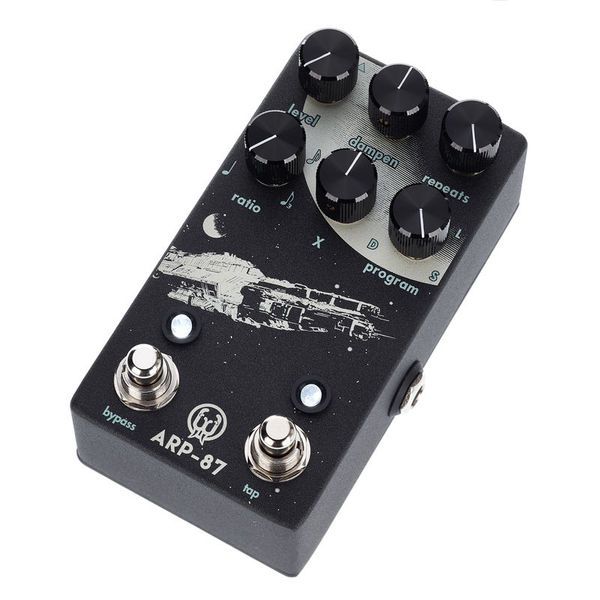
Four Delays in One Pedal
The ARP-87 packs Digital, Analog, Lo-Fi and Slapback delay programs into a single compact enclosure, selectable with a simple toggle. Digital mode is clean and pristine, built for ambient washes and long atmospheric trails.
Analog mode is where most players end up living – warmer, a bit darker on the repeats, closer to an old-school bucket-brigade delay without the noise floor those pedals usually come with.
Lo-Fi mode dirties things up with grit and degradation on each repeat, great for anything shoegaze-adjacent, and Slapback nails that short, tight rockabilly echo without any fiddly tap-tempo math required.
The Controls That Actually Matter
Level, Damps, Repeats and Ratio cover the basics you’d expect: how loud, how dark, how many, and how the delay time relates to your tapped tempo. Nothing revolutionary there.
The X knob is the interesting one. It adds a controllable modulation layer over the repeats, turning a straightforward delay into something closer to a chorus-soaked ambient wash the further you push it. This is genuinely where the pedal separates itself from cheaper competitors.
Combine a dirtier Lo-Fi setting with a heavy X modulation setting and you get sounds that feel closer to a dedicated ambient reverb pedal, from what’s fundamentally a delay unit.
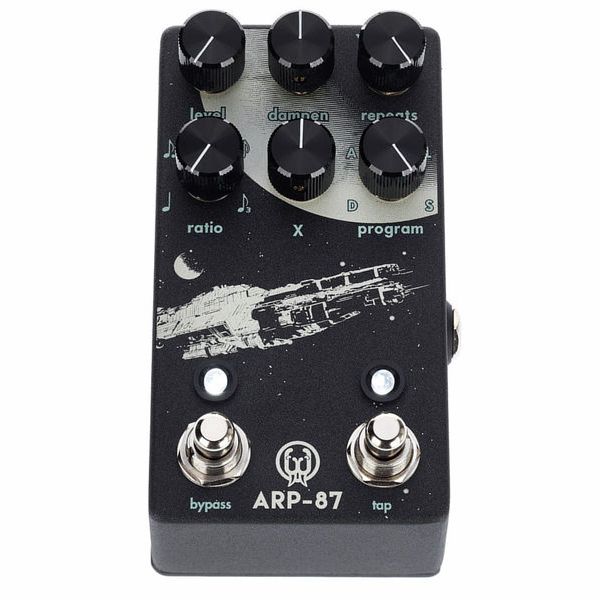
Tap Tempo and Live Features
Tap tempo is standard these days, but the ARP-87 adds sub-division options – quarter notes, dotted eighths, eighth notes, eighth note triplets – so you’re not limited to straight-time repeats. There’s also an input for an external tap switch if you want that on a separate footswitch.
A momentary function lets you hold a footswitch down for a temporary effect rather than a permanent on/off toggle, handy for one-off swells mid-song. Trails mode keeps your repeats ringing out naturally after you switch the pedal off, instead of chopping them off abruptly, which matters a lot live.
How It Sounds in Practice
Set to Analog mode with the X knob barely nudged, this thing does a completely convincing impression of a vintage tape echo – warm, slightly compressed, never harsh. It sits beautifully behind a transparent overdrive, similar in spirit to what we found in our MXR Custom Shop Timmy review, letting the drive do its job while the delay adds space rather than mud.
Crank the modulation and switch to Digital mode, and it opens up into shimmering, almost synth-like textures – genuinely surprising range for a pedal this size. Players chasing ambient or post-rock tones, the kind covered in our best pedals for shoegaze guide, will find a lot to love here.
Where to Put It in Your Chain
Like most delays, the ARP-87 wants to sit toward the end of your signal chain, after drive and modulation pedals, so the repeats carry the full character of everything upstream rather than a plain, unaffected signal.
If you’re running it after a modulation pedal like a chorus, you’ll notice the repeats themselves pick up some of that swirl too, which can sound gorgeous or a bit much depending on your settings, worth experimenting with before committing to a final board layout.
Running it into a reverb afterward, rather than before, tends to give the cleanest sense of space, delay first for rhythmic repeats, reverb after for the ambient tail. It’s a small ordering detail but it changes the whole feel of a wash of sound.
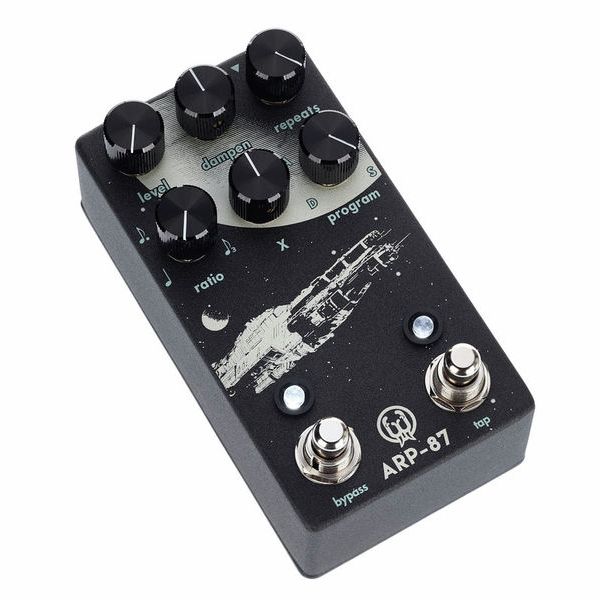
Build Quality and Practical Stuff
True bypass, solid metal enclosure, and it runs on a standard 9V DC power supply at 100mA, no battery option here, so factor a power supply into your order if your board doesn’t already have a spare output.
Dimensions are compact enough to fit most boards without a fight, and the control layout, while dense, stays intuitive once you’ve spent an evening with it.
Who This Pedal Is For
If you only ever want one delay pedal on your board, ever, this is a genuinely strong case for that approach. Bedroom players layering ambient textures over a budget setup like a Squier Sonic Strat will get just as much mileage from this as gigging musicians who need Slapback for a rockabilly set and Digital for the ambient outro of the next song.
Worship and prog players in particular seem to gravitate toward this pedal, reviewers specifically call out the swell and analog modes for exactly that kind of use, and it slots in nicely if your rig already leans toward the picks in our best guitar pedals for jazz roundup, where subtle, tasteful ambience matters more than raw gain.
A Note on Presets and Live Use
The ARP-87 doesn’t offer full digital preset recall the way some higher-end delays do, so if you’re the type who needs to instantly snap between five saved patches mid-set, this isn’t quite that pedal. What it does offer instead is fast, tactile switching between four fundamentally different delay characters using the toggle, which for a lot of players is actually the more useful workflow live, less menu-diving, more just reaching down and turning a knob.
Any Downsides Worth Knowing?
A few users mention the tap tempo doesn’t always register with total consistency, particularly with external tap switches, worth knowing if reliable live tap tempo is a dealbreaker for you.
The control density also means it’s not the fastest pedal to learn on day one. Expect an evening of genuinely getting to know all four modes before you’ve found your favourites.
Specs at a Glance
- Type: Digital multi-mode delay pedal
- Delay time: up to 1000 ms
- Delay programs: Digital, Analog, Lo-Fi, Slapback
- Controls: Level, Damps, Repeats, Ratio, X (Modulation)
- Extras: Tap tempo with sub-division, momentary function, trails function, external tap switch input
- Bypass: True bypass
- Power: 9V DC, 100mA (no battery operation, adapter not included)
Final Verdict
The Walrus Audio ARP-87 earns its reputation by refusing to be just one kind of delay pedal. Four genuinely distinct voicings, a modulation control that adds real depth, and live-friendly extras like trails and momentary mode make this one of the smartest all-in-one delay purchases you can make right now.
Is it the cheapest delay out there? Not even close. But given how much ground it covers, this could realistically be the only delay pedal you ever need to buy.
If you want vintage warmth and modern flexibility in the same box, this is exactly that pedal.