Watch It First
Quick heads up before we start: the original 385 has been replaced by the MKII, so that’s what I’m covering here. Same weird origin story, more features.
And that origin story really is weird. Walrus Audio modeled this pedal’s drive circuit on the tube amp inside a Bell and Howell „Filmosound 385” – a vintage film projector, not a guitar amp at all.
Sounds like a gimmick. It mostly isn’t. Here’s why.
Tone – Genuinely Amp-Like Dynamics
The whole pitch of the 385 is that it reacts to your picking dynamics the way a tube amp would, not like a typical solid-state overdrive circuit. Dig in and it pushes back a bit; play soft and it cleans up. That part genuinely works.
It runs internally at 18V specifically to chase that extra headroom, and you can hear it – there’s a looseness and touch-sensitivity that a lot of overdrives in this price range don’t have.
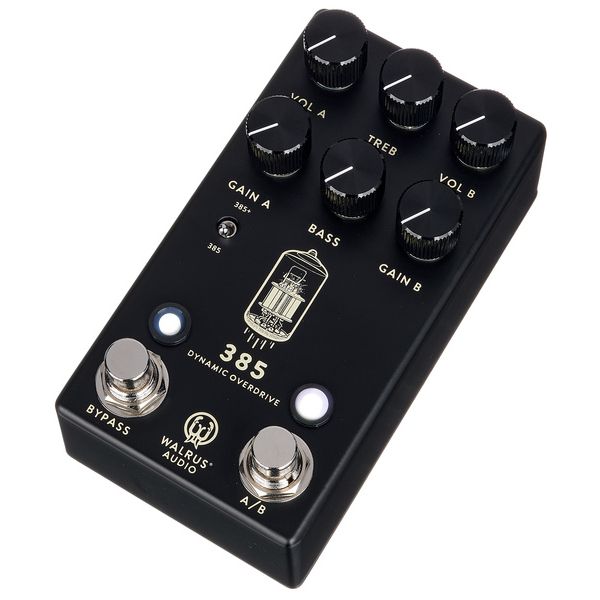
The MKII adds a second channel with its own Volume and Gain, so you get two completely different voicings on tap via the A/B footswitch – light crunch on one side, thicker saturation on the other, no need to kneel down and turn knobs mid-set.
Flip the 385+ switch and it slams the front end for a noticeably thicker, more sustained tone – genuinely useful for pushing from rhythm crunch into lead territory without stepping on a second pedal.
Active bass and treble controls (cut and boost, not just attenuation) mean you can genuinely reshape the voicing rather than just nudging it. Handy if your amp already has a certain character you want to lean into or away from.
What really separates this from generic drives is how it behaves at the edge of breakup. Roll back your guitar’s volume knob and it cleans up in a genuinely amp-like way rather than just getting quieter and staying fizzy – that’s the „film projector tube amp” DNA actually showing up in how the pedal responds, not just in the marketing copy.
Build and Usability
Made in the USA with Walrus Audio’s usual excellent fit and finish – solid enclosure, that soft-click relay-based true bypass switching that feels genuinely premium underfoot compared to a standard mechanical footswitch.
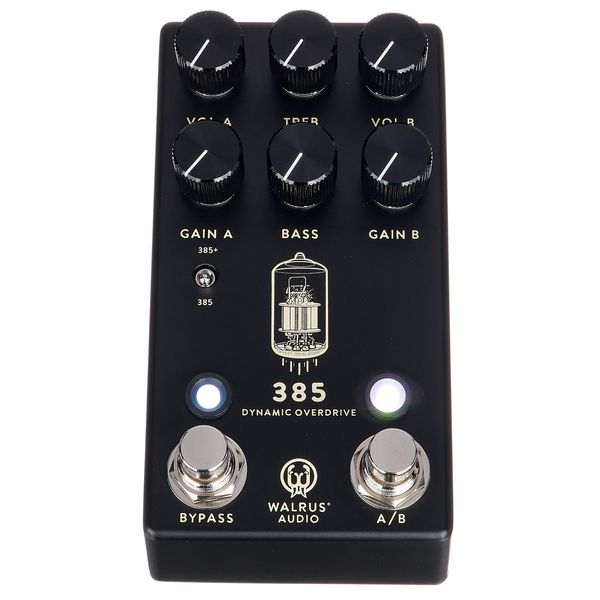
Six knobs (Volume A, Gain A, Treble, Bass, Volume B, Gain B) plus two footswitches on a compact 12.1 x 6.6cm chassis is a lot packed into a small space. It’s dense, but Walrus laid it out sensibly – no accidental knob bumps during normal play.
Because it runs at 18V internally, it’s a little pickier about power than your average pedal. Walrus recommends an isolated supply, and you genuinely want to follow that advice – noise issues on a shared, unisolated daisy chain are a real possibility here.
The top-mounted jacks are a small but appreciated design choice too – easier to fit on a crowded pedalboard without your cables sticking out the sides and colliding with neighboring pedals.
Who It’s For
Players who already own a couple of transparent or Klon-style drives and want something with more amp-like character and genuine two-channel flexibility. If you’ve looked at the MXR Custom Shop Timmy and wanted a second, more aggressive voice built into the same box, this is basically that.
It’s especially good in front of an already-driven valve amp – something like the Blackstar TV-10 A or a similar boutique-style combo – where the dynamic response of the pedal and the amp complement each other rather than fighting.
Gigging players who want two distinct tones without a second pedal will get real mileage out of the A/B switching. It’s less aimed at total beginners – the sheer number of controls means there’s a learning curve before you find your sound.
Guitarists running a leaner rig – just guitar, one drive, one amp – will also appreciate how much ground this covers on its own. You’re essentially carrying two pedals in the space of one, which matters if your board (or your back) is already at capacity.
The Honest Niggles
Price is firmly in premium territory, and that’s before you factor in needing a good isolated power supply to get the best out of it. Budget for that if you don’t already have one.
Some users have found the shared bass and treble controls across both channels a bit limiting – you can’t fully independently EQ channel A and channel B, only the gain and volume are separate. If you wanted two completely distinct tonal characters rather than two gain stages of a similar voicing, that’s worth knowing going in.
It’s also not a one-trick „boost and go” pedal – there’s a real learning curve to dialing in both channels well. If you want something simpler and more grab-and-go, a Cry Baby or a straightforward single-channel overdrive will get you playing faster.
If your rig is built more around amp gain than pedal gain – say you’re running something like the Orange Super Crush 100 – you might find you don’t need this much overdrive on your board at all. Worth being honest with yourself about how much of your tone is coming from the amp before adding a pedal this capable.
A couple of user reviews also mention the shared EQ feeling a bit fussy depending on playing technique – fingerstyle versus pick attack can shift how the treble and bass response reads. Not a flaw exactly, more a case of needing to actually dial it in for your specific playing style rather than expecting a one-size-fits-all setting.
Specs at a Glance
- Dynamic dual-channel overdrive inspired by a vintage film projector tube amp
- Controls: Volume A, Gain A, Treble, Bass, Volume B, Gain B
- A/B channel switch plus 385+ extra gain stage switch
- Active bass/treble cut and boost
- Runs internally at 18V for extended headroom
- Relay-based soft-click true bypass footswitch
- Powered by 9V DC, isolated supply recommended (not included)
- Dimensions: 12.1 x 6.6 x 3.5cm, made in USA
Final Verdict
The 385 MKII is a genuinely interesting overdrive in a market absolutely flooded with samey Klon clones. The film-projector backstory is a fun bit of trivia, but the dynamic response and dual-channel flexibility are the real reasons to care.
It’s a premium pedal and it asks a bit more of you than a plug-and-play drive – both in price and in the time it takes to actually dial it in. But if you put in that time, you end up with two genuinely usable, amp-like overdrive voices in one box.
Worth the money if you’re the type of player who actually uses two distinct gain stages live. If you just want one great always-on drive, there are simpler (and cheaper) ways to get there – but if you want a pedal that rewards you for actually learning it, this is one of the more interesting overdrives on the market right now.