Watch It First
Before you read another word, watch this. LowEndLobster puts the American Pro II through its paces and honestly nails most of what I’m about to say anyway.
I’ve owned three Precision Basses over the years. Never all at once, mind you — money doesn’t work that way. But every time I sold one, I regretted it within a year and bought another.
This one’s different though. This is the cheapest way into a genuinely US-made Precision Bass right now, and that matters more than it sounds like it should.
Why „Cheapest US P-Bass” Even Matters
Fender discontinued the American Performer series a while back. That was the old answer to „what’s the cheapest Made-in-USA P-Bass.” It’s gone now.
So the new answer is the American Professional II. It sits below the American Ultra II in Fender’s US lineup, and it’s the entry point if you want a bass stamped „Made in USA” without remortgaging anything.
Is it still a serious investment? Sure. But relative to the rest of Fender’s American range, this is the value play — punches well above its position in the lineup.
First Impressions
Pull it out of the case (yes, it ships with a proper Fender case, not a gig bag) and the finish quality is obvious immediately.
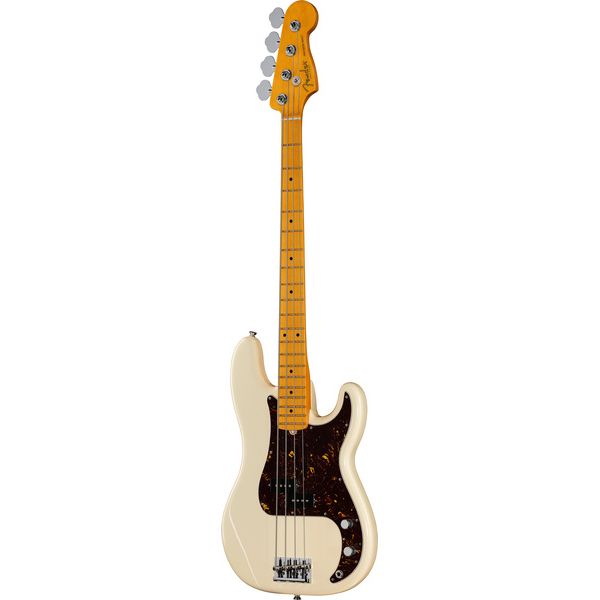
Mine — well, the one I tested — came in Olympic White with a maple board. Clean, classic, no-nonsense. Exactly what a Precision Bass should look like IMO.
The alder body is lighter than you’d expect looking at it. One reviewer on Thomann mentioned theirs was surprisingly light too, so this isn’t a one-off.
Build Quality
The neck profile is what Fender calls the „1963 C” shape. It’s a touch chunkier than a Jazz Bass neck, thinner than a lot of vintage Precisions, and it sits right in that sweet spot most players land on eventually.
If you’ve spent years on a Jazz Bass neck, expect an adjustment period. It’s wider at the nut (41.3mm) and some players actually prefer it once their hand relaxes into it.
Hardware is nickel/chrome with a Hi-Mass bridge, which adds sustain and a slightly tighter low end compared to the vintage-style bent-steel bridges. Not everyone likes that. I do.
One genuine gripe from owners: truss rod access isn’t great. You’ll want an actual truss rod wrench and a bit of patience, or a tech, if you need an adjustment. Not a dealbreaker, just annoying.
Fretwork and Fingerboard
20 frets, 9.5″ radius fingerboard, long scale (34″). Nothing exotic here — this is Fender playing it straight, which is exactly what you want from a Precision Bass.
The maple board option (like the one pictured) gives you snap and clarity. If you want something warmer and less zingy, Thomann also carries the rosewood board version in a couple of finishes.
Sound
This is where the American Pro II actually earns its keep. The V-Mod II split-coil pickup is not the same pickup as the old American Professional (the first one, without the „II”). Fender retooled it, and you can hear it.
It’s got more midrange growl than you’d expect from a passive P-Bass pickup. Not scooped, not polite. It sounds like a Precision Bass is supposed to sound — thick, woody, a little aggressive when you dig in.
Rolling the tone knob back gets you into vintage thump territory fast. Dime the tone and you’ve got enough top-end snap for slap, even though, let’s be honest, nobody buys a P-Bass primarily to slap on it.
Compared to the discontinued American Performer P-Bass (which had two pickups, P plus a bridge single-coil), this one is more purist. Single split-coil, passive electronics, one volume and one tone. If you wanted the extra tonal flexibility of the Performer’s bridge pickup, that specific option isn’t around anymore — this is the direct heir, and it trades some versatility for a punchier, more focused voice.
Genres It Actually Suits
- Rock and punk — the midrange growl cuts through a wall of guitars easily
- Funk and fingerstyle — classic thump, responds well to muting
- Country and Americana — clean and warm when you back off the attack
- Studio session work — reliable, predictable, mic’s it well
Where it’s less at home: if you need active electronics, a five-string range, or a super scooped modern metal tone. That’s just not this bass’s job.
Playability
Setup out of the box was, in my experience with these, close to perfect. Thomann’s own reviewers note the same thing, though one mentioned action was higher than they liked — that’s a five-minute truss rod and saddle job for a tech, not a flaw in the instrument.
Balance on a strap is excellent. It doesn’t neck-dive, which some P-Basses with lighter bodies can be prone to.
Upper fret access is genuinely improved over older American Standard-era Precision Basses thanks to a redesigned neck heel. If you’re the kind of bassist who actually plays past the 12th fret (be honest, most of us don’t much), you’ll notice.
Compared to something like a Harley Benton PB-50, this is obviously a different tier of instrument — better fret finishing, more consistent neck relief, and hardware that won’t need replacing in two years. You’re paying for exactly that jump.
Who It’s For
This bass makes sense if:
- You’ve been playing for years and know a P-Bass is „your” sound
- You want a USA-built instrument without going all the way up to the Ultra II or a Custom Shop build
- You gig regularly and need something reliable that also sounds great in the studio
- You’ve outgrown a budget bass and want the „forever” instrument
It doesn’t make as much sense if you’re just starting out — there are far cheaper ways to learn on a P-Bass shape, and you don’t need this level of build quality to learn where the notes are.
Honest Cons
Nothing’s perfect, so let’s not pretend.
Truss rod access is fiddly, as mentioned. Some units arrive with the action set higher than most players want — budget for a setup, or ask your dealer to do one before it ships.
It’s also, by definition, a one-trick pony. Single pickup, passive, no coil-splitting tricks, no active EQ. If you want a Swiss army knife bass, look at something like a Warwick RockBass Streamer 4 instead. This is a purist’s tool, and it knows it.
And yeah — it’s still a premium price point even as „the cheap one” in Fender’s US range. That’s just the nature of Made-in-USA manufacturing costs right now.
Comparison to Alternatives
If you want that Precision tone without the USA price tag, the Vintera II Road Worn ’60s Precision Bass gets you closer to vintage vibe at a friendlier price, made in Mexico rather than the US.
Prefer something completely different in feel? The Sire Marcus Miller M2 is a favorite among gigging bassists on a budget, though it’s a P/J config rather than a pure Precision voice.
None of them are „better” outright. They’re just different tools for different budgets and different ears.
Specs at a Glance
- Body: Alder
- Neck: Maple, bolt-on, „1963 C” profile
- Fingerboard: Maple (rosewood also available)
- Scale length: 34″ (long scale)
- Fingerboard radius: 9.5″
- Frets: 20
- Nut width: 41.3mm
- Pickup: 1x V-Mod II Precision split-coil
- Controls: 1x Volume, 1x Tone (passive)
- Bridge: Hi-Mass, nickel/chrome hardware
- Includes: Fender hardshell case
Final Verdict
Is this the cheapest Precision Bass you can buy? Not even close. Is it the cheapest one that says „Made in USA” on the neck plate? Yes, and that distinction is exactly why it exists in Fender’s lineup.
The American Performer that used to hold this spot is gone. The American Professional II picked up the torch, and honestly, it carries it better — tighter build, a genuinely improved pickup, and a neck that feels more refined than what it replaced.
If you’ve been circling a US-made P-Bass for years, telling yourself you’ll „get there eventually,” this is where „eventually” should land. It’s not cheap in absolute terms. It IS the entry ticket to a tier of instrument that used to cost a lot more to access.
Try one before you buy if you can. But if you already know you want that Precision Bass thump from an American-built instrument, you’re not going to be disappointed here.