Watch It First
Third V-shape on this site in a week. At this rate I am going to start dreaming in pointy headstocks.
But hear me out, because the Jackson JS32 King V is not just „the Kelly with the wonky wing straightened out”. It plays differently to the Jackson Kelly JS32 I wrote up a couple of days ago, and it is a completely different animal to the two Flying Vs before it.
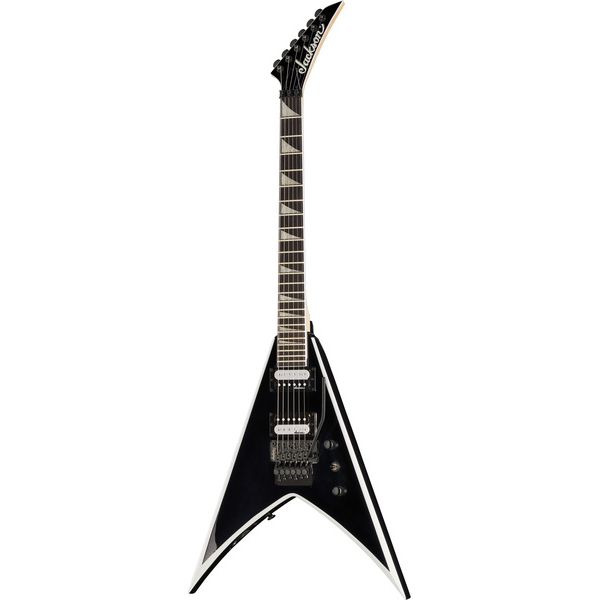
This is the symmetrical one. Both wings the same length, the Dave Mustaine and Robbin Crosby silhouette, and the cheapest way I know to get a licensed Floyd, 24 jumbo frets and a compound-radius neck under one pair of hands.
The Shape Is the Whole Point, and Also the Whole Problem
Let us not pretend otherwise: nobody buys a King V because it is practical. You buy it because it looks like it wants to start a fight in a car park.
Standing up, it is genuinely lovely. The two wings balance each other, the strap button sits far enough back that the neck does not dive, and the upper horn tucks into your ribs in a way the Kelly never quite manages.
Sitting down is a negotiation. Classical position works. Sofa position does not. If most of your playing happens on the end of a bed with a laptop on your knee, the Dinky Minion will make you far happier, and I say that as someone who loves this shape.
Also worth knowing before you order: it will not fit in a normal gig bag. Jackson does not include one, and the V-shaped cases are not cheap. Factor that in.
The Neck Is Genuinely the Best Bit
This is where the JS32 stops being a poster and starts being a guitar. The neck is one-piece maple, bolt-on, with graphite reinforcement rods and a scarf joint at the headstock.
That is not a normal spec at this money. The graphite keeps the neck stable when the seasons change, and the scarf joint means the headstock is far less likely to snap off if the guitar takes a tumble.
The fingerboard is amaranth (purpleheart, basically) with a compound radius that runs from 12 inches at the nut to 16 inches at the 24th fret. Chords feel comfortable down low, and by the time you are up in the dusty end the board has flattened out enough that big bends stop choking out.
Scale is the full 648 mm / 25.5 inches, nut width is 42.8 mm, and there are 24 jumbo frets with sharkfin inlays. Fretwork on the two I have handled was fine. Not Prestige-level fine, but no sprouting ends and no rattly high notes.
About That Floyd Rose
The bridge is a Jackson double-locking licensed Floyd. It is not an Original, it is not a 1000 Series, and you will notice.
It holds tune well enough for a set. Dive, return, still roughly in tune. Do a fifteen-minute abuse session and it drifts. The knife edges are softer than a German Floyd, so they will wear faster if you live on the bar.
The real cost is time. Restringing a locking trem the first time is a rite of passage, and if you have never done it, budget an hour and a lot of swearing. FYI, buying a couple of trem-block wedges is the cheapest sanity upgrade you will ever make.
How It Actually Sounds
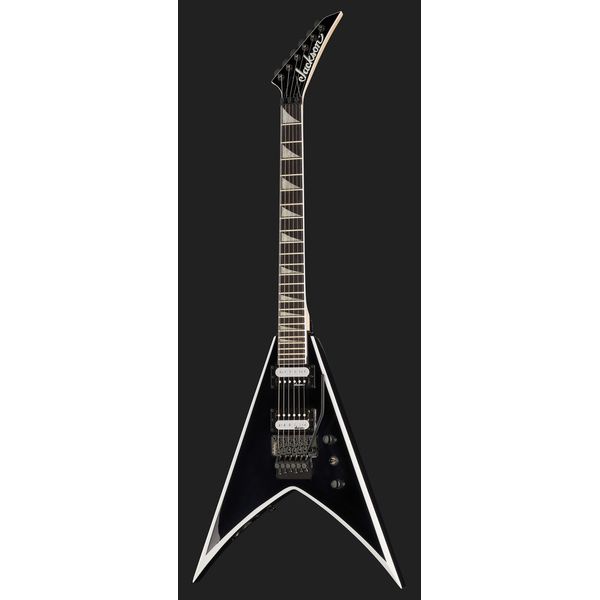
Two Jackson High Output humbuckers, one volume, one tone, three-way switch. That is the whole electronic story, and honestly that is fine for what this guitar is.
The bridge pickup is hot, ceramic-flavoured and aggressive in the upper mids. Palm-muted chugs are tight, tracking is good, and it does not get flabby when you tune down a step.
The neck pickup is the weaker of the two. It is dark and a little wooly, and it sits slightly too far under a wall of low-mids for my taste. Usable for leads, less fun for clean arpeggios.
Cleans in general are the compromise here. It will do a passable clean tone if you roll the volume back, but you are not buying this to play jazz standards. If you want something that does both ends of the spectrum, an Ibanez RG421 is a more versatile shape and a more versatile guitar.
The Bits That Annoy Me
- Stock strings are rubbish. Change them the day it arrives, then set the trem up properly.
- Neck pickup is an afterthought. A pickup swap is the obvious first upgrade.
- No case, no bag, no way to store it safely. Budget for one.
- Poplar body rather than the basswood the white version uses. Slightly brighter, slightly heavier. Not a dealbreaker, but Jackson quietly changed this and did not shout about it.
- Locking nut means no quick tuning tweaks. If you play in three tunings a night, buy something with a hardtail instead.
Who Should Actually Buy One
If you have wanted a V since you were fourteen and the real ones cost more than your car, this is the sensible way to scratch that itch. It is a proper, giggable, well-built guitar and nobody in the third row can tell what you paid.
If you are buying your first electric, do not start here. Start with something that sits on your lap. Come back for the V when you already play.
And if it is specifically the shape you love rather than the metal, the Epiphone Flying V 70s is warmer, easier to live with and better at rock and roll. The Gibson 70s Flying V is the same idea with a much bigger bill attached.
For pure metal value, the only thing I would cross-shop at this level is a Schecter, and that is a much more conventional-looking guitar. Which is rather the point of buying a King V in the first place.
Specs at a Glance
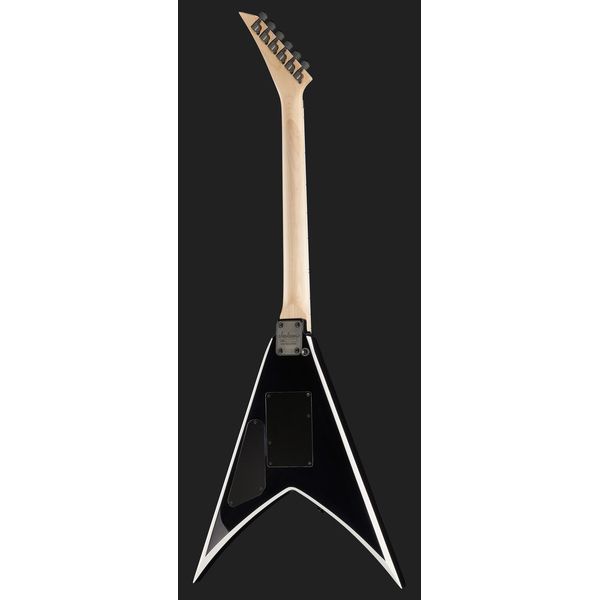
- Body: poplar, black with white bevels
- Neck: one-piece bolt-on maple, graphite reinforced, scarf joint
- Fingerboard: amaranth, compound 305 mm to 406 mm radius (12 in to 16 in)
- Frets: 24 jumbo, sharkfin inlays
- Scale: 648 mm (25.5 in), nut width 42.8 mm
- Pickups: 2 x Jackson High Output humbuckers
- Controls: volume, tone, 3-way switch
- Bridge: Jackson double-locking licensed Floyd Rose
- Hardware: black, sealed die-cast tuners
- Thomann item number: 463379
Final Verdict
The JS32 King V is one of those guitars where the spec sheet does more work than it should. Compound radius, graphite-reinforced neck, 24 jumbo frets and a double-locking trem, at a price where most brands are still shipping 22 frets and a hardtail.
It is not perfect. The neck pickup is dull, the Floyd is a licensed one and behaves like it, and you will spend money on a case. But the fundamentals – neck, frets, geometry, balance – are genuinely good, and those are the things you cannot fix later.
IMO this is the best pure-value V-shape Jackson currently sells, and it is still the guitar I would hand to someone who says they want to look like they play in a thrash band. Buy it, restring it, wedge the trem, and go and be loud.