Watch It First
Right, confession. I nearly did not write this one up, because on paper the M-200DX is the least exciting guitar ESP makes.
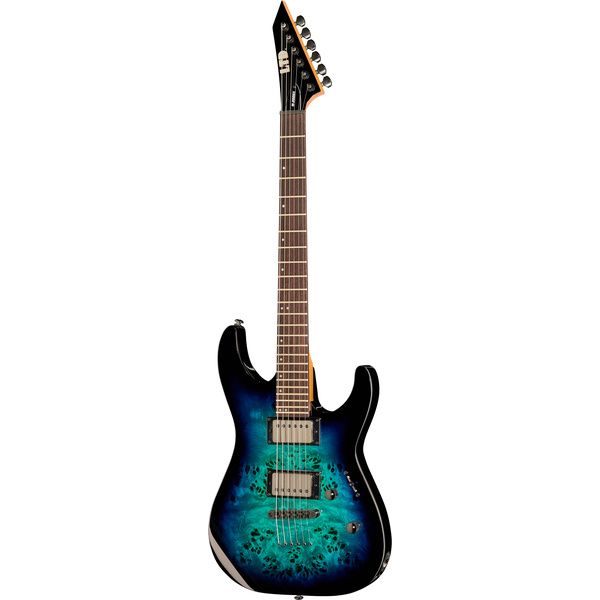
No Floyd. No pointy wings. A poplar body and a burl top in Blue Burst. It looks like the guitar your sensible cousin bought.
Then I plugged it in, found the push-pull coil split, and spent an hour not putting it down. So here we are.
A Hardtail Superstrat, Which Is Rarer Than You Think
Most cheap metal guitars want to sell you a tremolo, because a trem looks like value on a spec sheet.
The M-200DX does the opposite. Tune-o-matic bridge, strings through the body, no trem at all. Nothing to set up, nothing to knock out of tune, nothing to fight when you break a string mid-set.
That single decision makes this a very different proposition to the LTD M-1000HT only in price, not in philosophy. It is the same idea done cheaply.
And the Neck Is Roasted Maple
At this price. Roasted maple. Still slightly baffles me.
Roasting the timber drives moisture out, which makes the neck more stable against humidity swings and gives it that dry, satin-y feel straight out of the box.
Profile is ESP thin U with a 42 mm nut, and the fingerboard radius is a properly flat 350 mm — about 13.8 inches. Set your action low and it stays low.
The Coil Split Is the Whole Story
Two LTD LH-150 humbuckers, one volume, one tone, three-way toggle. Standard stuff.
Except the tone knob is a push-pull, and pulling it splits both humbuckers to single coil. Not a fake tap, an actual split.
Pushed in, it is a blunt instrument — tight, ceramic-flavoured, made for downtuned riffing. Pulled out, it gets thin and glassy in a way that is genuinely useful for cleans, funk parts and anything where a full humbucker just sits on top of the mix.
Does It Sound Expensive?
No. Let us be honest with each other.
The LH-150s are competent rather than characterful. Under heavy gain they do the job convincingly; on the edge of breakup they lack the dynamic response you get from something like the Fishman set in the MH-1000.
But the guitar underneath is good enough that a pickup swap down the line would be money well spent, rather than lipstick on a pig.
Build Quality and the Bits ESP Cheaped Out On
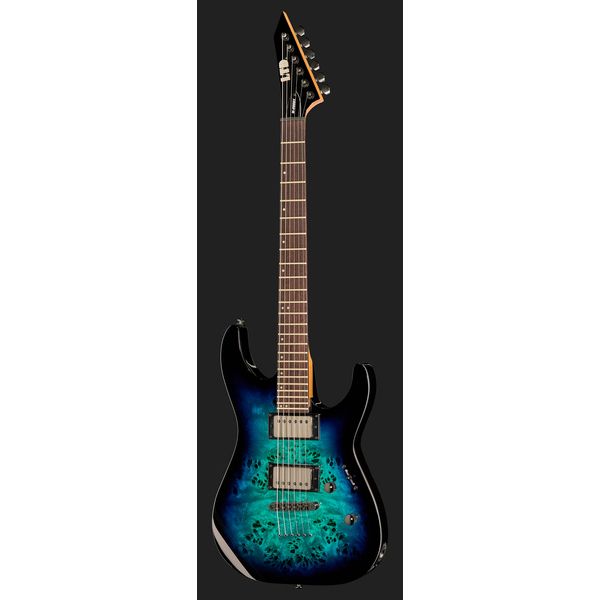
Poplar body with a poplar burl top and a natural binding line around the edge. Poplar is light, so this thing is a genuine relief on the shoulder after a couple of hours.
Fretwork on the one I played was tidy. 24 XJ frets, ends dressed properly, no sprouting.
The nut is the weak link. It is plastic, it is cut a fraction high from the factory, and it is the first thing I would take to a tech. That is a common complaint from owners too, not just me being fussy.
Die-cast LTD tuners are fine. Not locking, not smooth, but they hold.
Who Is This Actually For?
- Somebody buying their first proper metal guitar who does not want to learn Floyd Rose maintenance in week one.
- Anyone who needs a reliable backup that will not throw a tantrum on stage.
- Players in bands where one song needs cleans and the next needs chugs — the coil split earns its keep here.
- Anyone with a bad back. Seriously, poplar is light.
It is not for you if you want to dive-bomb. Go and read the H3-1000FR review instead and start saving.
Against the Obvious Rivals
The main competition at this money is Ibanez, and it is a close-run thing.
The Ibanez GRG131DX is thinner-necked and even more shred-focused, but you lose the coil split and the roasted maple.
Within ESP itself, the LTD TE-200 is the same money in a Tele shape if you want something less obviously metal. And the wider LTD range roundup is worth a skim if you are still shopping.
The Niggles
- Plastic nut, cut high. Budget a setup.
- Factory action was too tall on every one I have tried. Ten minutes with an allen key fixes it.
- Pickups are the ceiling on this guitar, not the wood.
- No locking tuners, and string changes are slower than you would like through a string-thru body.
- The burl top is a thin veneer, not a carved cap. Looks great, but do not pretend otherwise.
Specs at a Glance
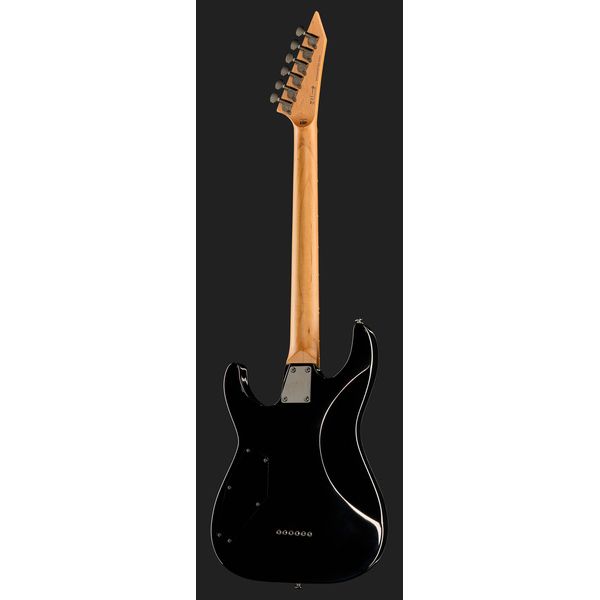
- Body: poplar with poplar burl top
- Neck: bolt-on roasted maple, thin U profile
- Fingerboard: rosewood, 350 mm (13.78″) radius
- Frets: 24 XJ
- Scale: 648 mm (25.5″)
- Nut width: 42 mm
- Pickups: LTD LH-150B bridge and LH-150N neck humbuckers
- Controls: volume, tone with push-pull coil split, 3-way toggle
- Bridge: Tune-o-matic with string-thru body
- Tuners: LTD die-cast, black hardware
- Finish: Blue Burst
Drop Tunings and the 25.5 Inch Question
A lot of people buying a guitar like this are going straight to drop C, so it is worth saying what happens when you do.
The scale is a standard 25.5 inches, not baritone, so with the factory 10-46 set the low string goes noticeably slack below drop D. Move up to an 11-52 or a 10-52 hybrid and it tightens up nicely, and because there is no floating trem you can change gauge without rebalancing spring tension. That is a real, practical advantage of the hardtail that never makes it onto spec sheets.
Intonation held fine after the string change too, which says good things about the Tune-o-matic and the fret levelling. If you want to go lower than drop B, ESP makes a baritone version of this platform and you should buy that instead of fighting physics.
Final Verdict
The M-200DX is the sensible one, and I mean that as a compliment.
It gives you a roasted maple neck, 24 frets, a coil split and a hardtail bridge for money where most rivals are still shipping unroasted necks and wobbly trems.
Nobody will stop you in the street to admire it. But it will be set up, in tune and ready every single time you pick it up, and after a few years of owning guitars you start to value that more than you expect.
IMO this is the best-value guitar in the whole LTD 200 series, and the coil split is the reason.