Watch It First
Singer-guitarists have a specific problem nobody else really has. You need vocal processing AND guitar processing, running at the same time, from one small pedal you can actually fit on a coffee table gig.
The Boss VE-8 Acoustic Singer has been the go-to answer to that problem for years. It’s not new, but it’s still one of the smartest all-in-one boxes for solo performers.
I plugged in a guitar and a mic to see if it’s still worth buying in 2026.
What It Actually Does
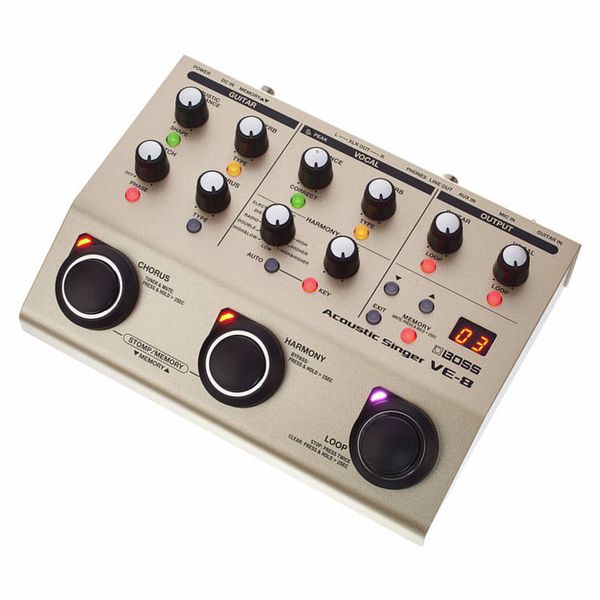
The VE-8 is a preamp and effects processor built specifically for one guitar plus one voice. Guitar input, XLR mic input with switchable phantom power, an aux input for backing tracks, and outputs to match — line out and a balanced XLR out with groundlift.
On the guitar side, there’s Acoustic Resonance modeling, which is Boss’s attempt to fix the thin, quacky tone that piezo pickups are famous for. On the vocal side, you get reverbs, an Enhance effect, chromatic pitch correction, and — the headline feature — a harmonist that generates up to four extra vocal voices, either following your guitar chords automatically or locked to a key you set manually.
There’s also an 80-second looper that can record guitar and vocals independently, which is genuinely useful for building up a one-person arrangement live.
Build and Layout
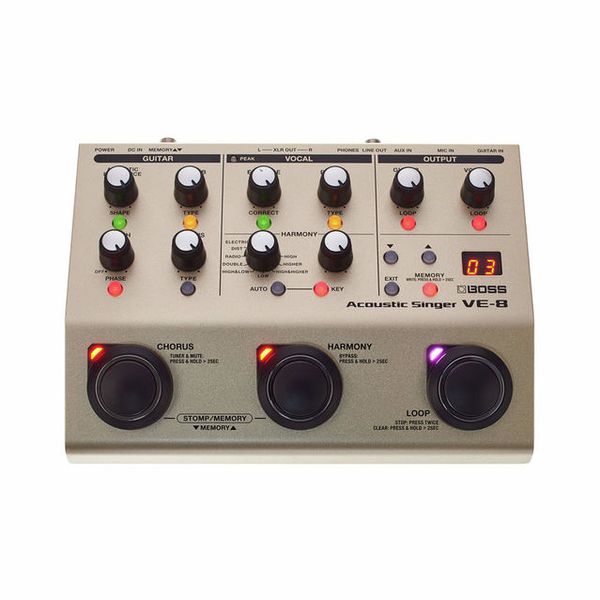
Typical Boss durability — metal chassis, footswitches that feel solid underfoot, and a compact footprint at 217 x 65 x 161mm and 1.3kg. It runs off the included power adapter or six AA batteries, which matters more than it sounds for buskers or anyone playing somewhere without a reliable outlet nearby.
It also has a USB port, which lets you use the VE-8 as a basic audio interface for recording straight into a DAW — handy if you write songs at home and want a quick way to track guitar and vocals together without a separate interface.
How It Actually Sounds
The Acoustic Resonance effect genuinely helps. Run a cheap piezo-equipped acoustic through it and the quack drops noticeably — it’s not magic, your guitar’s actual tone still matters, but it takes the edge off in a way that’s very noticeable live.
The harmonist is the star of the show, IMO. Set it to follow your guitar and it tracks chord changes well enough to add convincing backing harmonies without you touching anything mid-song. It’s not flawless — fast chord changes can occasionally trip it up — but for singer-songwriter material, it adds a genuinely professional layer that would otherwise need a second singer.
Reverbs and the Enhance effect on vocals are tasteful rather than showy, which is exactly what you want from a live vocal processor. Nobody wants to sound like they’re singing in a cathedral by accident.
The looper works well for building simple layered arrangements, though 80 seconds total (shared between guitar and vocal loops) is on the tighter side if you were hoping to use this as your main looping rig. If dedicated looping is your priority over vocal processing, something like a proper Boss looper pedal makes more sense as a companion, or check out the Zoom G2 Four if you want guitar multi-fx and looping in one cheaper box instead.
VE-8 vs the Competition
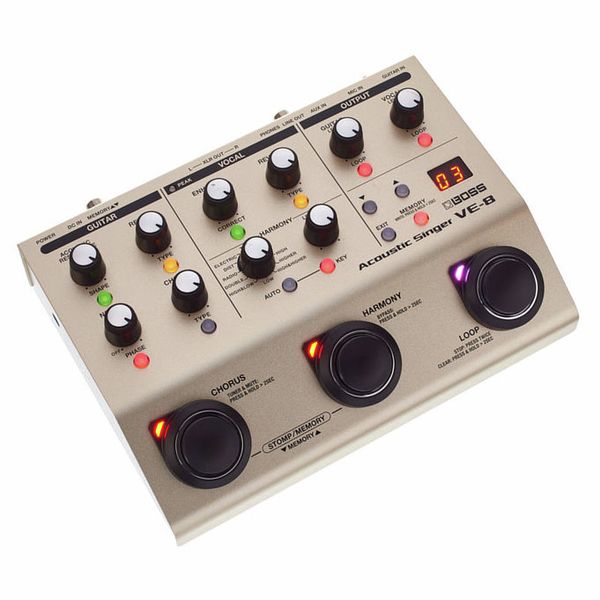
The obvious rival is TC-Helicon’s Perform-V, which leans harder into vocal effects and has a slightly friendlier interface for singers who don’t want to think about guitar modeling at all. The VE-8 counters with better guitar-side processing and a more natural-feeling harmonist when it’s following your chords. If vocals are 90% of your focus, try both before deciding; if you need equally strong guitar and vocal handling in one box, the Boss wins that trade.
Who It’s For
Solo singer-guitarists doing coffee shop gigs, open mics, weddings, or worship sets. If you’ve ever checked out the best pedals for worship and thought „but what about my voice, not just my guitar”, this pedal is the answer.
It also pairs beautifully with a busking rig. Feed the XLR out into a small PA, or run it straight into an acoustic-friendly amp like the Roland Cube Street EX and you’ve got a full solo act in a bag small enough to carry on the bus.
If you’d rather keep guitar and vocals on separate simpler units instead of one combined processor, something like a Fender Acoustasonic 15 for guitar tone plus a basic vocal harmonizer is a valid alternative approach — just less streamlined for solo performing.
Honest Niggles
- Harmonist can misread fast or unusual chord voicings
- 80-second looper is shared between guitar and vocal, so it fills up quicker than expected
- Menu diving needed for deeper editing — not everything is a dedicated knob
- An external footswitch is basically essential for full live control, and it’s sold separately
None of these are dealbreakers, but budget for the optional footswitch if you’re gigging with this — trying to hit tiny onboard buttons mid-song while playing guitar is not fun.
Specs at a Glance
- Type: Preamp + effects processor for singing guitarists
- Guitar effects: Acoustic Resonance modeling plus standard FX
- Vocal effects: Reverbs, Enhance, chromatic pitch correction
- Harmonist: Up to 4 voices, auto (guitar-controlled) or manual key
- Looper: 80 seconds, independent guitar/vocal loops
- Presets: 50 user memory slots
- Inputs: Guitar, XLR mic (switchable phantom power), Aux
- Outputs: Line out, XLR out with groundlift
- Connectivity: USB, footswitch jack
- Dimensions: 217 x 65 x 161 mm
- Weight: 1.3 kg
- Power: Included adapter or 6x AA batteries
Final Verdict
The Boss VE-8 Acoustic Singer is one of those pedals that just quietly does its job better than almost anything else in its category. If you sing and play guitar at the same time in front of people, it solves a real problem in a genuinely elegant way.
It’s not cheap, and it’s not the deepest looper on the market, but as a complete solo-performer solution it’s hard to beat. Get the footswitch, learn the harmonist’s quirks, and this thing basically becomes your bandmate.